
Pulp Fiction, 1921 · page 73 of 204
Adventure Magazine Cover — page 73: what you’re looking at
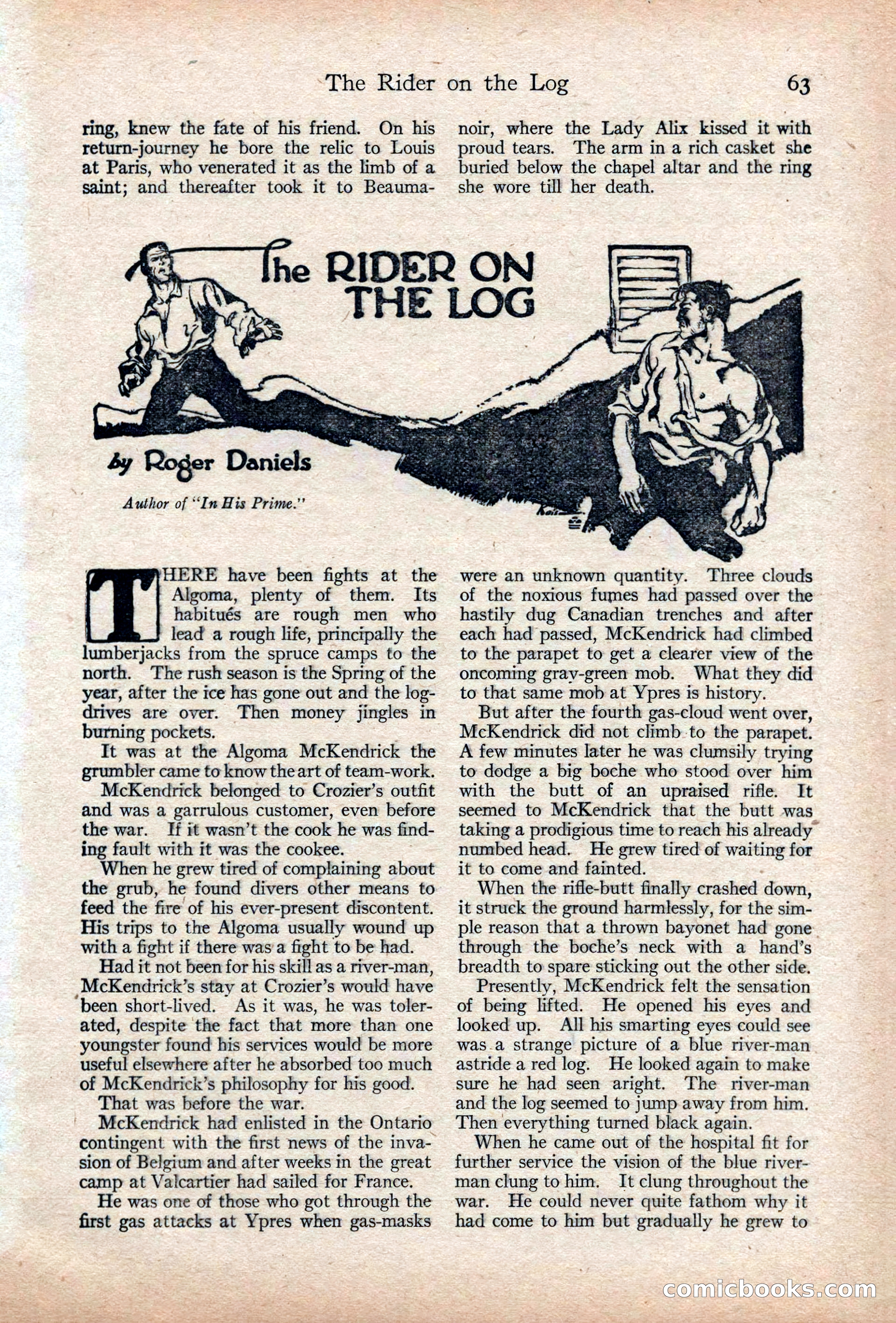
A restored page from Pulp Fiction, 1921. Page through the whole issue in the reader above.
📄 Transcribed text from this page (OCR, searchable)
Machine-transcribed from the original scan — historical spelling and the odd misread are preserved.
‘The Rider on the Log ring, knew the fate of his friend. On his return-journey he bore the relic to Louis at Paris, who venerated it as the limb of a saint; and thereafter took it to Beauma- Author of “‘In His Prime.”’ HERE have been fights at the Algoma, plenty of them. Its habitués are rough men who : lead a rough life, principally the lumberjacks from the spruce camps to the north. The rush season is the Spring of the year, after the ice has gone out and the log- drives are over. Then money jingles in burning pockets. It was at the Algoma McKendrick the grumbler came to know the art of team-work. McKendrick belonged to Crozier’s outfit and was a garrulous customer, even before the war. [If it wasn’t the cook he was find- ing fault with it was the cookee. 7 When he grew tired of complaining about the grub, he found divers other means to feed the fire of his ever-present discontent. His trips to the Algoma usually wound up with a fight if there was'a fight to be had. Had it not been for his skill as a rrver-man, _McKendrick’s stay at Crozier’s would have ‘been short-lived. As it was, he was toler- ated, despite the fact that more than one youngster found his services would be more useful elsewhere after he absorbed too much of McKendrick’s philosophy for his good. That was before the war. McKendrick had enlisted in the Ontario contingent with the first news of the inva- sion of Belgium and after weeks in the great camp at Valcartier had sailed for France. He was one of those who got through the first gas attacks at Ypres when gas-masks proud tears. noir, where the Lady Alix kissed it with The arm in a rich casket she buried below the chapel altar and the ring she wore till her death. were an unknown quantity. Three clouds of the noxious fumes had passed over the hastily dug Canadian trenches and after each had passed, McKendrick had climbed to the parapet to get a clearer view of the oncoming gray-green mob. What they did to that same mob at Ypres is history. But after the fourth gas-cloud went over, McKendrick did not climb-to the parapet. A few minutes later he was clumsily trying to dodge a big boche who stood over him with the butt of an upraised rifle. It seemed to McKendrick that the butt was taking a prodigious time to reach his already numbed head. He grew tired of — for it to come and fainted. When the rifle-butt finally crashed down, it struck the ground harmlessly, for the sim- ple reason that a thrown bayonet had gone through the boche’s neck with a hand’s breadth to spare sticking out the other side. Presently, McKendrick felt the sensation of bemg lifted. He opened his eyes and looked up. All his smarting eyes could see was.a strange picture of a blue river-man astride a red log. He looked again to make sure he had seen aright. The river-man and the log seemed to jump away from him. Then everything turned black again. When he came out of the hospital fit for further service the vision of the blue river- man clung to him. It clung throughout the war. He could never quite fathom why it had come to him but gradually he grew to 63 Gchoo com <S) (E(0) mn