
Pulp Fiction, 1921 · page 66 of 204
Adventure Magazine Cover — page 66: what you’re looking at
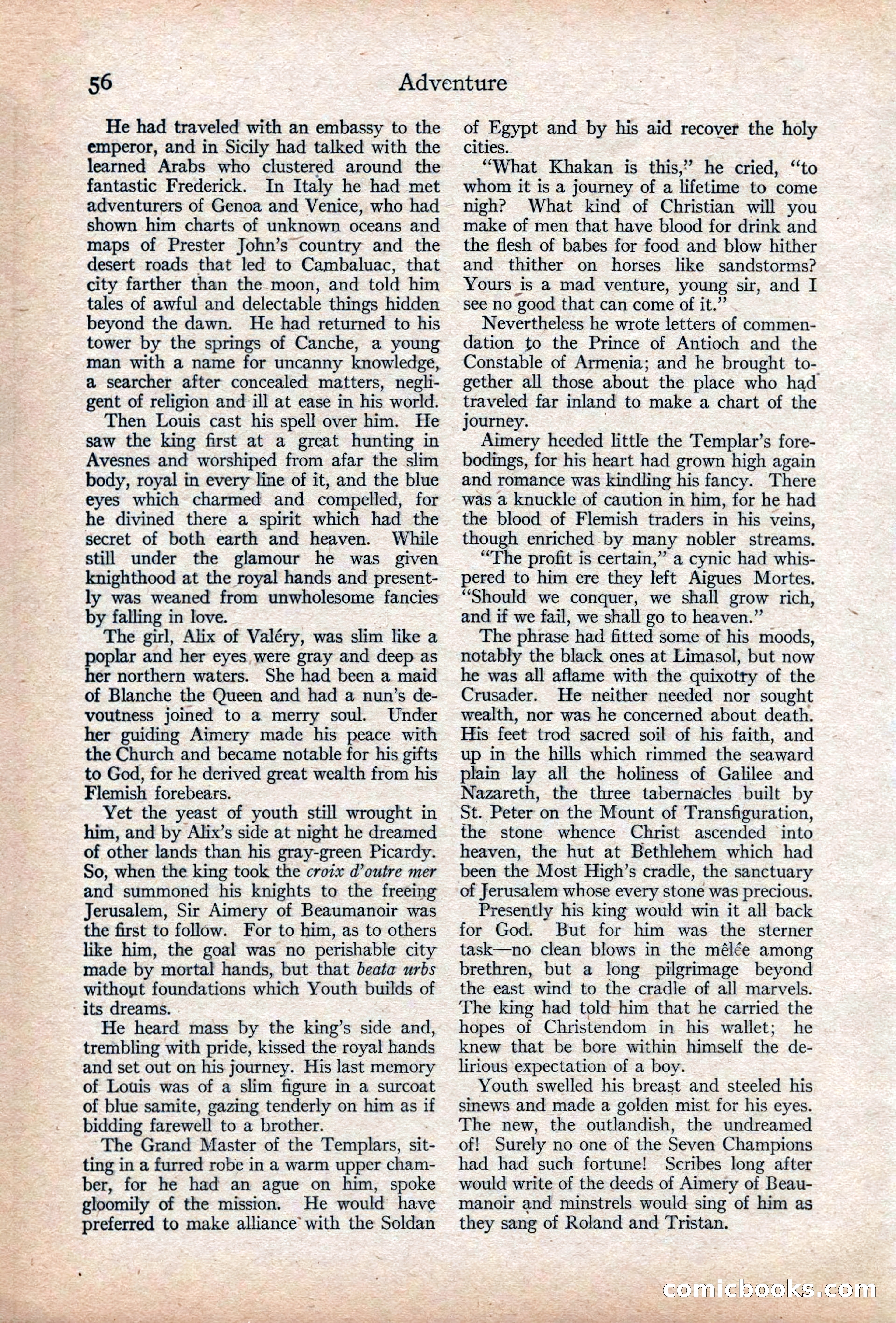
A restored page from Pulp Fiction, 1921. Page through the whole issue in the reader above.
📄 Transcribed text from this page (OCR, searchable)
Machine-transcribed from the original scan — historical spelling and the odd misread are preserved.
56 He had traveled with an embassy to the emperor, and in Sicily had talked with the learned Arabs who clustered around the fantastic Frederick. In Italy he had met adventurers of Genoa and Venice, who had shown him charts of unknown oceans and maps of Prester John’s country and the desert roads that led to Cambaluac, that city farther than the moon, and told him tales of awful and delectable things hidden beyond the dawn. He had returned to his tower by the springs of Canche, a young man with a name for uncanny knowledge, a searcher after concealed matters, negli- gent of religion and ill at ease in his world. Then Louis cast his spell over him. He saw the king first at a great hunting in Avesnes and worshiped from afar the slim body, royal in every line of it, and the blue eyes which charmed and compelled, for he divined there a spirit which had the secret of both earth and heaven. While still under the glamour he was given knighthood at the royal hands and present- ly was weaned from unwholesome fancies by falling in love. The girl, Alix of Valéry, was slim like a pape and her eyes were gray and deep as er northern waters. She had been a maid of Blanche the Queen and had a nun’s de- voutness joined to a merry soul. Under her guiding Aimery made his peace with the Church and became notable for his gifts to God, for he derived great wealth from his Flemish forebears. Yet the yeast of youth still wrought in him, and by Alix’s side at night he dreamed of other lands than his gray-green Picardy. So, when the king took the croix d’outre mer and summoned his knights to the freeing Jerusalem, Sir Aimery of Beaumanoir was the first to follow. For to him, as to others like him, the goal was no perishable city made by mortal hands, but that beata urbs without foundations which Youth builds of its dreams. He heard mass by the king’s side and, trembling with pride, kissed the royal hands and set out on his journey. His last memory of Louis was of a slim figure in a surcoat of blue samite, gazing tenderly on him as if bidding farewell to a brother. The Grand Master of the Templars, sit- ting in a furred robe in a warm upper cham- ber, for he had an ague on him, spoke gloomily of the mission. He would’ have preferred to make alliance with the Soldan Adventure of Egypt and by his aid recover the holy cities. “What Khakan is this,” he cried, “to whom it is a journey of a lifetime to come nigh? What kind of Christian will you make of men that have blood for drink and the flesh of babes for food and blow hither and thither on horses like sandstorms? Yours is a mad venture, young sir, and I see no good that can come of it.” Nevertheless he wrote letters of commen- dation to the Prince of Antioch and the Constable of Armenia; and he brought to- gether all those about the place who had traveled far inland to make a chart of the journey. Aimery heeded little the Templar’s fore- bodings, for his heart had grown high again and romance was kindling his fancy. There was a knuckle of caution in him, for he had the blood of Flemish traders in his veins, though enriched by many nobler streams. “The profit is certain,” a cynic had whis- pered to him ere they left Aigues Mortes. “Should we conquer, we shall grow rich, and if we fail, we shall go to heaven.” The phrase had fitted some of his moods, notably the black ones at Limasol, but now he was all aflame with the quixotry of the Crusader. He neither needed nor sought wealth, nor was he concerned about death. His feet trod sacred soil of his faith, and up in the hills which rimmed the seaward plain lay all the holiness of Galilee and Nazareth, the three tabernacles built by St. Peter on the Mount of Transfiguration, the stone whence Christ ascended into heaven, the hut at Bethlehem which had been the Most High’s cradle, the sanctuary of ferusalem whose every stone was precious. Presently his king would win it all back for God. But for him was the sterner task—no clean blows in the mélée among brethren, but a long pilgrimage beyond the east wind to the cradle of all marvels. The king had told him that he carried the hopes of Christendom in his wallet; he knew that be bore within himself the de- lirious expectation of a boy. Youth swelled his breast and steeled his sinews and made a golden mist for his eyes. The new, the outlandish, the undreamed of! Surely no one of the Seven Champions had had such fortune! Scribes long after would write of the deeds of Aimery of Beau- manoir and minstrels would sing of him as they sang of Roland and Tristan. cComicbook (E@)