
Pulp Fiction, 1921 · page 46 of 204
Adventure Magazine Cover — page 46: what you’re looking at
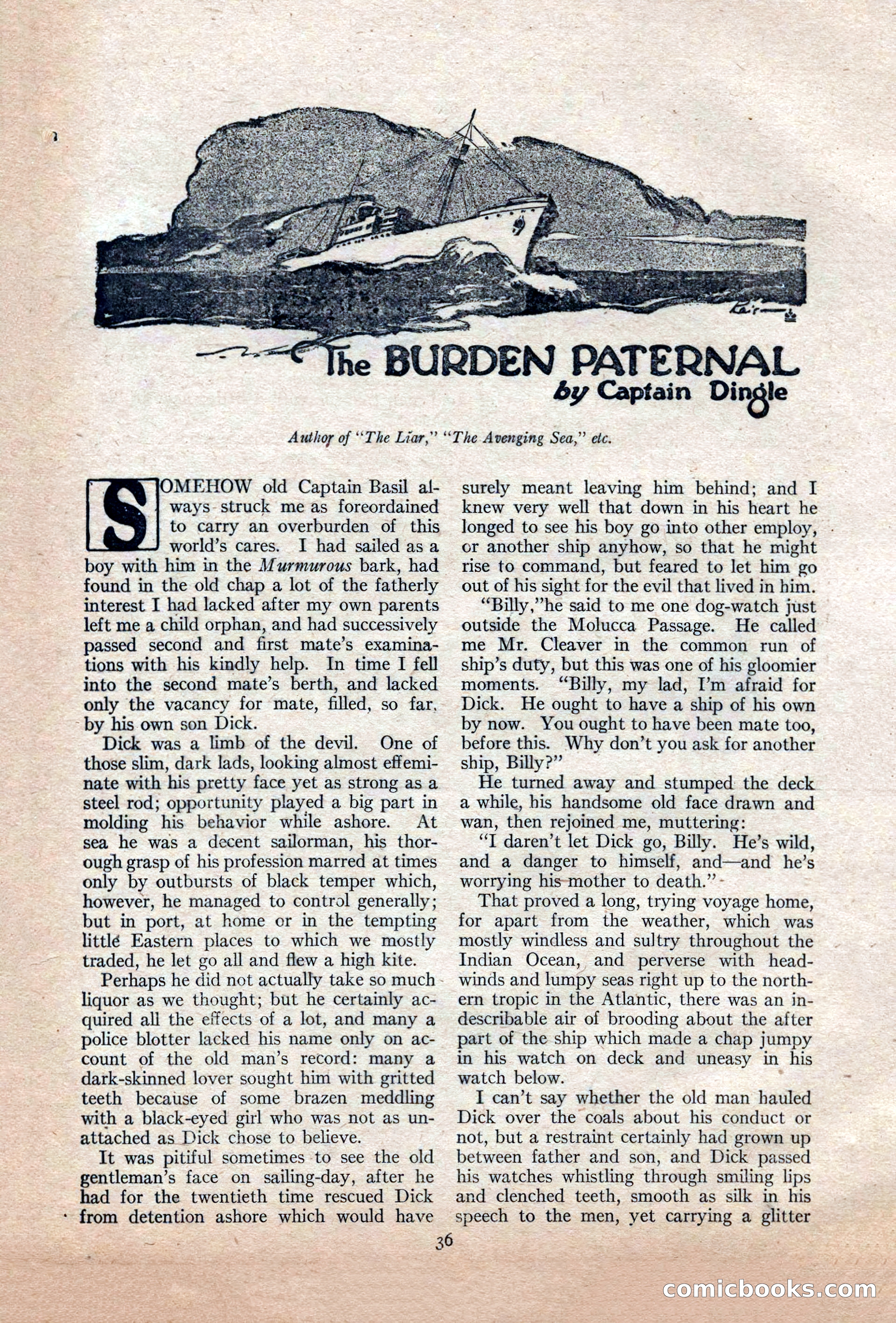
A restored page from Pulp Fiction, 1921. Page through the whole issue in the reader above.
📄 Transcribed text from this page (OCR, searchable)
Machine-transcribed from the original scan — historical spelling and the odd misread are preserved.
“The BURDEN PATERNAL 4y Captain Dingle Authoy of “The Liar,” “The Avenging Sea,” etc. MEHOW old Captain Basil al- ways- struck me as foreordained to carry an overburden of this world’s cares. I had sailed asa boy with him in the Murmurous bark, had found in the old chap a lot of the fatherly interest I had lacked after my own parents left me a child orphan, and had successively passed second and first mate’s examina- tions with his kindly help. In time I fell into the second mate’s berth, and lacked only the vacancy for mate, filled, so far, -by his own son Dick. Dick was a limb of the devil. One of those slim, dark lads, looking almost effemi- nate with his pretty face yet as strong as a steel rod; opportunity played a big part in molding his behavior while ashore. At sea he was a decent sailorman, his thor- ough grasp of his profession marred at times only by outbursts of black temper which, however, he managed to control generally; but in port, at home or in the tempting littlé Eastern places to which we mostly traded, he let go all and flew a high kite. Perhaps he did not actually take so much - liquor as we thought; but he certainly ac- quired all the effects of a lot, and many a police blotter lacked his name only on ac- count of the old man’s record: many a dark-skinned lover sought him with gritted teeth because of some brazen meddling with a black-eyed girl who was not as un- attached as Dick chose to believe. It was pitiful sometimes to see the old gentleman’s face on sailing-day, after he had for the twentieth time rescued Dick ‘ from detention ashore which would have \ 26 surely meant leaving him behind; and I knew very well that down in his heart he longed to see his boy go into other employ, or another ship anyhow, so that he might rise to command, but feared to let him go out of his sight for the evil that lived in him. “Billy,” he said to me one dog-watch just outside the Molucca Passage. He called me Mr. Cleaver in the common run of ship’s duty, but this was one of his gloomier moments. “Billy, my lad, I’m afraid for Dick. He ought to have a ship of his own by now. You ought to have been mate too, before this. Why don’t you ask for another ship, Billy?” He turned away and stumped the deck a while, his handsome old face drawn and wan, then rejoined me, muttering: “T daren’t let Dick go, Billy. He’s wild, and a danger to himself, and—and he’s worrying his-mother to death.” - That proved a long, trying voyage home, for apart from the weather, which was mostly windless and sultry throughout the Indian Ocean, and perverse with head- winds and lumpy seas right up to the north- ern tropic in the Atlantic, there was an in- describable air of brooding about the after part of the ship which made a chap jumpy in his watch on deck and uneasy in his watch below. I can’t say whether the old man hauled Dick over the coals about his conduct or not, but a restraint certainly had grown up between father and son, and Dick passed his watches whistling through smiling lips and clenched teeth, smooth as silk in his speech to the men, yet carrying a glitter 1) 000) co