
Pulp Fiction, 1921 · page 199 of 204
Adventure Magazine Cover — page 199: what you’re looking at
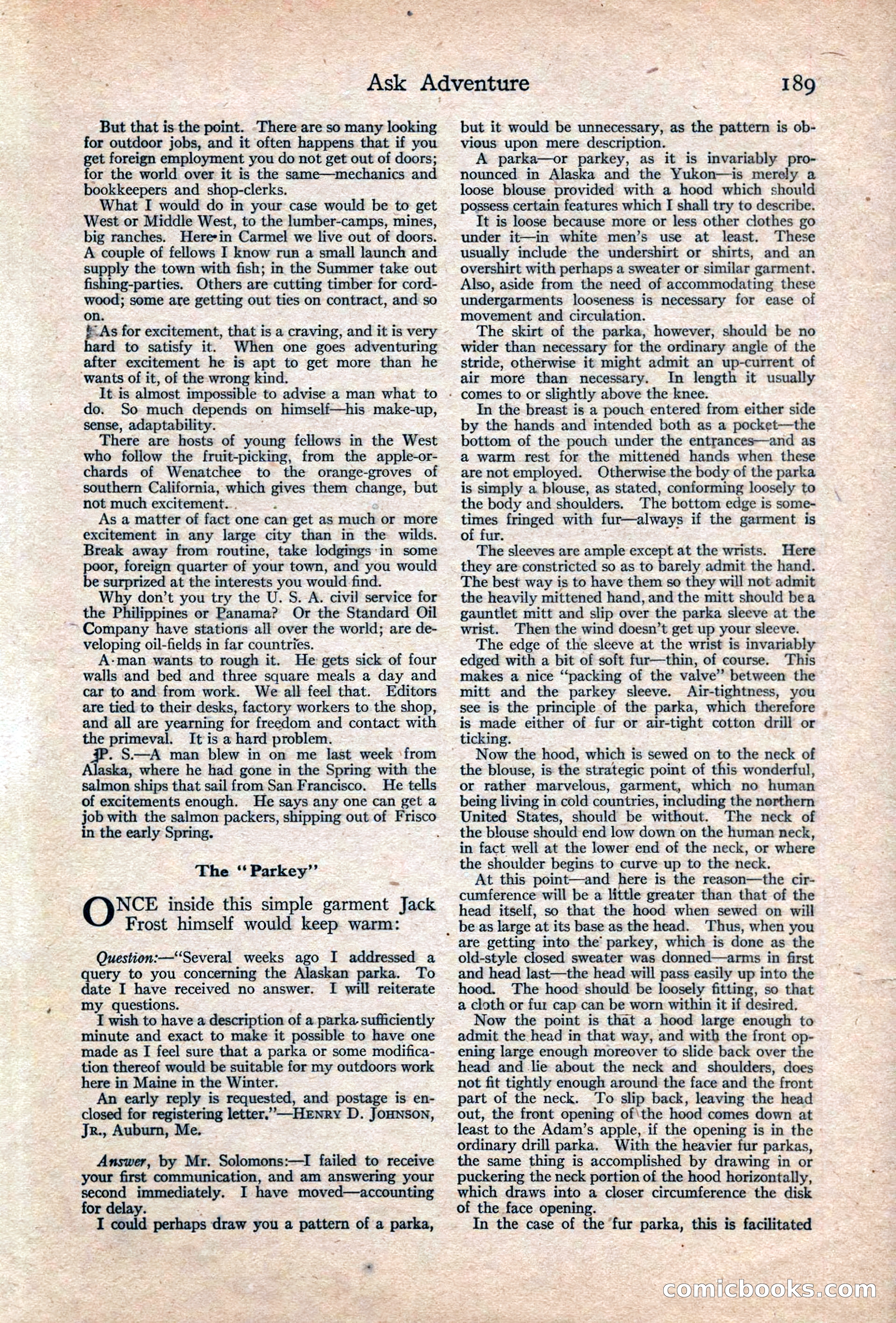
A restored page from Pulp Fiction, 1921. Page through the whole issue in the reader above.
📄 Transcribed text from this page (OCR, searchable)
Machine-transcribed from the original scan — historical spelling and the odd misread are preserved.
Ask Adventure But that is the point. -There are so many looking for outdoor jobs, and it often happens that if you get foreign employment you do not get out of doors; for the world over it is the same—mechanics and bookkeepers and shop-clerks. What I would do in your case would be to get West or Middle West, to the lumber-camps, mines, big ranches. Here-in Carmel we live out of doors. A couple of fellows I know run a small launch and supply the town with fish; in the Summer take out fishin g-parties. Others are cutting timber for cord- — some are getting out ties on contract, and so BA s for excitement, that is a craving, and it is very d to satisfy it. When one goes adventuring after excitement he is apt to get more than he ‘wants of it, of the wrong kind. It is almost impossible to advise a man what to do. So much depends on himself—his make-up, sense, adaptability. There are hosts of young fellows in the West who follow the fruit-picking, from the apple-or- chards of Wenatchee to the orange-groves of southern California, which gives them change, but not much excitement. As a matter of fact one can get as much or more excitement in any large city than in the wilds. Break away from routine, take lodgings: in some — foreign quarter of your town, and you would e surprized at the interests you would find. Why don’t you try the U. S. A. civil service for the Philippines or Panama? Or the Standard Oil ~ Company have stations all over the world; are de- veloping oil-fields in far countries. A-man wants to rough it. He gets sick of four walls and bed and three square meals a day and car to and from work. We all feel that. Editors are tied to their desks, factory workers to the shop, and all are yearning for freedom and contact with the primeval. It is a hard problem. ’ S.—A man blew in on me last week ‘from , where he had gone in the Spring with the salmon ships that sail from San Francisco. He tells of excitements enough. He says any one can get a job with the salmon packers, shipping out of Frisco in the early Spring. The ‘ Parkey’”’ ONCE inside this simple garment Jack Frost himself would keep warm: Question:—“‘Several weeks ago I addressed a query to you concerning the Alaskan parka. To date I have received no answer: I will reiterate my questions. I wish to have a description of a parka sufficiently minute and exact to make it possible to have one made as I feel sure that a parka or some modifica- tion thereof would be suitable for my outdoors work here in Maine in the Winter. An early reply is requested, and postage is en- closed for registering letter.”—Henry D. JoHNSOoN, Jr., Auburn, Me. Answer, by Mr. Solomons:—I failed to receive your communication, and am answering your second immediately. I have moved—accounting for delay. I could perhaps draw you a pattern of a parka, ~ but it would be unnecessary, as the pattern is ob- vious upon mere description. A parka—or parkey, as it is invariably pro- nounced in Alaska and the Yukon—is merely a loose blouse provided with a hood which should possess certain features which I shall try to describe. It is loose because more or less other clothes go under it—in white men’s use at least. These usually include the undershirt or shirts, and an overshirt with perhaps a sweater or similar garment. Also, aside from the need of accommodating these undergarments looseness is necessary for ease of movement and circulation. The skirt of the parka, however, should be no wider than necessary for the ordinary angle of the stride, otherwise it might admit an up-current of air moré than necessary. In length it usually - comes to or slightly above the knee. In the breast is a pouch entered from either side by the hands and intended both as a pocket—the bottom of the pouch under the entrances—and as a warm rest for the mittened hands when these are not employed. Otherwise the body of the parka is simply a. blouse, as stated, conforming loosely to the body and shoulders. The bottom edge is some- — fringed with fur—always if the garment is of fur. The sleeves are ample except at the wrists. Here they are constricted so as to barely admit the hand. The best way is to have them so they will not admit the heavily mittened hand, and the mitt should bea gauntlet mitt and slip over the parka sleeve at the wrist. Then the wind doesn’t get up your sleeve. The edge of the sleeve at the wrist is invariably edged with a bit of soft fur—thin, of course. This makes a nice “packing of the valve” between the mitt and the parkey sleeve. Air-tightness, you 189 see is the principle of the parka, which therefore | is made either of fur or air-tight cotton drill or ticking. Now the hood, which is sewed on to the neck of the blouse, is the strategic point of this wonderful, or rather marvelous, garment, which no human being living in cold countries, including the northern United States, should be without. The neck of the blouse should end low down on the human neck, in fact well at the lower end of the neck, or where the shoulder begins to curve up to the neck. At this point—and here is the reason—the cir- cumference will be a little greater than that of the head itself, so that the hood when sewed on will _ beas large ‘at its base as the head. Thus, when you are getting into the parkey, which is done as the old-style closed sweater was donned—arms in first and head last—the head will pass easily up into the hood. The hood should be loosely fitting, so that a cloth or fur cap can be worn within it if desired, Now the point is that a hood large enough to admit the head in that way, and with the front op- ening large enough moreover to slide back over the head and lie about the neck and shoulders, does not fit tightly enough around the face and the front part of the neck. To slip back, leaving the head out, the front opening of\the hood comes down at least to the Adam’s apple, if the opening is in the » ordinary drill parka. With the heavier fur parkas, the same thing is accomplished by drawing in or puckering the neck portion of the hood horizontally, which draws into a closer circumference the disk of the face opening. In the case of the ‘fur parka, this is facilitated (E(0) VOOKS A) (E@) ms