
Pulp Fiction, 1921 · page 191 of 204
Adventure Magazine Cover — page 191: what you’re looking at
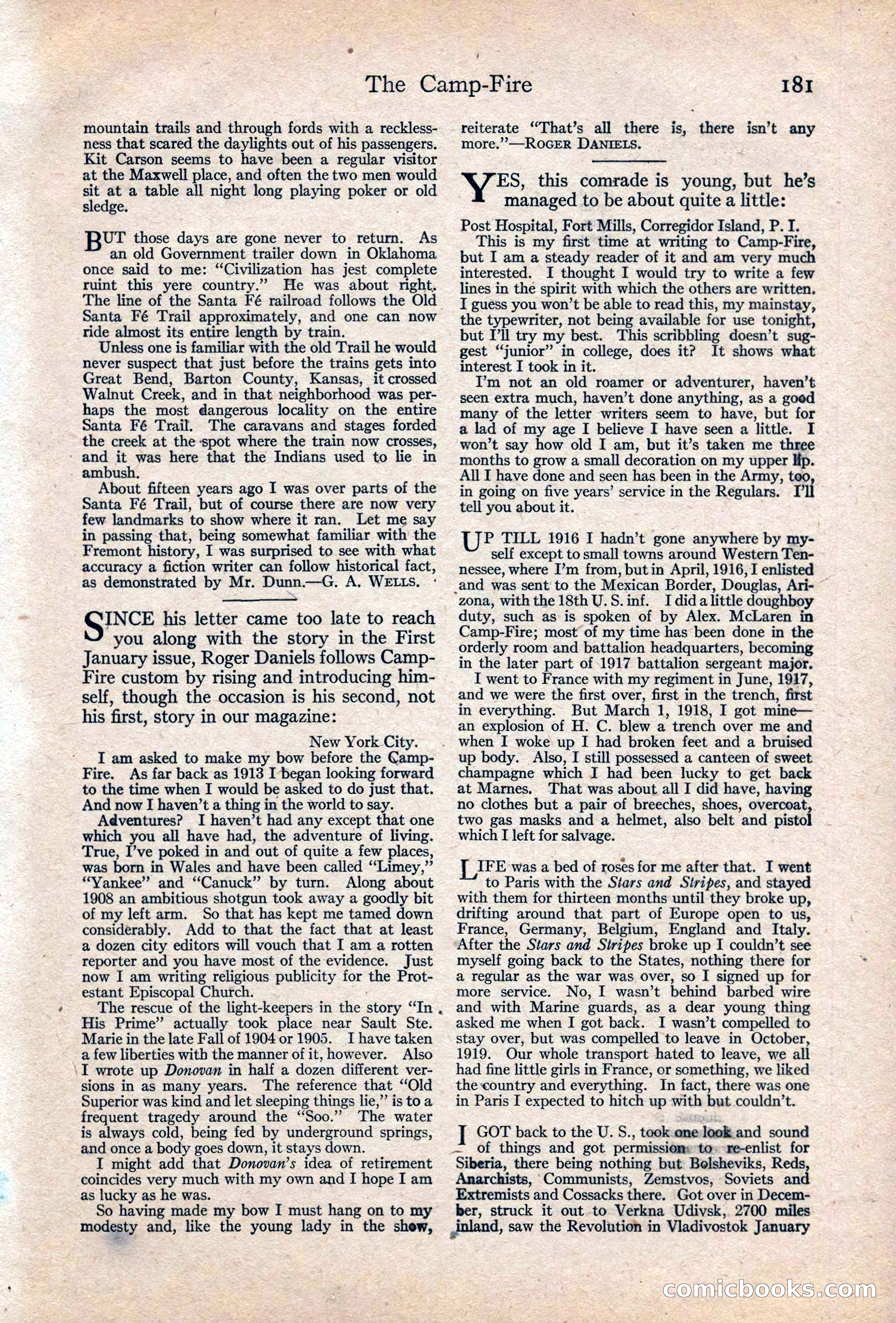
A restored page from Pulp Fiction, 1921. Page through the whole issue in the reader above.
📄 Transcribed text from this page (OCR, searchable)
Machine-transcribed from the original scan — historical spelling and the odd misread are preserved.
The Camp-Fire mountain trails and through fords with a reckless- ness that scared the daylights out of his passengers. Kit Carson seems to have been a regular visitor at the Maxwell place, and often the two men would sit at a table all night long playing ee * or old sledge. Bur those days are gone never to return. As an old Government trailer down in Oklahoma once said to me: “Civilization has jest complete ruint this yere country.” He was about nght. The line of the Santa Fé railroad follows the Old Santa Fé Trail approximately, and one can now ride almost its entire length by train. Unless one is familiar with the old Trail he would never suspect that just before the trains gets into Great Bend, Barton County, Kansas, it crossed Walnut Creek, and in that neighborhood was per- haps the most dangerous locality on the entire Santa Fé Trail. The caravans and stages forded the creek at the ‘spot where the train now crosses, - and it was here that the Indians used to lie in ambush. About fifteen years ago I was over parts of the Santa Fé Trail, but of course there are now very few landmarks to show where it ran. Let me say in passing that, being somewhat familiar with the Fremont history, I was surprised to see with what accuracy a fiction writer can follow historical fact, as demonstrated by Mr. Dunn—G. A. WELLS. INCE his letter came too late to reach you along with the story in the First January issue, Roger Daniels follows Camp- Fire custom by rising and introducing him- self, though the occasion is his second, not his first, story in our magazine: New York City. I am asked to make my bow before the Camp- | Fire. As far back as 1913 I began looking forward to the time when I would be asked to do just that. And now I haven’t a thing in the world to say. Adventures? I haven’t had any except that one which you all have had, the adventure of living. True, I’ve poked in and ‘out of quite a few places, was born in Wales and have been called “Limey,”’ “Vankee” and “Canuck” by turn. Along about 1908 an ambitious shotgun took away a goodly bit of my left arm. So that has kept me tamed down considerably. Add to that the fact that at least a dozen city editors will vouch that I am a rotten reporter and you have most of the evidence. Just now I am writing religious publicity for the Prot- estant Episcopal Church. The rescue of the light-keepers in the stony “In His Prime” actually took place near Sault Ste. Marie in the late Fall of 1904 or 1905. Ihave taken a few liberties with the manner of it, however. Also \I wrote up Donovan in half a dozen different ver- sions in as many years. The reference that “Old Superior was kind and let sleeping things lie,” is to a frequent tragedy around the “Soo.” The water is always cold, being fed by underground springs, and once a body goes down, it stays down. I might add that Donovan’s idea of retirement coincides very much with my own and I hope I am as lucky as he was. So having made my bow I must hang on to my modesty and, like the young lady in the shew, 181 reiterate ‘“That’s all there is, there isn’t any more.’”’—ROGER DANIELS, YES: this comrade is young, but he’s managed to be about quite a little: Post Hospital, Fort Mills, Corregidor Island, P. I. This is my first time at writing to Camp-Fi ire, but I am a steady reader of it and am very much interested. I thought I would try to write a few lines in the spirit with which the others are written. I guess you won’t be able to read this, my mainstay, the typewriter, not being available for use tonight, but Tl try my best. This scribbling doesn’t sug- gest “junior” in college, does it? It shows what interest I took in it. I’m not an old roamer or adventurer, haven’t seen extra much, haven’t done anything, as a good many of the letter writers seem to have, but for a lad of my age I believe I have seen a little. I won’t say how old I am, but it’s taken me three months to grow a small decoration on my upper Hp. All I have done and seen has been in the Army, teo, in going on five years’ service in the Regulars. I'll tell you about it. UP TILL 1916 I hadn’t gone anywhere by my- self except to small towns around Western Ten- nessee, where I’m from, butin April, 1916, 1 enlisted — _and was sent to the Mexican Border, Douglas, Ari- zona, with the 18th U. S. inf. I did a little doughboy duty, such as is spoken of by Alex. McLaren in Camp-Fire; most of my time has been done in the orderly room and battalion headquarters, becoming in the later part of 1917 battalion sergeant major. I went to France with my regiment in June, 1917, and we were the first over, first in the trench, first in everything. But March 1, 1918, I got mine— an explosion of H. C. blew a trench over me and when I woke up I had broken feet and a bruised up body. Also, I still possessed a canteen of sweet champagne which I had been lucky to get back at Marnes. That was about all I did have, having no clothes but a pair of breeches, shoes, overcoat, two gas masks and a helmet, also belt and pistol which I left for salvage. [_IFE was a bed of roses for me after that. I went to Paris with the Stars and Stripes, and stayed with them for thirteen months until they broke up, drifting around that part of Europe open to us, France, Germany, Belgium, England and Italy. After the Stars and Stripes broke up I couldn’t see myself going back to the States, nothing there for a regular as the war was over, so I signed up for more service. No, I wasn’t behind barbed wire and with Marine guards, as a dear young thing asked me when I got back. I wasn’t compelled to stay over, but was compelled to leave in October, 1919. Our whole transport hated to leave, we all had fine little girls in France, or something, we liked the country and everything. In fact, there was one in Paris I expected to hitch up with but couldn’t. I GOT back to the U. S., took.one:look.and sound — of things and got permission: to: re-enlist for Siberia, there being nothing but Bolsheviks, Reds, Anarchists, ‘Communists, Zemstvos, Soviets and Extremists and Cossacks there. Got over in Decem- ber, struck it out to Verkna Udivsk, 2700 miles Joland, saw the Revolution in Vladivostok January Gomichoo SS