
Pulp Fiction, 1921 · page 188 of 204
Adventure Magazine Cover — page 188: what you’re looking at
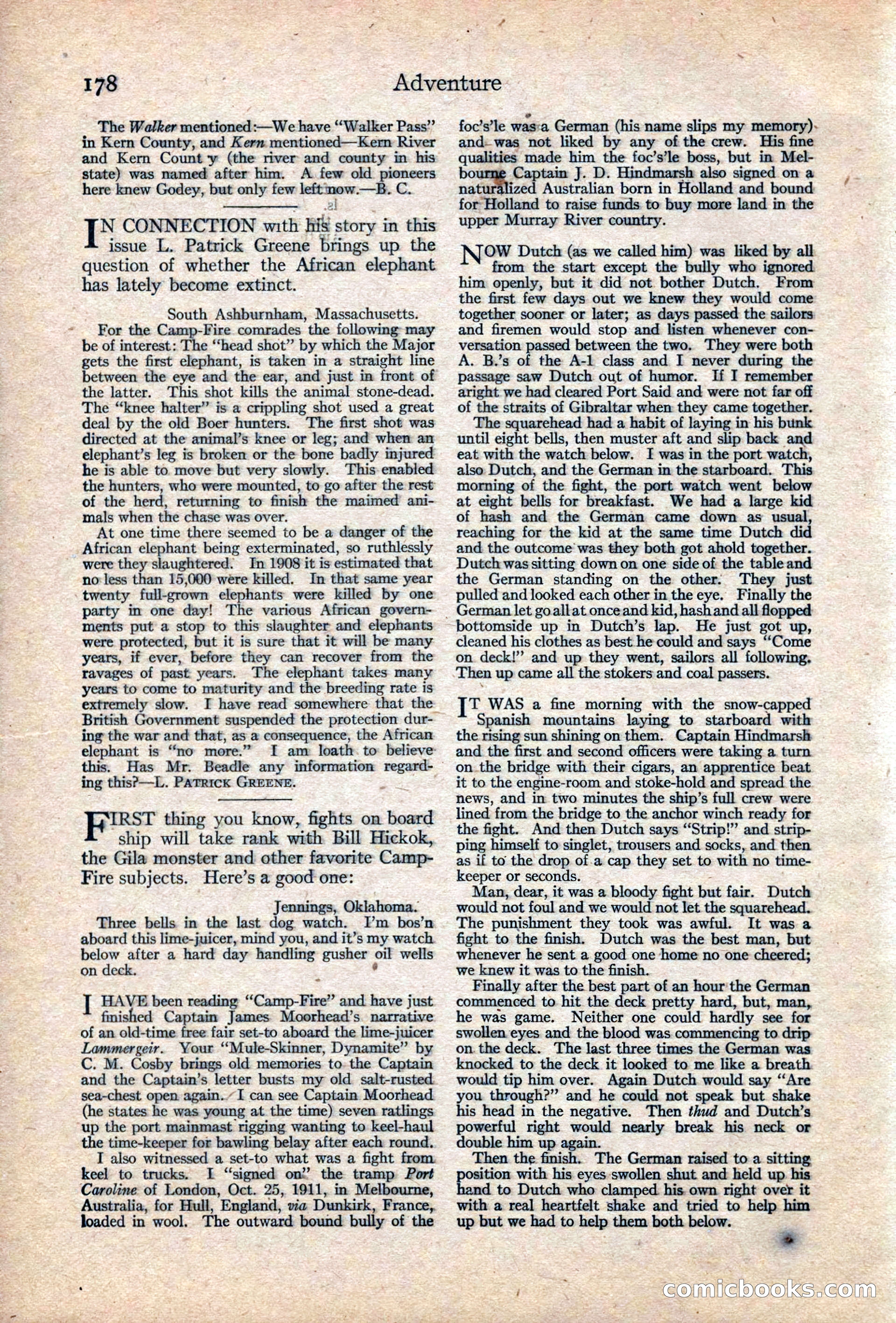
A restored page from Pulp Fiction, 1921. Page through the whole issue in the reader above.
📄 Transcribed text from this page (OCR, searchable)
Machine-transcribed from the original scan — historical spelling and the odd misread are preserved.
178 The Walker mentioned :—We have “Walker Pass”’ in Kern County, and Kern mentioned—Kem River and Kern County (the river and county in his state) was named after him. A few old pioneers here knew Godey, but only few —— —B. C. |e CONNECTION with HR story in this issue L. Patrick Greene brings up the question of whether the African elephant has lately become extinct. South Ashburnham, Massachusetts. For the Camp-Fire comrades ‘the following may be of interest: The “head shot” by which the Major gets the first elephant, is taken in a straight line between the eye and the ear, and just in front of the latter. This shot kills the animal stone-dead. The “knee halter” is a crippling shot used a great deal by the old Boer hunters. The first shot was directed at the animal’s knee or leg; and when an elephant’s leg is broken or the bone badly injured he is able to. move but very slowly. This enabled the hunters, who were mounted, to go after the rest of the herd, returning to finish the maimed’ ani- mals when the chase was over. At one time there seemed to be a danger of the African elephant being exterminated, so ruthlessly were they slaughtered. In 1908 it is estimated that no: less than 15,000 were killed. In that same year twenty full-grown elephants were killed by one party in one day! The various African govern- — ments put a stop to this slaughter and elephants were protected, but it is sure that it will be many years, if ever, before they can recover from the ravages of past years. The elephant takes many years to come to maturity and the breeding rate is extremely slow. I have read somewhere that the British Government suspended the protection dur- ing the war and that, as a consequence, the African elephant is “no more.” I am loath. to believe this. Has Mr. Beadle any information ergy : ing this?—L. Patrick GREENE. ag thing you know, fights on board ship will take rank with Bill Hickok, the Gila monster and other favorite Camp- Fire subjects. Here’s a good one: Jennings, Oklahoma. Three bells in the last dog watch. I’m bos’n aboard this lime-juicer, mind you, and it’s my watch below after a hard day handling gusher oll wells on deck. I HAVE been “Camp-Fire” and have just finished cave James. Moorhead’s. narrative of an old-time free fair set-to aboard the lime-juicer Lammergeir. Your “Mule-Skinner, Dynamite” by C. M. Cosby brings old memories to. the Captain and the Captain’s letter busts my old salt-rusted. sea-chest open again. I can see eee Moorhead. (he states he was young at the time) seven ratlings ‘up the port mainmast rigging wanting to keel-haul the time-keeper for bawling belay after each round. I also witnessed a set-to what was a fight from keel to trucks. I “signed on?’ the tramp Port Caroline of London, Oct. 25, 1911, in Melbourne, Australia, for Hull, England, via Dunkirk, France, loaded in wool. The outward bound bully of the Adventure foc’s’le was:a German (his name slips my memory)- and was not liked by any of the crew. His fine qualities made him the fae! s’‘le boss, but in ees bo Captain J. D. Hindmarsh also signed on nat d Australian born in Holland and SSecrel for Holland to raise funds. to buy more land in the upper Murray River country. 8 gee me (as we called him) was liked by all the start except the bully who ignored. him psa but it did not bother Dutch. From the first few days out we — they would come together sooner or later; as days passed the sailors and firemen would stop and listen whenever con- versation between the two. They were both A. B.’s of the A-1 class and I never during the passage saw Dutch out of humor. If I remember aright we had cleared Port Said and were not far off of the straits of Gibraltar when they came together. The squarehead had a habit of laying in his bunk until eight bells, then muster aft and slip back and eat with the watch below. I was in the port watch, also. Dutch, and the German in the starboard. This morning of the fight, the port watch went below at eight bells for breakfast. We had a large kid of hash and the German came down as usual, reaching for the kid at the same time Dutch did and the outcome was they both got ahold together. Dutch was sitting down on one side of the table and the German standing on the other. They just pulled and looked each other in the eye. Finally the German let goallat onceand kid, hashand all flopped bottomside up in Dutch’s lap. He just got up, cleaned his clothes as best he could and says “Come on. deck!” and up they went, sailors all following, Then up came all the stokers and coal passers. [tz WAS a fine morning with the snow-capped Spanish mountains laying to starboard with the rising sun shining on them. Captain Hindmarsh and the first and second officers were taking a turn onthe bridge with their cigars, an apprentice beat it to the engine-room and stoke-hold and spread the news, and in two minutes the ship’s full crew were lined from the bridge to the anchor winch ready for the fight. And then Dutch says “Strip!” and strip- ping himself to singlet, trousers and socks, and then as if to the drop of.a cap they set to with no time- keeper or seconds. Man, dear, it was a bloody fight but fair. Dutch would not foul and we would not let the squarehead, The punishment they took was awful. It was a fight to the finish. Dutch was the best man, but whenever he sent a good one home no one cheered; we knew it was to the finish. Finally after the best part of an hour'the German commenced to hit the deck pretty hard, but, man, he was game. Neither one could hardly see for swollen eyes and the blood was commencing to drip on.the deck. The last three times the German was knocked to the deck it looked to me like a breath would tip him over. Again Dutch would say “Are ou through?” and he could not speak but shake is head in the negative. Then thud and Dutch’s powerful — would nearly break his neck or double him up ‘Then. the. nish. 7 The German raised to a sitting — with his eyes swollen shut and held up. his to Dutch who clamped. his. own right over it with a real heartfelt shake and tried to help him up but eee ° KS - GComichboo (E@)