
Pulp Fiction, 1921 · page 180 of 204
Adventure Magazine Cover — page 180: what you’re looking at
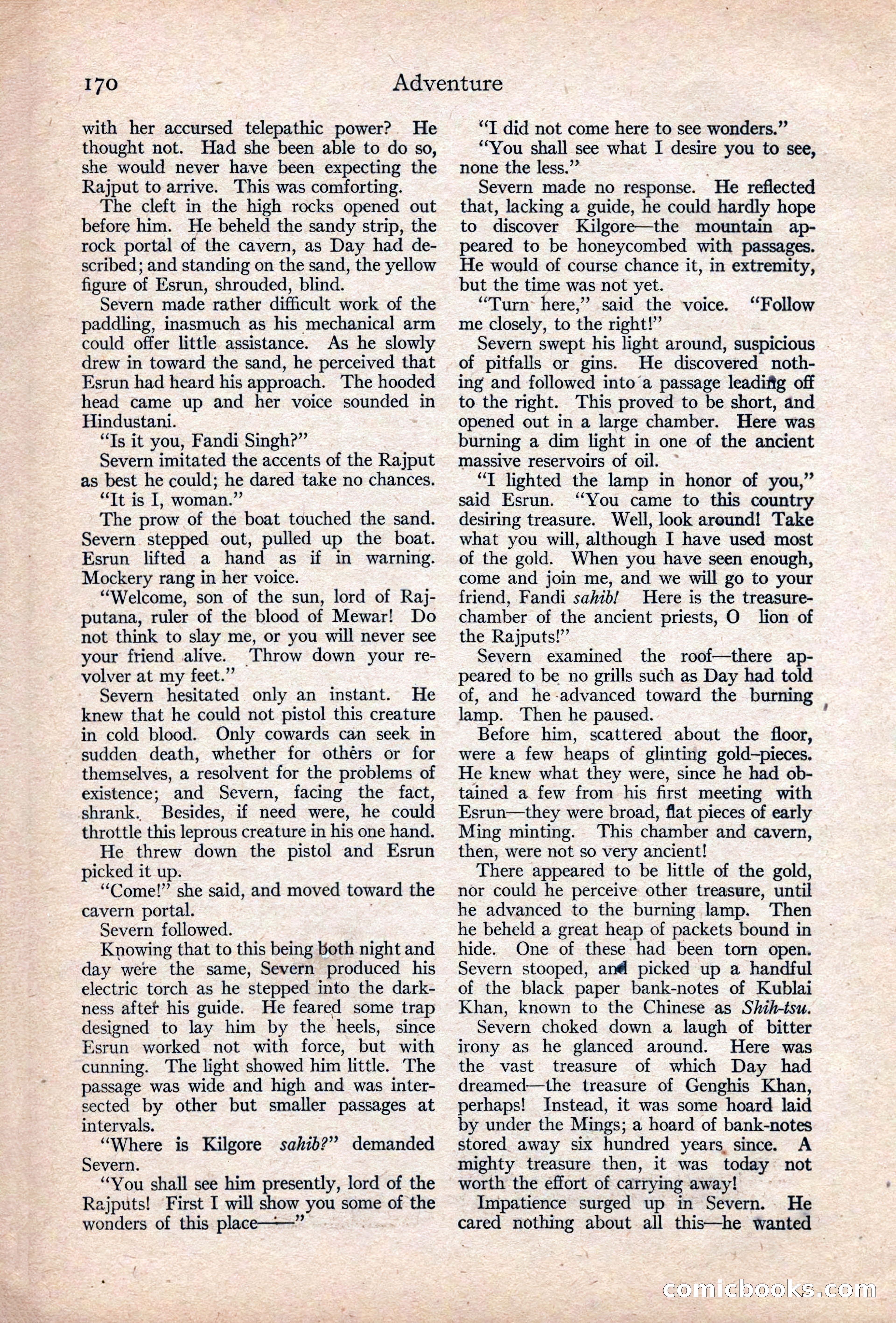
A restored page from Pulp Fiction, 1921. Page through the whole issue in the reader above.
📄 Transcribed text from this page (OCR, searchable)
Machine-transcribed from the original scan — historical spelling and the odd misread are preserved.
170 with her accursed telepathic power? He thought not. Had she been able to do so, she would never have been expecting the Rajput to arrive. This was comforting. The cleft in the high rocks opened out before him. He beheld the sandy strip, the rock portal of the cavern, as Day had de- scribed; and standing on the sand, the yellow figure of Esrun, shrouded, blind. Severn made rather difficult work of the paddling, inasmuch as his mechanical arm could offer little assistance. As he slowly drew in toward the sand, he perceived that Esrun had heard his approach. The hooded head came up and her voice sounded in Hindustani. “Ts it you, Fandi Singh?” Severn imitated the accents of the Rajput as best he could; he dared take no chances. “Tt is I, woman.” The prow of the boat touched the sand. Severn stepped out, pulled up the boat. Esrun lifted a hand as if in warning. Mockery rang in her voice. “Welcome, son of the sun, lord of Raj- putana, ruler of the blood of Mewar! Do not think to slay me, or you will never see your friend alive. Throw down your re- volver at my feet.”’ Severn hesitated only an instant. He knew that he could not pistol this creature in cold blood. Only cowards can seek in - sudden death, whether for othérs or for themselves, a resolvent for the problems of existence; and Severn, facing the fact, shrank. Besides, if need were, he could throttle this leprous creature in his one hand. He threw down the pistol and Esrun picked it up. “Come!” she said, and moved toward the cavern portal. Severn followed. Knowing that to this being both night and day were the same, Severn produced his electric torch as he stepped into the dark- ness aftet his guide. He feared some trap designed to lay him by the heels, since Esrun worked not with force, but with cunning. The light showed him little. The passage was wide and high and was inter- sected by other but smaller passages at intervals. “Where is Kilgore sahib?” demanded Severn. “You shall see him presently, lord of the Rajputs! First I will show jyou some of the wonders of this place——” Adventure “T did not come here to see wonders.” “You shall see what I desire you to see, none the less.” Severn made no response. He reflected that, lacking a guide, he could hardly hope to discover Kilgore—the mountain ap- peared to be honeycombed with passages. He would of course chance it, in extremity, but the time was not yet. “Turn: here,” said the voice. me closely, to the right!” “Follow Severn swept his light around, suspicious | of pitfalls or gins. He discovered noth- ing and followed into a passage leadifig off to the right. This proved to be short, and opened out in a large chamber. Here was burning a dim light in one of the ancient massive reservoirs of oil. ~ “T lighted the lamp in honor of you,” said Esrun. “You came to this country desiring treasure. Well, look around! Take what you will, although I have used most of the gold. When you have seen enough, come and join me, and we will go to your friend, Fandi sahib! Here is the treasure- chamber of the ancient priests, O lion of the Rajputs!” Severn examined the roof—there ap- peared to be no grills such as Day had told of, and he-advanced toward the burning lamp. Then he paused. Before him, scattered about the floor, were a few heaps of glinting gold-—pieces. He knew what they were, since he had ob- tained a few from his first meeting with Esrun—they were broad, flat pieces of early Ming minting. This chamber and cavern, then, were not so very ancient! There appeared to be little of the gold, nor could he perceive other treasure, until he advanced to the burning lamp. Then he beheld a great heap of packets bound in hide. One of these had been torn open. Severn stooped, and picked up a handful of the black paper bank-notes of Kublai Khan, known to the Chinese as Shih-isu. Severn choked down a laugh of bitter irony as he glanced around. Here was the vast treasure of which Day had dreamed—the treasure of Genghis Khan, perhaps! Instead, it was some hoard laid by under the Mings; a hoard of bank-notes stored away six hundred years since. A mighty treasure then, it was today not worth the effort of carrying away! Impatience surged up in Severn. He cared nothing about all this—he wanted EOLPNIC OOO KS (E@ i