
Pulp Fiction, 1921 · page 171 of 204
Adventure Magazine Cover — page 171: what you’re looking at
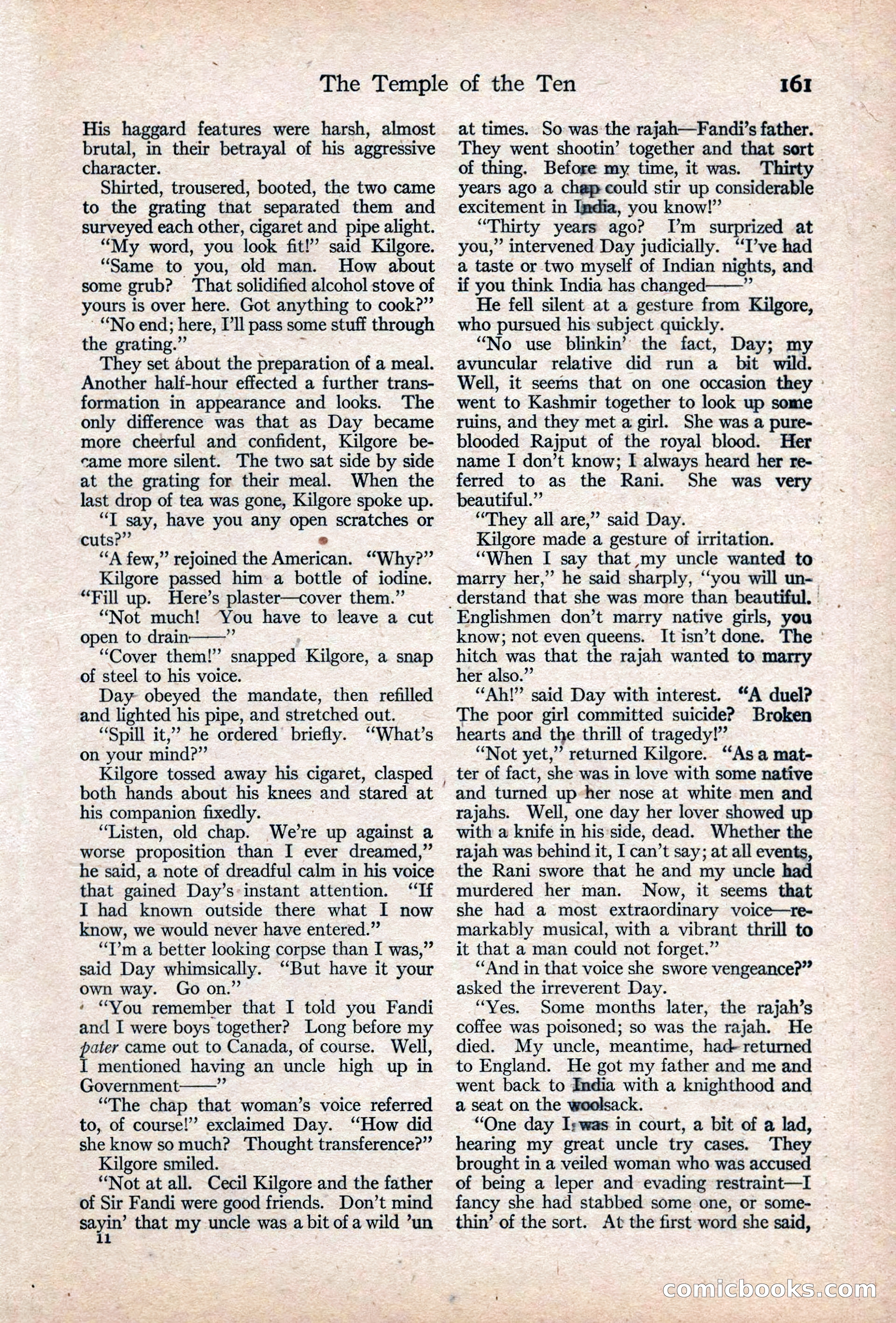
A restored page from Pulp Fiction, 1921. Page through the whole issue in the reader above.
📄 Transcribed text from this page (OCR, searchable)
Machine-transcribed from the original scan — historical spelling and the odd misread are preserved.
The Temple of the Ten His haggard features were harsh, almost brutal, in their betrayal of his aggressive character. Shirted, trousered, booted, the two came to the grating that separated them and surveyed each other, cigaret and pipe alight. “My word, you look fit!” said Kilgore. “Same to you, old man. How about some grub? That solidified alcohol stove of yours is over here. Got anything to cook?” “No end; here, Ill pass some stuff through the grating. “3 They set about the preparation of a meal. Another half-hour effected a further trans- formation in appearance and looks. The only difference was that as Day became more cheerful and confident, Kilgore be- came more silent. The two sat side by side at the grating for their meal. When the last drop of tea was gone, Kilgore spoke up. “T say, have you any si scratches or cuts?” “A few,” rejoined the Angie “Why?” Kilgore passed him a bottle of iodine. “Fill up. Here’s plaster—cover them.” “Not much! “You have to leave a cut open to drain——’”’ “Cover them!” snapped Kilgore, a snap of steel to his voice. Day obeyed the mandate, then refilled and lighted his pipe, and stretched out. “Spill it,’ he ordered briefly. ‘‘What’s on your mind?” Kilgore tossed away his cigaret, clasped | both hands about his knees and stared at his companion fixedly. | “Listen, old chap. We’re up against a worse proposition than I ever dreamed,” he said, a note of dreadful calm in his voice that gained Day’s:instant attention. “Tf I had known outside there what I now know, we would never have entered.” “I’m a better looking corpse than I was,” said Day whimsically. “But have it your own way. Go on.’ ‘ “Vou remember that I told you Fandi and I were boys together? Long before my pater came out to Canada, of course. Well, I mentioned having an uncle high up in Government——”’ “The chap that woman’s voice referred to, of course!” exclaimed Day. “How did she know somuch? Thought transference?” Kilgore smiled. “Not at all. Cecil Kilgore and the father of Sir Fandi were good friends. Don’t mind ae fld that my uncle was a bit of a wild ’un 161 at times. So was the rajah—Fandi’s father. They went shootin’ together and that sort of thing. Before my time, it was. years ago a chapcould stir up considerable excitement in Imdia, you know!” “Thirty years ago? I’m surprized at you,” intervened Day judicially. “I’ve had a taste or two myself of Indian nights, and if you think India has changed——” He fell silent at a gesture from Kilgore, who pursued his subject quickly. “No use blinkin’ the fact, Day; my avuncular relative did run a bit wild. Well, it seems that on one occasion they » went to Kashmir together to look up some ruins, and they met a girl. She was a pure- - blooded Rajput of the royal blood. Her name I don’t know; I always heard her re- She was very ferred to as the Rani. beautiful.” “They all are,” said Day. Kilgore made a gesture of irritation. ‘When I say that my uncle wanted to . marry her,” he said sharply, “you will un- _derstand that she was more than beautiful. | Englishmen don’t marry native girls, you know; not even queens. It isn’t done. The ° hitch was that the rajah wanted to marry her also.” “Ah!” said Day with interest. “A duel? The poor girl committed suicide? Broken hearts and the thrill of tragedy!” “Not yet,” returned Kilgore. “As a mat- ter of fact, she was in love with some native and turned up-her nose at white men and rajahs. Well, one day her lover showed up with a knife in his side, dead. Whether the rajah was behind it, I can’t say; at all events, the Rani swore that he and my uncle had murdered her man. Now, it seems that she had a most extraordinary voice—re- markably musical, with a vibrant thrill to it that a man could not forget.” “And in that voice she swore vengeance?” asked the irreverent Day. “Yes. Some months later, the rajah’s coffee was poisoned; so was the rajah. He died. My uncle, meantime, had returned Thirty to England. He got my father and me and - went back to India with a knighthood and a seat on the woolsack. “One day Iswas in court, a bit of a lad, hearing my great uncle try cases. They brought in a veiled woman who was accused © of being a leper and evading restraint—I fancy she had stabbed some one, or some- . thin’-of the sort. At the first word she said, VOOLKS (C@