
Pulp Fiction, 1921 · page 15 of 204
Adventure Magazine Cover — page 15: what you’re looking at
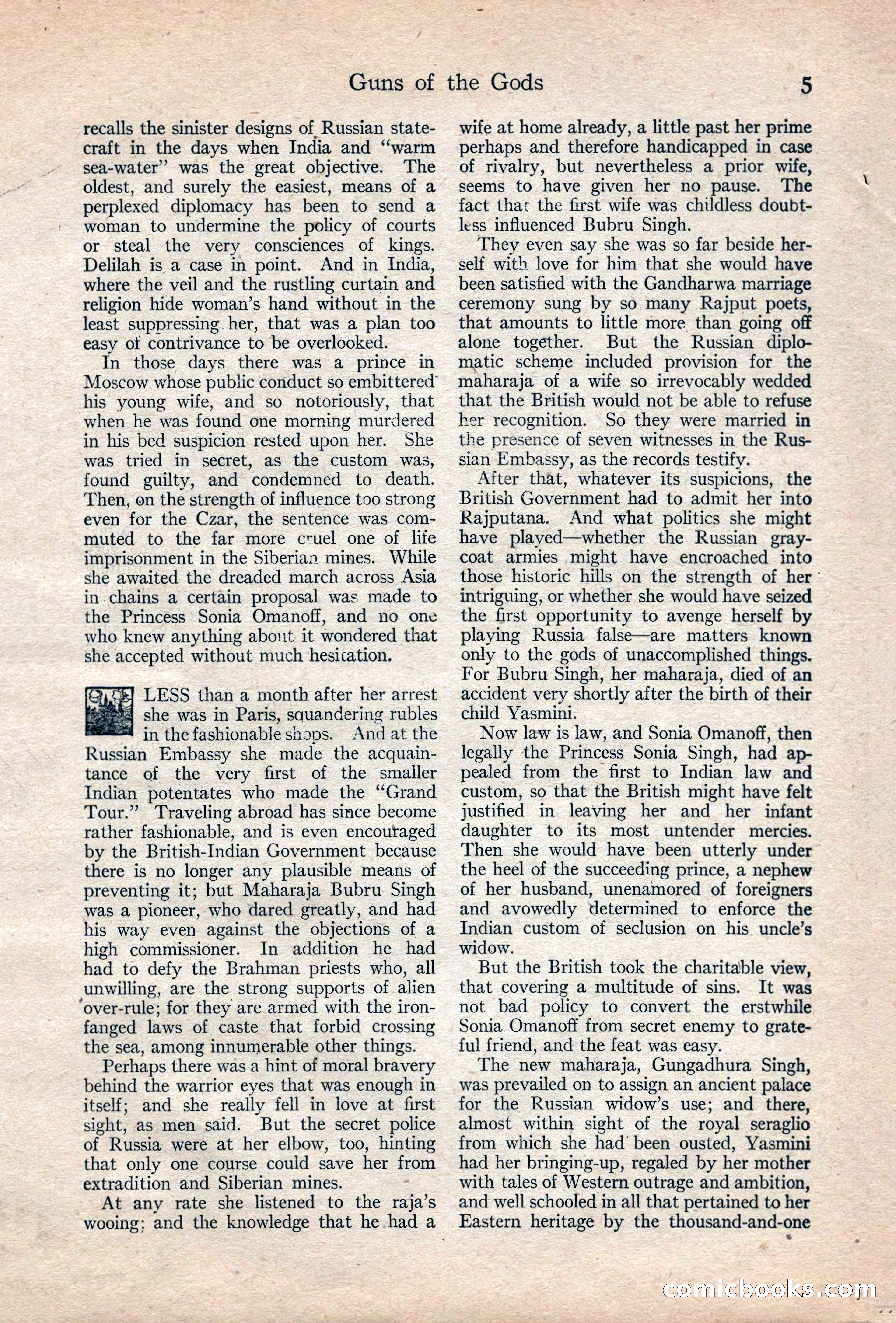
A restored page from Pulp Fiction, 1921. Page through the whole issue in the reader above.
📄 Transcribed text from this page (OCR, searchable)
Machine-transcribed from the original scan — historical spelling and the odd misread are preserved.
Guns of the Gods 5 recalls the sinister designs of Russian state- craft in the days when India and “warm sea-water’ was the great objective. The oldest, and surely the easiest, means of a perplexed diplomacy has been to send a woman to undermine the policy of courts or steal the very consciences of kings. Delilah is a case in point. And in India, where the veil and the rustling curtain and religion hide woman’s hand without in the least suppressing her, that was a plan too easy of contrivance to be overlooked. In those days there was a prince in Moscow whose public conduct so embittered’ his young wife, and so notoriously, that when he was found one morning murdered in his bed suspicion rested upon her. She was tried in secret, as the custom was, found guilty, and condemned to death. Then, on the strength of influence too strong even for the Czar, the sentence was com- muted to the far more cruel one of life imprisonment in the Siberian mines. While she awaited the dreaded march across Asia in. chains a certain proposal was made to the Princess Sonia Omanoff, and no one who knew anything about it wondered that she accepted without much hesitation. LESS than a month after her arrest %4 she was in Paris, sauandering rubles in the fashionable shops. And at the Russian Embassy she made the acquain- tance of the very first of the smaller Indian potentates who made the “Grand Tour.” Traveling abroad has since become rather fashionable, and is even encouraged by the British-Indian Government because there is no longer any plausible means of preventing it; but Maharaja Bubru Singh was a pioneer, who dared greatly, and had his way even against the objections of a high commissioner. In addition he had had to defy the Brahman priests who, all unwilling, are the strong supports of alien ‘over-rule; for they are armed with the iron- fanged laws of caste that forbid crossing the sea, among innumerable other things. Perhaps there was a hint of moral bravery behind the warrior eyes that was enough in itself; and she really fell in love at first sight, as men said. But the secret police of Russia were at her elbow, too, hinting that only one course could save her from extradition and Siberian mines. At any rate she listened to the raja’s wooing: and the knowledge that he had a wife at home already, a little past her prime perhaps and therefore handicapped in case of rivalry, but nevertheless a prior wife, seems to have given her no pause. The fact tha: the first wife was childless doubt- less influenced Bubru Singh. They even say she was so far beside her- self with love for him that she would have been satisfied with the Gandharwa marriage ceremony sung by so many Rajput poets, that amounts to little more than going off alone together. But the Russian diplo- matic scheme included provision for the maharaja of a wife so irrevocably wedded that the British would not be able to refuse her recognition. So they were married in the presence of seven witnesses in the Rus- sian Embassy, as the records testify. After that, whatever its suspicions, the British Government had to admit her into Rajputana. And what politics she might have played—whether the Russian gray- coat armies might have encroached into those historic hills on the strength of her ™ intriguing, or whether she would have seized the first opportunity to avenge herself by playing Russia false—are matters known only to the gods of unaccomplished things. For Bubru Singh, her maharaja, died of an accident very shortly after the birth of their child Yasmini. Now law is law, and Sonia Omanoff, then legally the Princess Sonia Singh, had ap- pealed from the first to Indian law and custom, so that the British might have felt justified in leaving her and her infant daughter to its most untender mercies. Then she would have been utterly under the heel of the succeeding prince, a nephew of her husband, unenamored of foreigners and avowedly determined to enforce the Indian custom of seclusion on his uncle’s widow. But the British took the charitable view, that covering a multitude of sins. It was not bad policy to convert the erstwhile Sonia Omanoff from secret enemy to grate- ful friend, and the feat was easy. The new maharaja, Gungadhura Singh, was prevailed on to assign an ancient palace for the Russian widow’s use; and there, almost within sight of the royal seraglio from which she had been ousted, Yasmini had her bringing-up, regaled by her mother with tales of Western outrage and ambition, and well schooled in all that pertained to her Eastern heritage by the thousand-and-one CS €or Eomichoo