
Pulp Fiction, 1921 · page 118 of 204
Adventure Magazine Cover — page 118: what you’re looking at
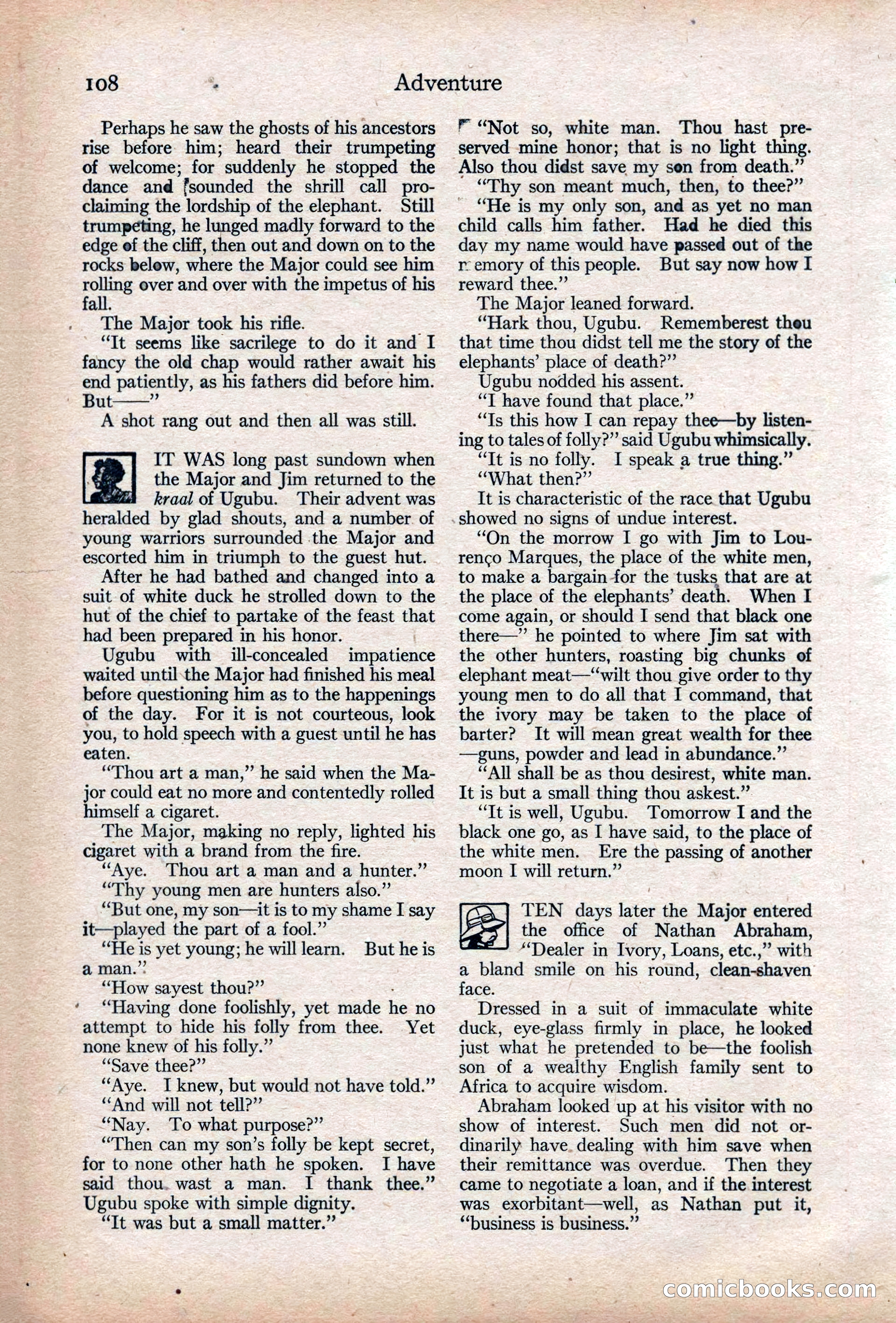
A restored page from Pulp Fiction, 1921. Page through the whole issue in the reader above.
📄 Transcribed text from this page (OCR, searchable)
Machine-transcribed from the original scan — historical spelling and the odd misread are preserved.
108 ‘s Perhaps he saw the ghosts of his ancestors rise before him; heard their trumpeting of welcome; for suddenly he stopped the dance and /fsounded the shrill call pro- claiming the lordship of the elephant. Still trumpeting, he lunged madly forward to the edge of the cliff, ea out and down on to the rocks below, where the Major could see him rolling over and over with the impetus of his fall. The Major took his rifle. “Tt seems like sacrilege to do it and I fancy the old chap would rather await his end patiently, as his fathers did before him. A shot rang out and then all was still. IT WAS long past sundown when the Major and Jim returned to the eaZ4 kraal of Ugubu. Their advent was heralded by glad shouts, and a number. of young warriors surrounded the Major and escorted him in triumph to the guest hut. After he had bathed and changed into a suit of white duck he strolled down to the hut of the chief to partake of the feast that had been prepared in his honor. Ugubu with ill-concealed feinatience waited until:the Major had finished his meal before questioning him as to the happenings of the day. For it is not courteous, look you, to hold speech with a guest until he has eaten. ‘Thou art a man,” he said when the Ma- jor could eat no more and contentedly rolled himself a cigaret. The Major, making no reply, lighted his cigaret with a brand from the fire. “Aye. Thou art a man and a hunter.” “Thy young men are hunters also.” “But one, my son—it is to my shame I say it—played the part of a fool.” “He is yet young; he will learn. a man.’ “How sayest thou?” “Having done foolishly, yet made he no attempt to hide his folly from thee. Yet none knew of his folly.” “Save thee?” “Aye. I knew, but would not have told.” “And will not tell?” “Nay. To what purpose?” “Then can my son’s folly be kept secret, for to none other hath he spoken. I have said thou. wast a man. I thank thee.” Ugubu spoke with simple dignity. “It was but a small matter.” But he is Adventure “Not so, white man. Thou hast pre- served mine honor; that is no light thing. Also thou didst save my son from death.” “Thy son meant much, then, to thee?” “He is my only son, and as yet no man child calls him father. Had he died this day my name would have passed out of the r-emory of this people. But say now how I reward thee.” The Major leaned forward. “Hark thou, Ugubu. Rememberest theu that time thou didst tell me the story of the elephants’ place of death?” Ugubu nodded his assent. “T have found that place.” “Ts this how I can repay thee—by listen- ing to tales of folly?” said Ugubu whimsically. “Tt is no folly. I speak a true thing.” “What then?” It is characteristic of the race that Ugubu .showed no signs of undue interest. “On the morrow I go with Jim to Lou- renco Marques, the place of the white men, to make a bargain for the tusks that are at the place of the elephants’ death. When I come again, or should I send that black one there—’”’ he pointed to where Jim sat with the other hunters, roasting big chunks of elephant meat—“wilt thou give order to thy young men to do all that I command, that the ivory may be taken to the place of barter? It will mean great wealth for thee —guns, powder and lead in abundance.” ‘All shall be as thou desirest, white man. It is but a small thing thou askest.”’ “Tt is well, Ugubu. ‘Tomorrow I and the black one go, as I have said, to the place of the white men. Ere the passing of another moon I will return.” [ex TEN days lates the Major entered Poy the office of Nathan Abraham, =~ “Dealer in Ivory, Loans, etc.,” with a bland smile on his round, clean-shaven face. Dressed in a suit of immaculate white duck, eye-glass firmly in place, he looked just what he pretended to be—the foolish son of a wealthy English family sent to Africa to acquire wisdom. Abraham looked up at his visitor with no show of interest. Such men did not or- dinarily have. dealing with him save when their remittance was overdue. Then they came to negotiate a loan, and if the interest was exorbitant—well, as Nathan put it, “business is business.” (EO [ANieLoxeye) (@) ON S (E)