
Pulp Fiction, 1921 · page 94 of 200
Adventure Magazine Cover, February 3, 1921 — page 94: what you’re looking at
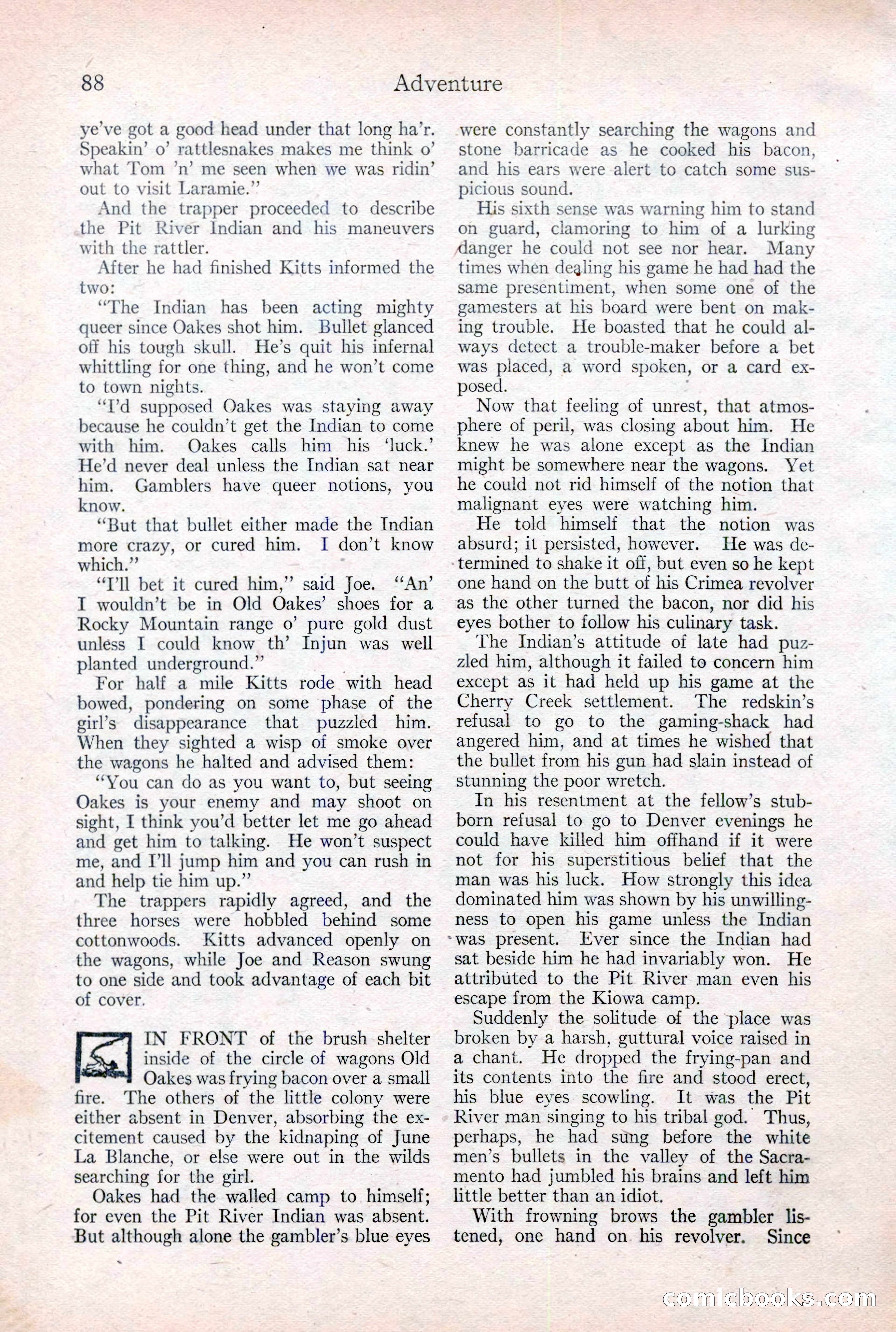
A restored page from Pulp Fiction, 1921. Page through the whole issue in the reader above.
📄 Transcribed text from this page (OCR, searchable)
Machine-transcribed from the original scan — historical spelling and the odd misread are preserved.
88 ye’ve got a good head under that long ha’r. Speakin’ o’ rattlesnakes makes me think o’ what Tom ’n’ me seen when we was ridin’ out to visit Laramie.” And the trapper proceeded to describe the Pit River Indian and his maneuvers with the rattler. After he had finished Kitts informed the two: “The Indian has been acting mighty queer since Oakes shot him. Bullet glanced off his towgh skull. He’s quit his infernal whittling for one thing, and he won’t come to town nights. “Td supposed Oakes was staying away because he couldn’t get the Indian to come with him. Oakes calls him his ‘luck.’ He’d never deal unless the Indian sat near him. Gamblers have queer notions, you know. “But that bullet either made the Indian more crazy, or cured him. I don’t know which.” “T’ll bet it cured him,” said Joe. “An’ I wouldn’t be in Old Oakes’ shoes for a Rocky Mountain range o’ pure gold dust unless I could know th’ Injun was well planted underground.” ) For half a mile Kitts rode with head bowed, pondering on some phase of the girl’s disappearance that puzzled him. When they sighted a wisp of smoke over the wagons he halted and advised them: “You can do as you want to, but seeing Oakes is your enemy and may shoot on sight, I think you’d better let me go ahead and get him to talking. He won’t suspect me, and I’ll jump him and you can rush in and help tie him up.” The trappers rapidly agreed, and the three horses were hobbled behind some cottonwoods. Kitts advanced openly on the wagons, while Joe and Reason swung to one side and took advantage of each bit of cover. IN FRONT of the brush shelter S| inside of the circle of wagons Old Oakes was frying bacon over a small fire. The others of the little colony were either absent in Denver, absorbing the ex- citement caused by the kidnaping of June La Blanche, or else were out in the wilds searching for the girl. Oakes had the walled camp to himself; for even the Pit River Indian was absent. But although alone the gambler’s blue eyes x “was present. Adventure were constantly searching the wagons and stone barricade as he cooked his bacon, and his ears were alert to catch some sus- picious sound. His sixth sense was warning him to stand on guard, clamoring to him of a lurking danger he could not see nor hear. Many times when degling his game he had had the same presentiment, when some one of the gamesters at his board were bent on mak- ing trouble. He boasted that he could al- ways detect a trouble-maker before a bet was placed, a word spoken, or a card ex- posed. Now that feeling of unrest, that atmos- phere of peril, was closing about him. He knew he was alone except as the Indian might be somewhere near the wagons. Yet he could not rid himself of the notion that malignant eyes were watching him. He told himself that the notion was absurd; it persisted, however. He was de- ‘termined to shake it off, but even so he kept one hand on the butt of his Crimea revolver as the other turned the bacon, nor did his eyes bother to follow his culinary task. The Indian’s attitude of late had puz- zled him, although it failed to concern him except as it had held up his game at the Cherry Creek settlement. The redskin’s refusal to go to the gaming-shack had angered him, and at times he wished that the bullet from his gun had slain instead of stunning the poor wretch. In his resentment at the fellow’s stub- born refusal to go to Denver evenings he could have killed him offhand if it were not for his superstitious belief that the man was his luck. How strongly this idea dominated him was shown by his unwilling- ness to open his game unless the Indian Ever since the Indian had sat beside him he had invariably won. He attributed to the Pit River man even his escape from the Kiowa camp. Suddenly the solitude of the place was broken by a harsh, guttural voice raised in a chant. He dropped the frying-pan and its contents into the fire and stood erect, his blue eyes scowling. It was the Pit River man singing to his tribal god. Thus, perhaps, he had sung before the white men’s bullets in the valley of the Sacra- mento had jumbled his brains and left him little better than an idiot. With frowning brows the gambler lis- tened, one hand on his revolver. Since CORNICLOoOokKs (C@