
Pulp Fiction, 1921 · page 189 of 200
Adventure Magazine Cover, February 3, 1921 — page 189: what you’re looking at
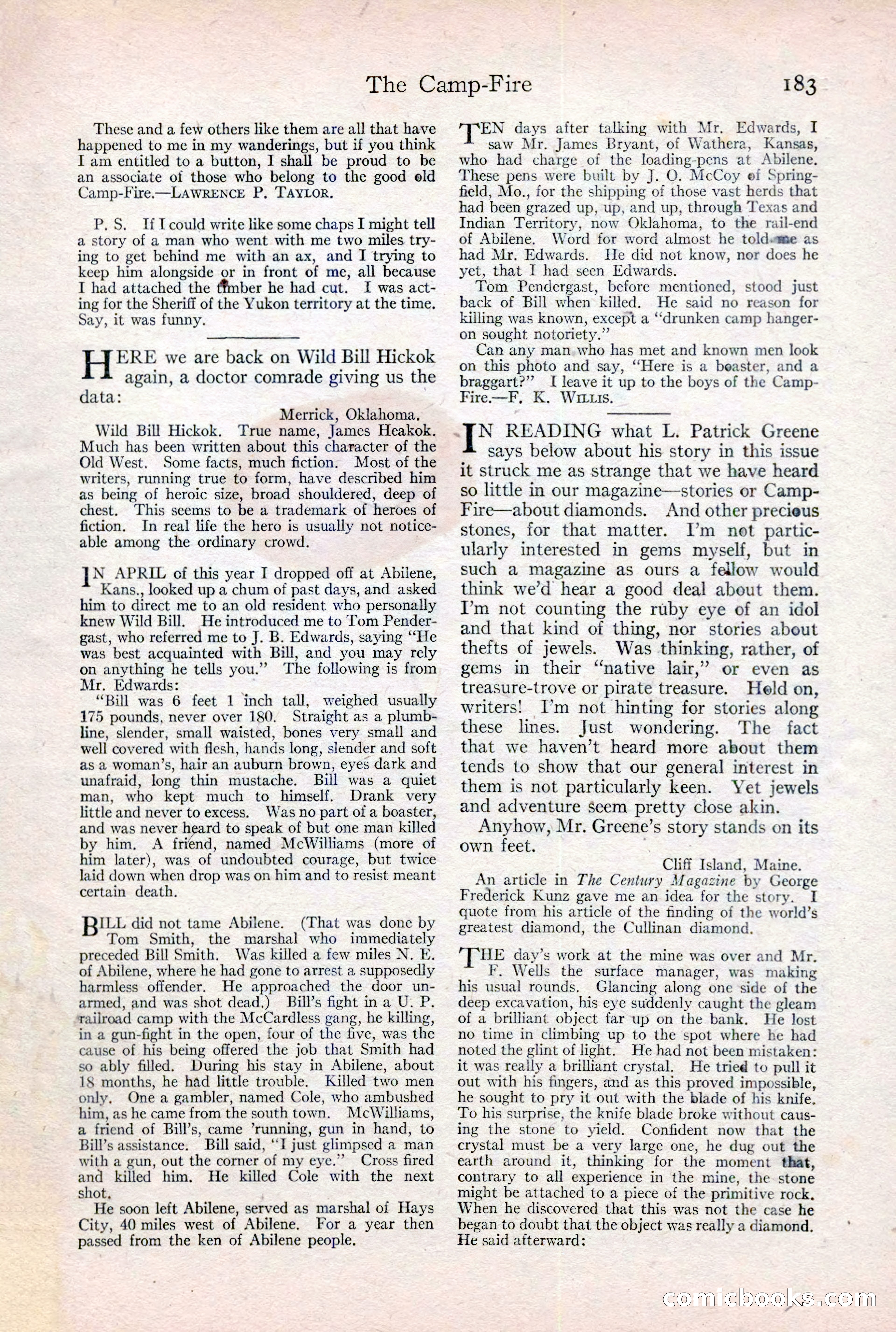
A restored page from Pulp Fiction, 1921. Page through the whole issue in the reader above.
📄 Transcribed text from this page (OCR, searchable)
Machine-transcribed from the original scan — historical spelling and the odd misread are preserved.
The Camp-Fire These and a few others like them are all that have happened to me in my wanderings, but if you think I am entitled to a button, I shall be proud to be an associate of those who belong to the good eld Camp-Fire-—LAWRENCE P, TAYLOR. P. S. If I could write like some chaps I might tell a story of a man who went with me two miles try- ing to get behind me with an ax, and I trying to keep him alongside or in front of me, all because I had attached the ffmber he had cut. I was act- ing for the Sheriff of the Yukon territory at the time. Say, it was funny. ERE we are back on Wild Bill Hickok again, a doctor comrade giving us the data: Merrick, Oklahoma, Wild Bill Hickok. True name, James Heakok. Much has been written about this character of the Old West. Some facts, much fiction. Most of the writers, running true to form, have described him as being of heroic size, broad shouldered, deep of chest. This seems to be a trademark of heroes of fiction. In real life the hero is usually not notice- able among the ordinary crowd. N APRIL cf this year I dropped off at Abilene, Kans., looked up a chum of past days, and asked him to direct me to an old resident who personally knew Wild Bill. He introduced me to Tom Pender- gast, who referred me to J. B. Edwards, saying ‘He was best acquainted with Bill, and you may rely on anything he tells you.” The following is from Mr. Edwards: “Bill was 6 feet 1 inch tall, weighed usually 175 pounds, never over 180. Straight as a plumb- line, slender, small waisted, bones very small and well covered with flesh, hands long, slender and soft as a woman’s, hair an auburn brown, eyes dark and unafraid, long thin mustache. Bill was a quiet man, who kept much to himself. Drank very little and never to excess. Was no part of a boaster, and was never heard to speak of but one man killed by him. A friend, named McWilliams (more of him later), was of undoubted courage, but twice laid down when drop was on him and to resist meant certain death. ILL did not tame Abilene. (That was done by Tom Smith, the marshal who immediately preceded Bill Smith. Was killed a few miles N. E. of Abilene, where he had gone to arrest a supposedly harmless offender. He approached the door un- armed, and was shot dead.) Bill’s fight in a U. P. railroad camp with the McCardless gang, he killing, in a gun-fight in the open, four of the five, was the cause of his being offered the job that Smith had so ably filled. During his stay in Abilene, about 18 months, he had little trouble. Killed two men only, One a gambler, named Cole, who ambushed him, as he came from the south town. McWilliams, a friend of Bill’s, came ’running, gun in hand, to Bill’s assistance. Bill said, ‘I just glimpsed a man with a gun, out the corner of my eye.” Cross fired and killed him. He killed Cole with the next shot, He soon left Abilene, served as marshal of Hays City, 40 miles west of Abilene. For a year then passed from the ken of Abilene people. 183 TEN days after talking with Mr. Edwards, I saw Mr. James Bryant, of Wathera, Kansas, who had charge of the loading-pens at Abilene. These pens were built by J. O. McCoy ef Spring- held, Mo., for the shipping of those vast herds that had been grazed up, up, and up, through Texas and Indian Territory, now Oklahoma, to the rail-end of Abilene. Word for word almost he toldemme as had Mr. Edwards. He did not know, nor does he yet, that I had seen Edwards. Tom Pendergast, before mentioned, stood just back of Bill when killed. He said no reason for killing was known, except a “drunken camp hanger- on sought notoriety.” Can any man.who has met and known men look on this photo and say, “Here is a beaster, and a braggart?” I leave it up to the boys of the Camp- Fire—F, K. WI.z1s. N READING what L. Patrick Greene says below about his story in this issue it struck me as strange that we have heard so little in our magazine—stories or Camp- Fire—about diamonds. And other precieus stones, for that matter. I’m not partic- ularly interested in gems myself, but in such a magazine as ours a fellow would think we’d hear a good deal about them. I’m not counting the ruby eye of an idol and that kind of thing, nor stories about thefts of jewels. Was thinking, rather, of gems in their “native lair,” or even as treasure-trove or pirate treasure. Held on, writers! I’m not hinting for stories along these lines. Just wondering. The fact that we haven’t heard more about them tends to show that our general interest in them is not particularly keen. Yet jewels and adventure seem pretty close akin. Anyhow, Mr. Greene’s story stands on its own feet. $ Cliff Island, Maine. An article in The Century Magazine by George Frederick Kunz gave me an idea for the story. I quote from his article of the finding of the world’s greatest diamond, the Cullinan diamond. ‘THE day’s work at the mine was over and Mr. F. Wells the surface manager, was making his usual rounds. Glancing along one side of the deep excavation, his eye suddenly caught the gleam of a brilliant object far up on the bank. He lost no time in climbing up to the spot where he had noted the glint of light. He had not been mistaken: it was really a brilliant crystal. He tried to pull it out with his fingers, and as this proved impossible, he sought to pry it out with the blade of his knife. To his surprise, the knife blade broke without caus- ing the stone to yield. Confident now that the crystal must be a very large one, he dug out the earth around it, thinking for the moment that, contrary to all experience in the mine, the stone might be attached to a piece of the primitive rock. When he discovered that this was not the case he began to doubt that the object was really a diamond. He said afterward: CONmiclOOO|KS (C@