
Pulp Fiction, 1921 · page 187 of 200
Adventure Magazine Cover, February 3, 1921 — page 187: what you’re looking at
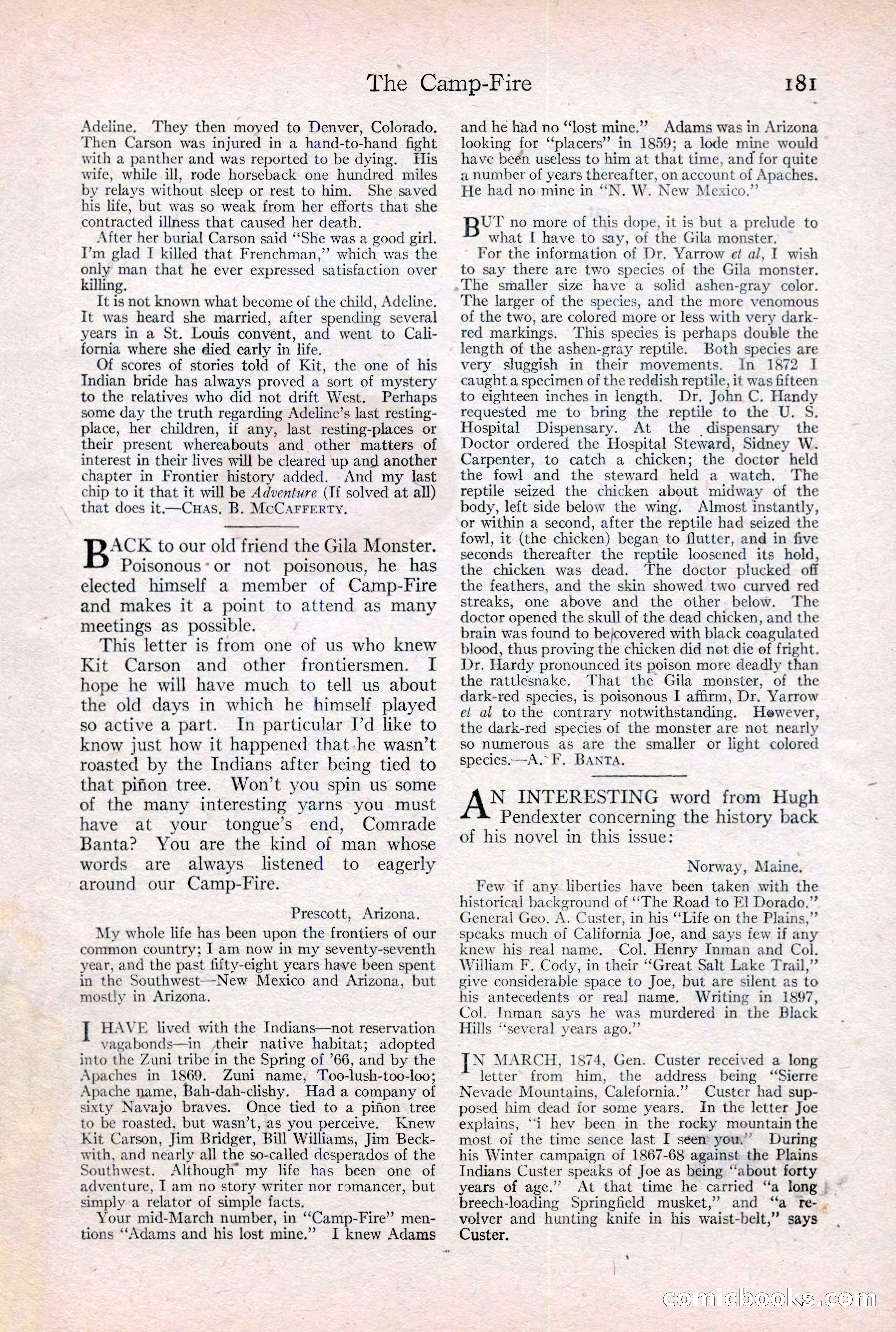
A restored page from Pulp Fiction, 1921. Page through the whole issue in the reader above.
📄 Transcribed text from this page (OCR, searchable)
Machine-transcribed from the original scan — historical spelling and the odd misread are preserved.
The Camp-F ire Adeline. They then moyed to Denver, Colorado. Then Carson was injured in a hand-to-hand fight with a panther and was reported to be dying. His wife, while ill, rode horseback one hundred miles by relays without sleep or rest to him. She saved his life, but was so weak from her efforts that she contracted illness that caused her death. After her burial Carson said ‘‘She was a good girl. I’m glad I killed that Frenchman,” which was the only man that he ever expressed satisfaction over g. It is not known what become of the child, Adeline. It was heard she married, after spending several years in a St. Louis convent, and went to Cali- fornia where she died early in life. Of scores of stories told of Kit, the one of his Indian bride has always proved a sort of mystery to the relatives who did not drift West. Perhaps some day the truth regarding Adeline’s last resting- place, her children, if any, last resting-places or their present whereabouts and other matters of interest in their lives will be cleared up and another chapter in Frontier history added. And my last chip to it that it will be Adventure (If solved at all) that does it—Cuas, B. McCarFrerty. ACK to our old friend the Gila Monster. Poisonous’ or not poisonous, he has elected himself a member of Camp-Fire and makes it a point to attend as many meetings as possible. This letter is from one of us who knew Kit Carson and other frontiersmen. I hope he will have much to tell us about the old days in which he himself played so active a part. In particular I'd like to know just how it happened that he wasn’t roasted by the Indians after being tied to that pifion tree. Won’t you spin us some of the many interesting yarns you must have at your tongue’s end, Comrade Banta? You are the kind of man whose words are always listened to eagerly around our Camp-Fire. Prescott, Arizona. My whole life has been upon the frontiers of our common country; I am now in my seventy-seventh year, and the past fifty-eight years have been spent in the Southwest—New Mexico and Arizona, but mostly in Arizona. HAVE lived with the Indians—not reservation vagabonds—in their native habitat; adopted into the Zuni tribe in the Spring of ’66, and by the Apaches in 1869. Zuni name, Too-lush-too-loo; Apache name, Bah-dah-clishy. Had a company of sixty Navajo braves. Once tied to a pifion tree to be roasted, but wasn’t, as you perceive. Knew Kit Carson, Jim Bridger, Bill Williams, Jim Beck- with, and nearly all the so-called desperados of the Southwest. Although’ my life has been one of adventure, I am no story writer nor romancer, but simply a relator of simple facts. Your mid-March number, in “‘Camp-Fire” men- tions “‘Adams and his lost mine.” I knew Adams 18I and he had no “lost mine.”” Adams was in Arizona looking for “placers” in 1859; a lode mine would have beén useless to him at that time, and for quite a number of years thereafter, on account of Apaches. He had no mine in “N. W. New Mexico.” But no more of this dope, it is but a prelude to what I have to say, of the Gila monster. For the information of Dr. Yarrow et al, I. wish to say there are two species of the Gila monster. .The smaller size have a solid ashen-gray color. The larger of the species, and the more venomous of the two, are colored more or less with very dark- red markings. This species is perhaps double the length of the ashen-gray reptile. Both species are very sluggish in their movements. In 1872 I caught a specimen of the reddish reptile, it was fifteen to eighteen inches in length. Dr. John C. Handy requested me to bring the reptile to the U. S. Hospital Dispensary. At the dispensary the Doctor ordered the Hospital Steward, Sidney W. Carpenter, to catch a chicken; the doctor held the fowl and the steward held a watch. The reptile seized the chicken about midway of the body, left side below the wing. Almost instantly, or within a second, after the reptile had seized the fowl, it (the chicken) began to flutter, and in five seconds thereafter the reptile loosened its hold, the chicken was dead. The doctor plucked off the feathers, and the skin showed two curved red streaks, one above and the other below. The doctor opened the skull of the dead chicken, and the brain was found to bejcovered with black coagulated blood, thus proving the chicken did net die of fright. Dr. Hardy pronounced its poison more deadly than the rattlesnake. That the Gila monster, of the dark-red species, is poisonous I affirm, Dr. Yarrow et al to the contrary notwithstanding. Hewever, the dark-red species of the monster are not nearly so numerous as are the smaller or light colored species.—A. F. BANTA. N INTERESTING word from Hugh Pendexter concerning the history back of his novel in this issue: Norway, Maine. Few if any liberties have been taken with the historical background of ‘“‘The Road to El Dorado.” General Geo. A. Custer, in his “Life on the Plains,” speaks much of California Joe, and says few if any knew his real name. Col. Henry Inman and Col. William F. Cody, in their “Great Salt Lake Trail,” give considerable space to Joe, but are silent as to his antecedents or real name. Writing in 1897, Col. Inman says he was murdered in the Black Hills “several years ago.”’ [N MARCH, 1874, Gen. Custer received a long letter from him, the address being “‘Sierre Nevade Mountains, Calefornia.’”’ Custer had sup- posed him dead for some years. In the letter Joe explains, ‘i hev been in the rocky mountain the most of the time sence last I seem you’ During his Winter campaign of 1867-68 against the Plains Indians Custer speaks of Joe as being “‘about forty years of age.’ At that time he carried “a long | breech-loading Springfield musket,’ and “a re-. volver and hunting knife in his waist-belt,” says Custer. (C@ = a VOO|KS EO