
Pulp Fiction, 1921 · page 150 of 200
Adventure Magazine Cover, February 3, 1921 — page 150: what you’re looking at
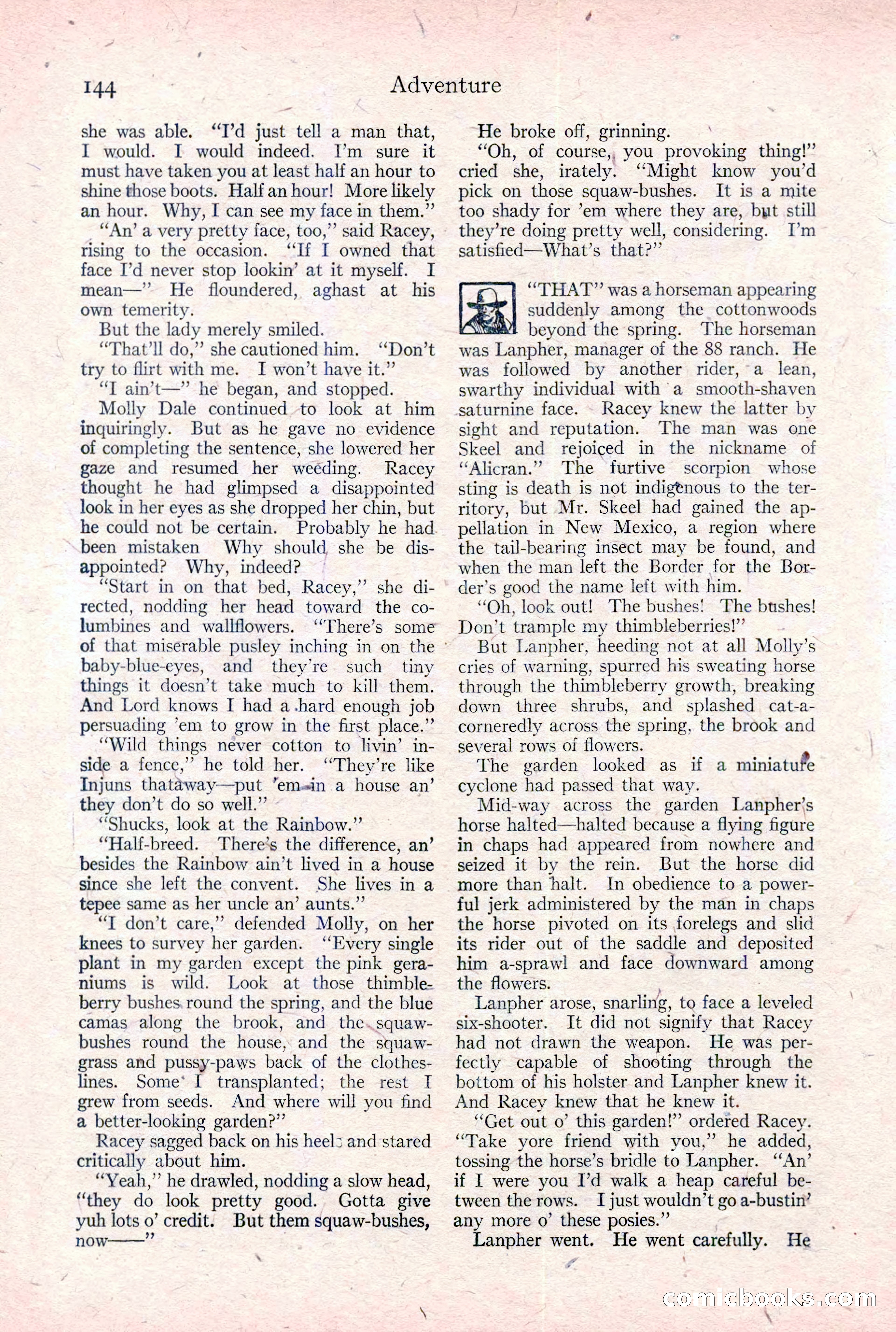
A restored page from Pulp Fiction, 1921. Page through the whole issue in the reader above.
📄 Transcribed text from this page (OCR, searchable)
Machine-transcribed from the original scan — historical spelling and the odd misread are preserved.
144 she was able. “I’d just tell a man that, I would. I would indeed. I’m sure it must have taken you at least half an hour to shine those boots. Half an hour! More likely an hour. Why, I can see my face in them.” _“An’ a very pretty face, too,” said Racey, rising to the occasion. “If I owned that face I’d never stop lookin’ at it myself. I mean—” He floundered, aghast at his own temerity. But the lady merely smiled. “That'll do,” she cautioned him. ‘Don’t try to flirt with me. I won’t have it.” “T ain’t—” he began, and stopped. Molly Dale continued to look at him inquiringly. But as he gave no evidence of completing the sentence, she lowered her gaze and resumed her weeding. Racey thought he had glimpsed a disappointed look in her eyes as she dropped her chin, but he could not be certain. been mistaken Why should she be dis- appointed? Why, indeed? “Start in on that bed, Racey,” she di- rected, nodding her head toward the co- lumbines and wallflowers. ‘‘There’s some of that miserable pusley inching in on the ° baby-blue-eyes, and they’re such tiny things it doesn’t take much to kill them. And Lord knows I had a-hard enough job persuading ’em to grow in the first place.” “Wild things never cotton to livin’ in- side a fence,” he told her. ‘They’re like Injuns thataway—put ’em-«in a house an’ they don’t do so well.” “Shucks, look at the Rainbow.” “Half-breed. There’s the difference, an’ besides the Rainbow ain’t lived in a house since she left the convent. She lives in a tepee same as her uncle an’ aunts.”’ “T don’t care,” defended Molly, on her knees to survey her garden. “Every single plant in my garden except the pink gera- niums is wild. Look at those thimble- berry bushes. round the spring, and the blue camas along the brook, and the.squaw- bushes round the house, and the squaw- grass and pussy-paws back of the clothes- lines. Some’ I transplanted; the rest I grew from seeds. And where will you find a better-looking garden?” Racey sagged back on his heels and stared critically about him. “Yeah,” he drawled, nodding a slow head, “they do look pretty good. Gotta give yuh lots o’ credit. But them squaw-bushes, now——”’ | Probably he had. Adventure He broke off, grinning. “Oh, of course,, you provoking thing!’ cried she, irately. “Might know you’d pick on those squaw-bushes. It is a mite too shady for ’em where they are, but still they’re doing pretty well, considering. I’m satisfied—What’s that?’ 1 “THAT” was a horseman appearing ) suddenly among the cottonwoods Swavi beyond the spring. The horseman was Lanpher, manager of the 88 ranch. He was followed by another rider, ~a_ lean, swarthy individual with a smooth-shaven saturnine face. - Racey knew the latter by sight and reputation. The man was one Skeel and rejoiced in the nickname of “Alicran.”” The furtive scorpion whose sting is death is not indigtnous to the ter- ritory, but Mr. Skeel had gained the ap- pellation in New Mexico, a region where the tail-bearing insect may be found, and when the man left the Border for the Bor- der’s good the name left with him. “Oh, look out! The bushes! The bushes! Don’t trample my thimbleberries!”’ , But Lanpher, heeding not at all Molly’s cries of warning, spurred his sweating horse through the thimbleberry growth, breaking down three shrubs, and splashed cat-a- corneredly across the spring, the brook and several rows of flowers. The garden looked as if a miniatufe cyclone had passed that way. Mid-way across the garden Lanpher’s horse halted—halted because a flying figure in chaps had appeared from nowhere and seized it by the rein. But the horse did more than halt. In obedience to a power- ful jerk administered by the man in chaps the horse pivoted on its forelegs and slid its rider out of the saddle and deposited him a-sprawl and face downward among the flowers. . Lanpher arose, snarling, to face a leveled six-shooter. It did not signify that Racey had not drawn the weapon. He was per- fectly capable of shooting through the bottom of his holster and Lanpher knew it. And Racey knew that he knew it. ‘‘Get out o’ this garden!” ordered Racey. “Take yore friend with you,” he added, tossing the horse’s bridle to Lanpher. ‘An’ if I were you I’d walk a heap careful be- tween the rows. I just wouldn’t go a-bustin’ any more o’ these posies.”’ Lanpher went. He went carefully. He COmMiclooks \ (C@