
Pulp Fiction, 1921 · page 148 of 200
Adventure Magazine Cover, February 3, 1921 — page 148: what you’re looking at
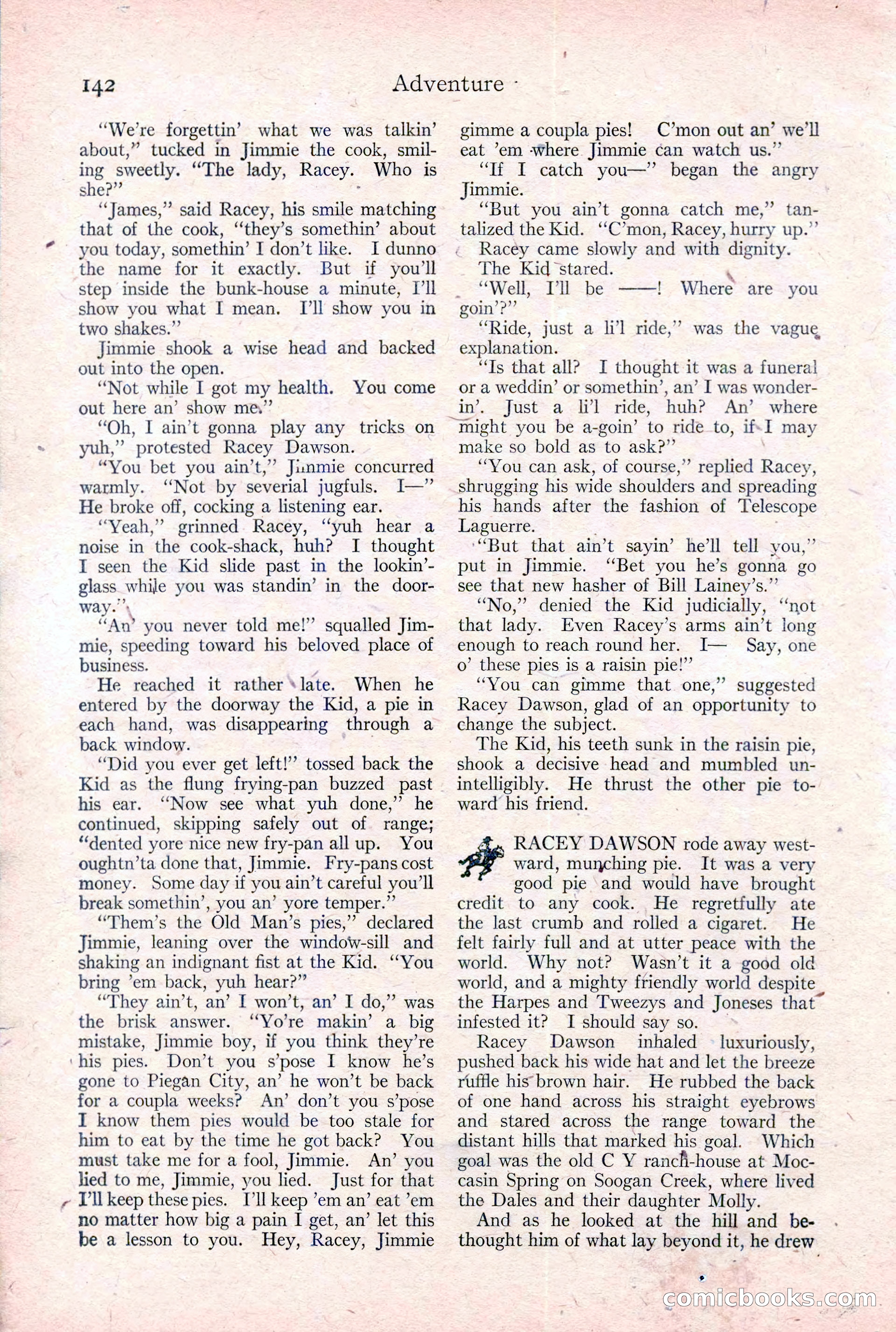
A restored page from Pulp Fiction, 1921. Page through the whole issue in the reader above.
📄 Transcribed text from this page (OCR, searchable)
Machine-transcribed from the original scan — historical spelling and the odd misread are preserved.
‘ ‘his pies. - Vl keep these pies. 142 “We're forgettin’ what we was talkin’ about,” tucked in Jimmie the cook, smil- ing sweetly. “The lady, Racey. Who is she?” “James,” said Racey, his smile eeideg that of the cook, “they’s somethin’ about you today, somethin’ I don’t like. I dunno the name for it exactly. But if you'll step inside the bunk-house a minute, I'll show you what I mean. I'll show you in two shakes.”’ Jimmie shook a wise head and backed out into the open. “Not while I got my health. You come out here an’ show me,” “Oh, I ain’t gonna play any tricks on yuh,” protested Racey Dawson. “You bet you ain’t,’’ Jimmie concurred warmly. “Not by severial jugfuls. I-—” He broke off, cocking a listening ear. “Yeah,” grinned. Racey, “yuh hear a noise in the cook-shack, huh? I thought I seen the Kid slide past in the lookin’- glass. ante you was standin’ in the door- way.’ Ay you never told me!” squalled Jim- mie, speeding toward his beloved place of business. He reached it rather ‘late. When he entered by the doorway the Kid, a pie in each hand, was disappearing through a back window. . “Did you ever get left!’ tossed back the Kid as the flung frying-pan buzzed past his ear. ‘Now see what yuh done,” he continued, skipping safely out of range; “dented yore nice new fry-pan all up. You oughtn’ta done that, Jimmie. Fry-pans cost money. Some day if you ain’t careful you'll break somethin’, you an’ yore temper.” “Them’s the Old Man’s pies,” declared Jimmie, leaning over the window-sill and shaking an indignant fist at the Kid. “You bring ’em back, yuh hear?” | “They ain’t, an’ I won’t, an’ I do,” was the brisk answer. ‘“‘Yo’re makin’ a big mistake, Jimmie boy, if you think they’re Don’t you s’pose I know he’s gone to Piegan City, an’ he won’t be back for a coupla weeks? An’ don’t you s’pose I know them pies would be too stale for him to eat by the time he got back? You must take me for a fool, Jimmie. An’ you lied to me, Jimmie, you lied. Just for that I'll keep ’em an’ eat ’em no matter how big a pain I get, an’ let this be a lesson to you. Hey, Racey, Jimmie Adventure - gimme a coupla pies! C’mon out an’ we'll eat ’em -where Jimmie can watch us.”’ “Tf I catch you—” began the angry Jimmie. “But you ain’t gonna catch me,” tan- talized the Kid. ‘‘C’mon, Racey, hurry up.” Racey came slowly and with dignity. The Kid ‘stared. “Well, 1'll be «-———! ‘. Where are you goin’?”’ “Ride, just a li’l ride,” explanation. “Ts that all? I thought it was a funeral or a weddin’ or somethin’, an’ I was wonder- in’. Just a lil nde, huh? An’ where “might you be a-goin’ to ride to, if<I may make so bold as to ask?” “You can ask, of course,” replied Racey, shrugging his wide shoulders and spreading his hands after the fashion of Telescope Laguerre. “But that ain’t sayin’ he’ll tell you,’ put in Jimmie. “Bet you he’s gonna go see that new hasher of Bill Lainey’s.”’ “No,” denied the Kid judicially, ‘not that lady. Even Racey’s arms ain’t long enough to reach round her. I— Say, one 0’ these pies is a raisin pie!” “You can gimme that one,” suggested Racey Dawson, glad of an opportunity to change the subject. The Kid, his teeth sunk in the raisin pie, shook a decisive head and mumbled un- intelligibly. He thrust the other pie to- ward his friend. yf ward, munching pie. It was a very good pie and would have brought credit to any cook. He regretfully ate the last crumb and rolled a cigaret. He felt fairly full and at utter peace with the world. Why not? Wasn’t it a good old world, and a mighty friendly world despite the Harpes and ‘Tweezys and Joneses that™ infested it? I should say so. Racey Dawson inhaled © luxuriously, pushed back his wide hat and let the breeze ruffle his brown hair. He rubbed the back of one hand across his straight eyebrows and stared across the range toward the distant hills that marked his goal. Which goal was the old C Y ranch-house at Moc- casin Spring on Soogan Creek, where lived the Dales and their daughter Molly. And as he looked at the hill and be- RACEY DAWSON rode away west- thought him of what lay beyond it, he drew ry AAU C© JOO was the vague S EQ