
Pulp Fiction, 1921 · page 11 of 200
Adventure Magazine Cover, February 3, 1921 — page 11: what you’re looking at
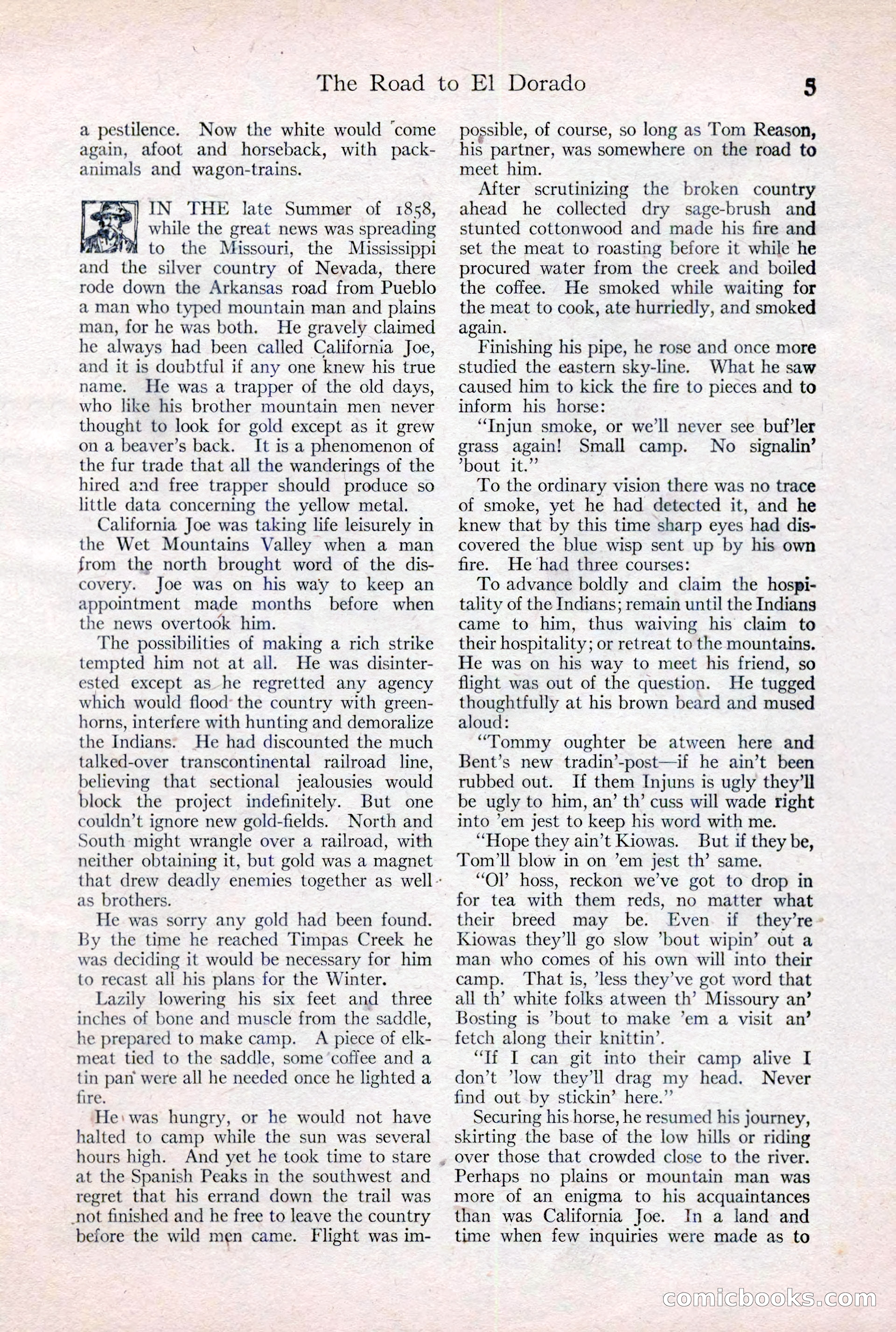
A restored page from Pulp Fiction, 1921. Page through the whole issue in the reader above.
📄 Transcribed text from this page (OCR, searchable)
Machine-transcribed from the original scan — historical spelling and the odd misread are preserved.
The Road to El Dorado 5 a pestilence. Now the white would ‘come again, afoot and horseback, with pack- animals and wagon-trains. IN THE late Summer of 1858, _{ while the great news was spreading Matt to the Missouri, the Mississippi and the silver country of Nevada, there rode down the Arkansas road from Pueblo a man who typed mountain man and plains man, for he was both. He gravely claimed he always had been called California Joe, and it is doubtful if any one knew his true name. He was a trapper of the old days, who like his brother mountain men never thought to look for gold except as it grew on a beaver’s back. It is a phenomenon of the fur trade that all the wanderings of the hired and free trapper should produce so little data concerning the yellow metal. California Joe was taking life leisurely in the Wet Mountains Valley when a man from the north brought word of the dis- covery. Joe was on his way to keep an appointment made months before when the news overtook him. The possibilities of making a rich strike tempted him not at all. He was disinter- ested except as_he regretted any agency which would flood the country with green- horns, interfere with hunting and demoralize the Indians. He had discounted the much talked-over transcontinental railroad line, believing that sectional jealousies would block the project indefinitely. But one couldn’t ignore new gold-fields. North and South might wrangle over a railroad, with neither obtaining it, but gold was a magnet that drew deadly enemies together as well- as brothers. He was sorry any gold had been found. By the time he reached Timpas Creek he was deciding it would be necessary for him to recast all his plans for the Winter. Lazily lowering his six feet and three inches of bone and muscle from the saddle, he prepared to make camp. A piece of elk- meat tied to the saddle, some ‘coffee and a tin pan were all he needed once he lighted a fire. He: was hungry, or he would not have halted to camp while the sun was several hours high. at the Spanish Peaks in the southwest and regret that his errand down the trail was not finished and he free to leave the country before the wild men came. Flight was im- And yet he took time to stare , possible, of course, so long as Tom Reason, his partner, was somewhere on the road to meet him. After scrutinizing the broken country ahead he collected dry sage-brush and stunted cottonwood and made his fire and set the meat to roasting before it while he procured water from the creek and boiled the coffee. He smoked while waiting for the meat to cook, ate hurriedly, and smoked again. Finishing his pipe, he rose and once more studied the eastern sky-line. What he saw caused him to kick the fire to pieces and to inform his horse: “Tnjun smoke, or we’ll never see buf’ler grass again! Small camp. No signalin’ ‘bout it.” To the ordinary vision there was no trace of smoke, yet he had detected it, and he knew that by this time sharp eyes had dis- covered the blue wisp sent up by his own fire. He had three courses: To advance boldly and claim the hospi- tality of the Indians; remain until the Indians came to him, thus waiving his claim to their hospitality; or retreat to the mountains. He was on his way to meet his friend, so flight was out of the question. He tugged thoughtfully at his brown beard and mused aloud: “Tommy oughter be atween here and Bent’s new tradin’-post—if he ain’t been rubbed out. If them Injuns is ugly they’ll be ugly to him, an’ th’ cuss will wade right into ’em jest to keep his word with me. ‘Hope they ain’t Kiowas. But if they be, Tom’ll blow in on ’em jest th’ same. “OP hoss, reckon we’ve got to drop in for tea with them reds, no matter what their breed may be. Even. if they’ re Kiowas they’ go slow “bout wipin’ out a man who comes of his own will into their camp. That is, ‘less they’ve got word that all th’ white folks atween th’ Missoury an’ Bosting is *bout to make ’em a visit an’ fetch along their knittin’. “Tf I can git into their camp alive I don’t “low they’ll drag my head. Never find out by stickin’ here.” Securing his horse, he resumed his journey, skirting the base of the low hills or riding over those that crowded close to the river. Perhaps no plains or mountain man was more of an enigma to his acquaintances than was California Joe. In a land and time when few inquiries were made as to COMMICLOOOkKS (C@