
Pulp Fiction, 1921 · page 108 of 200
Adventure Magazine Cover, February 3, 1921 — page 108: what you’re looking at
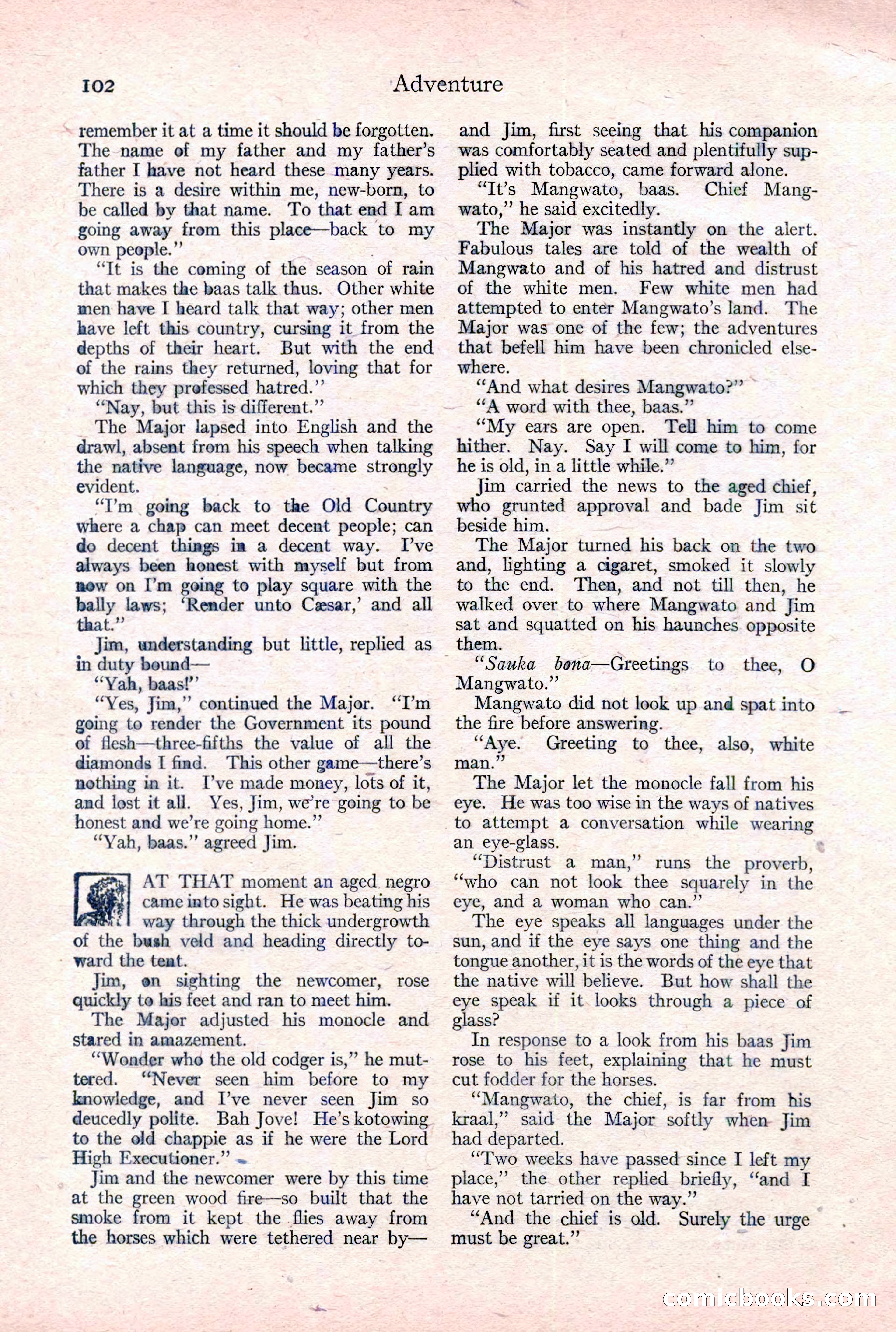
A restored page from Pulp Fiction, 1921. Page through the whole issue in the reader above.
📄 Transcribed text from this page (OCR, searchable)
Machine-transcribed from the original scan — historical spelling and the odd misread are preserved.
102 remember it at a time it should be forgotten. The name of my father and my father’s father I have not heard these many years. There is a desire within me, new-born, to be called by that name. To that end I am going away from this place—back to my own people.” “Tt is the coming of the season of rain that makes the baas talk thus. Other white men have I heard talk that way; other men have left this country, cursing it from the depths of their heart. But with the end of the rains they returned, loving that for which they prefessed hatred.”’ “Nay, but this is different.” The Major lapsed into English and the drawl, absent from his speech when talking the native language, now became strongly evident. “T’m going back to the Old Country where a chap can meet decent people; can do decent things im a decent way. Ive always been honest with myself but from new on I’m going to play square with the bally laws; ‘Remder unto Cesar,’ and all that.” Jim, understanding but little, replied as — in duty bound— “Yah, baas!’’ “Ves, Jim,” continued the Major. “I’m going to render the Government its pound of flesh—three-fifths the value of all the diamonds I find. This other game—there’s nothing in it. I’ve made money, lots of it, and lest it all. Yes, Jim, we're going to be honest and we’re going home.” “Vah, baas.’’ agreed Jim. .| AT THAT moment an aged. negro Fei came into sight. He was beating his <l way through the thick undergrowth of the bush veld and heading directly to- - ward the tent. Jim, on sighting the newcomer, rose quickly to luis feet and ran to meet him. The Major adjusted his monocle and stared in amazement. “Wonder who the old codger is,” he mut- tered. “Never seen him before to my knowledge, and I’ve never seen Jim so deucedly polite. Bah Jove! He’s kotowing to the old chappie as if he were the Lord High Executioner.” = Jim and the newcomer were by this time at the green wood fire—so built that the smoke from it kept the flies away from the horses which were tethered near by— Adventure and Jim, first seeing that his companion was comfortably seated and plentifully sup- plied with tobacco, came forward alone. “It’s Mangwato, baas. Chief Mang- wato,” he said excitedly. The Major was instantly on the alert. Fabulous tales are told of the wealth of Mangwato and of his hatred and distrust of the white men. Few white men had attempted to enter Mangwato’s land. The Major was one of the few; the adventures that befell him have been chronicled else- where. “And what desires Mangwato?” “A word with thee, baas.” “My ears are open. Tell him to come hither. Nay. Say I will come to him, for he is old, in a little while.” Jim carried the news to the aged chief, who grunted approval and bade Jim sit beside him. The Major turned his back on the two and, lighting a cigaret, smoked it slowly to the end. Then, and not till then, he walked over to where Mangwato and Jim sat and squatted on his haunches opposite them. “Sauka bona—Greetings to thee, O Mangwato.”’ Mangwato did not look up and spat into the fire before answering. “Aye. Greeting to thee, also, white man.” The Major let the monocle fall from his eye. He was too wise in the ways of natives to attempt a conversation while wearing an eye-glass. “Distrust a man,’ runs the proverb, ‘who can not look thee squarely in the eye, and a woman who can.”’ The eye speaks all languages under the sun, and if the eye says one thing and the tongue another, it is the words of the eye that the native will believe. But how shall the eye speak if it. looks through a piece of glass? In response to a look from his baas Jim rose to his feet, explaining that he must cut fodder for the horses. “Mangwato, the chief, is far from his kraal,”’ said the Major softly when Jim had departed. “Two weeks have passed since I left my place,” the other replied briefly, “and I have not tarried on the way.” “And the chief is old. Surely the urge must be great.” : CORnNICLOOOkKS (C@