
Pulp Fiction, 1920 · page 95 of 172
Adventure, December 3, 1920 — page 95: what you’re looking at
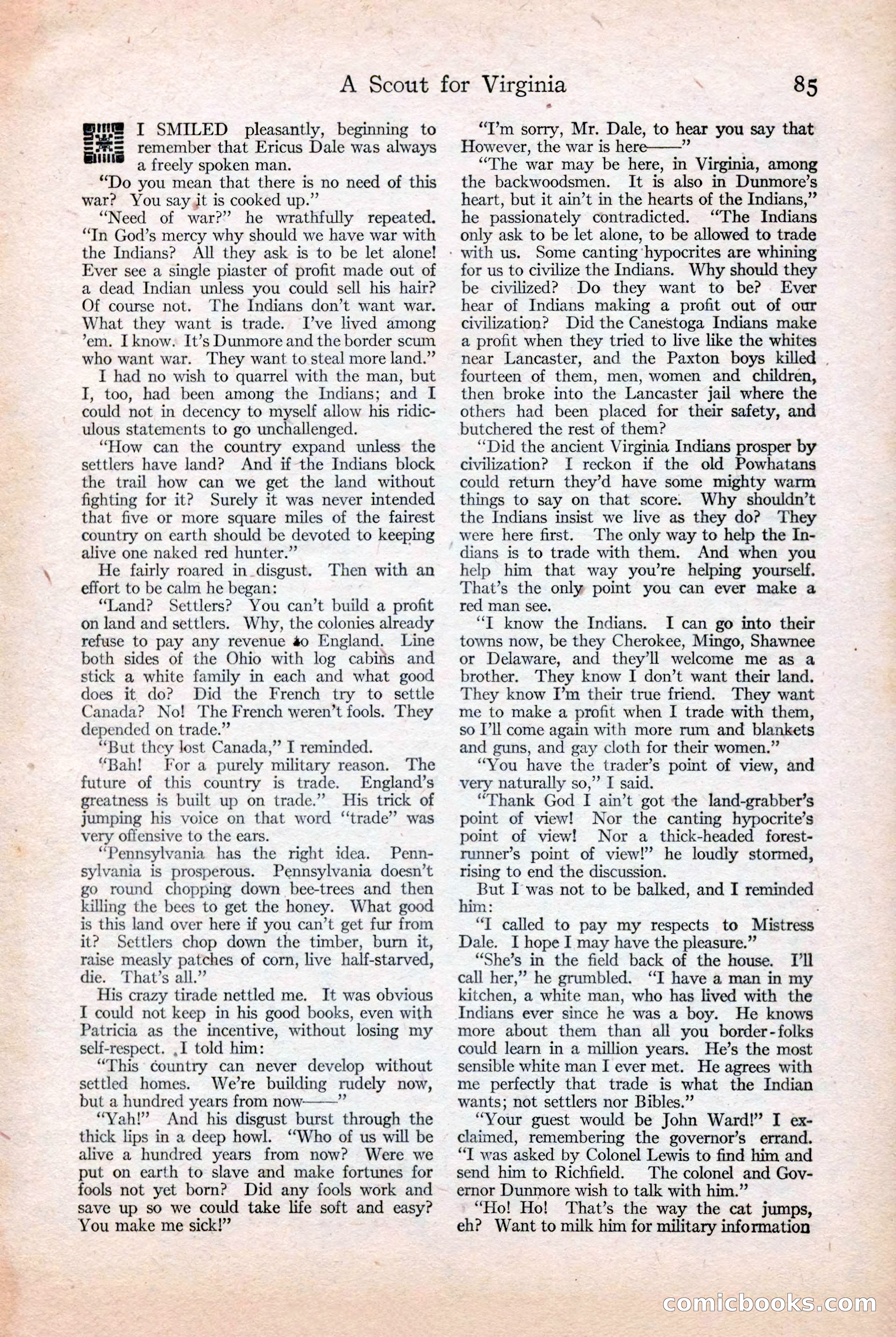
A restored page from Pulp Fiction, 1920. Page through the whole issue in the reader above.
📄 Transcribed text from this page (OCR, searchable)
Machine-transcribed from the original scan — historical spelling and the odd misread are preserved.
A Scout for Virginia =p I SMILED pleasantly, beginning to remember that Ericus Dale was always sis a freely spoken man. “Do you mean that there Is no need of this war? You say jt is cooked up.” “Need of war?” he wrathfully repeated. “Tn God’s mercy why should we have war with the Indians? All they ask is to be let alone! Ever see a single piaster of profit made out of a dead Indian unless you could sell his hair? Of course not. The Indians don’t want war. What they want is trade. I’ve lived among em. I know. It’s Dunmore and the border scum who want war. They want to steal more land.” I had no wish to quarrel with the man, but I, too, had been among the Indians; and I could not in decency to myself allow his ridic- ulous statements to go unchallenged. “How can the country expand unless the settlers have land? And if the Indians block the trail how can we get the land without fighting for it? Surely it was never intended that five or more square miles of the fairest country on earth should be devoted to keeping alive one naked red hunter.” He fairly roared in_ disgust. effort to be calm he began: “Land? Settlers? You can’t build a profit on land and settlers. Why, the colonies already refuse to pay any revenue 40 England. Line both sides of the Ohio with log cabiris and stick a white family in each and what good does it do? Did the French try to settle Canada? No! The French weren’t fools. They depended on trade.” “But they lost Canada,” I reminded. “Bah! For a purely military reason. The future of this country is trade. England’s greatness is built up on trade.” His trick of jumping his voice on that word ‘‘trade” was very offensive to the ears. “Pennsylvania has the mght idea. Penn- sylvania is prosperous. Pennsylvania doesn’t go round chopping down bee-trees and then killing the bees to get the honey. What good is this land over here if you can’t get fur from it? Settlers chop down the timber, burn it, raise measly patches of corn, live half-starved, die. That’s all.” His crazy tirade nettled me. It was obvious I could not keep in his good books, even with Patricia as the incentive, without losing my self-respect. ,I told him: “This country can never develop without settled homes. We’re building rudely now, but a hundred years from now cn “Vah!” And his disgust burst through the thick lips in a deep howl. ‘Who of us will be alive a hundred years from now? Were we put on earth to slave and make fortunes for fools not yet born? Did any fools work and save up so we could take life soft and easy? You make me sick!” Then with an 85 “T’m sorry, Mr. Dale, to hear you say that However, the war is here——” “The war may be here, in Virginia, among the backwoodsmen. It is also in Dunmore’s heart, but it ain’t in the hearts of the Indians,” he passionately contradicted. ‘The Indians only ask to be let alone, to be allowed to trade - with us. Some canting hypocrites are whining for us to civilize the Indians. Why should they be civilized? Do they want to be? Ever hear of Indians making a profit out of our civilization? Did the Canestoga Indians make a profit when they tried to live like the whites near Lancaster, and the Paxton boys killed . fourteen of them, men, women and children, then broke into the Lancaster jail where the others had been placed for their safety, and butchered the rest of them? “Did the ancient Virginia Indians prosper by civilization? I reckon if the old Powhatans could return they’d have some mighty warm things to say on that score. Why shouldn’t the Indians insist we live as they do? They were here first. The only way to help the In- dians is to trade with them. And when you help him that way you’re helping yourself. That’s the only point you can ever make a red man see. “T know the Indians. I can go into their towns now, be they Cherokee, Mingo, Shawnee or Delaware, and they’ll welcome me as a brother. They know I don’t want their land. They know I’m their true friend. They want me to make a profit when I trade with them, so I'll come again with more rum and blankets and guns, and gay cloth for their women.” “You have the trader’s point of view, and very naturally so,” I said. “Thank God I ain’t got the land-grabber’s point of view! Nor the canting hypocrite’s point of view! Nor a thick-headed forest- runner’s point of view!” he loudly stormed, rising to end the discussion. = But I was not to be balked, and I reminded im: Dale. I hope I may have the pleasure.” “She’s in the field back of the house. I'll call her,” he grumbled. “TI have a man in my kitchen, a white man, who has lived with the Indians ever since he was a boy. He knows more about them than all you border-folks could learn in a million years. He’s the most sensible white man I ever met. He agrees with me perfectly that trade is what the Indian wants; not settlers nor Bibles.” “Your guest would be John Ward!” I ex- claimed, remembering the governor’s errand. “T was asked by Colonel Lewis to find him and send him to Richfield. The colonel and Gov- ernor Dunmore wish to talk with him.” “Ho! Ho! That’s the way the cat jumps, eh? Want to milk him for military information COPMICLOOOKS “T called to pay my respects to Mistress (E©)