
Pulp Fiction, 1920 · page 91 of 172
Adventure, December 3, 1920 — page 91: what you’re looking at
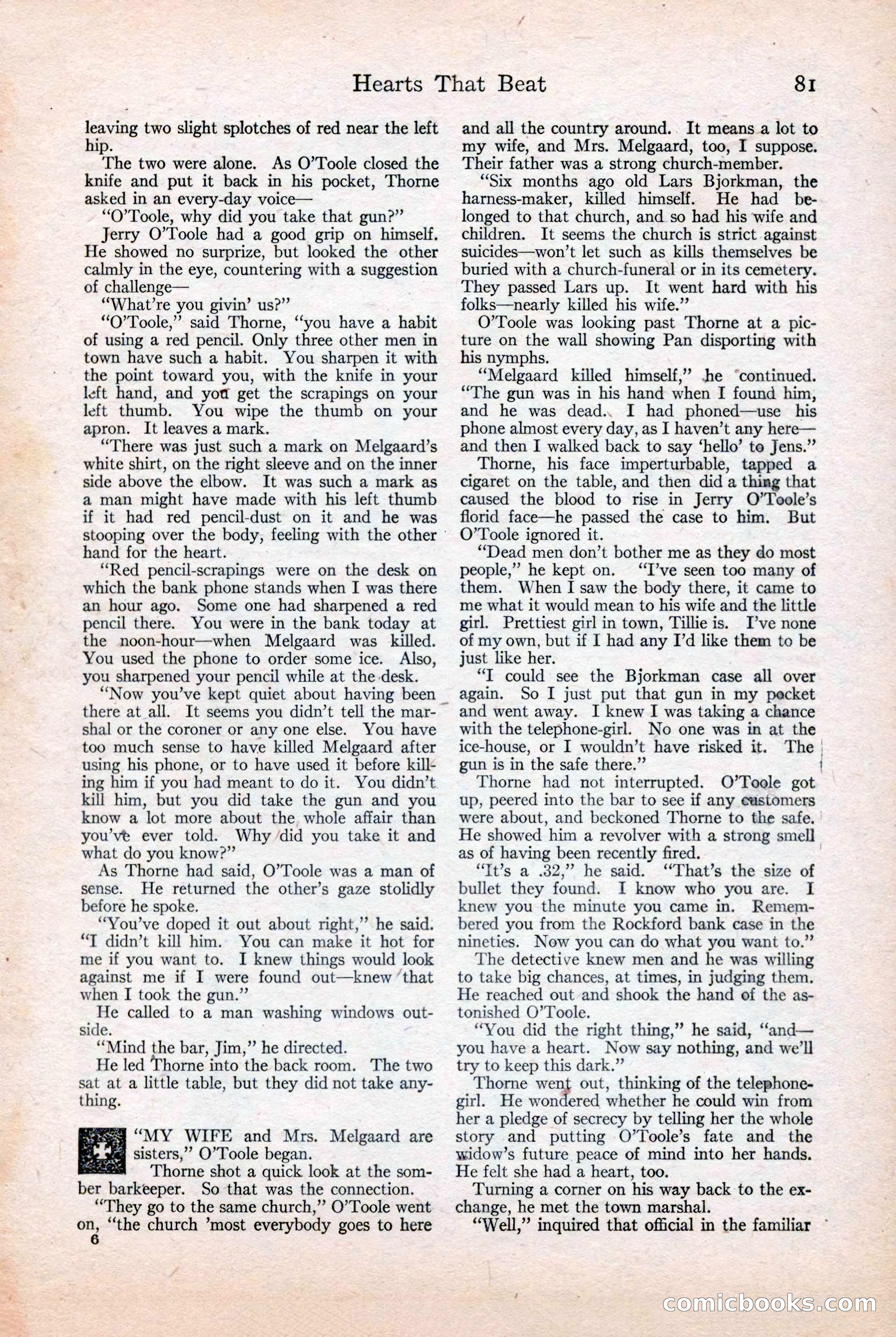
A restored page from Pulp Fiction, 1920. Page through the whole issue in the reader above.
📄 Transcribed text from this page (OCR, searchable)
Machine-transcribed from the original scan — historical spelling and the odd misread are preserved.
Hearts That Beat panes two slight splotches of red near the left ip. The two were alone. As O’Toole closed the knife and put it back in his pocket, Thorne asked in an every-day voice— “O’Toole, why did you take that gun?” Jerry O’Toole had a good grip on himself, He showed no surprize, but looked the other calmly in the eye, countering with a suggestion of challenge— “What’re you givin’ us?” “Q’Toole,” said Thorne, “you have a habit of using a red pencil. Only three other men in town have such a habit. You sharpen it with the point toward you, with the knife in your left hand, and yom get the scrapings on your left thumb. You wipe the thumb on your apron. It leaves a mark. “There was just such a mark on Melgaard’s white shirt, on the right sleeve and on the inner side above the elbow. It was such a mark as a man might have made with his left thumb if it had red pencil-dust on it and he was stooping over the body, feeling with the other — hand for the heart. “Red pencil-scrapings were on the desk on which the bank phone stands when I was there an hour ago. Some one had sharpened a red pencil there. You were in the bank today at the noon-hour—when Melgaard was killed. You used the phone to order some ice. Also, you sharpened your pencil while at the desk. “Now you’ve kept quiet about having been there at all. It seems you didn’t tell the mar- shal or the coroner or any one else. You have too much sense to have killed Melgaard after using his phone, or to have used it before kill- ing him if you had meant to do it. You didn’t kill him, but you did take the gun and you know a lot more about the whole affair than you’vt ever told. Why did you take it and what do you know?” As Thorne had said, O’Toole was a man of sense. He returned the other’s gaze stolidly before he spoke. “You’ve doped it out about right,” he said. “T didn’t kill him. You can make it hot for me if you want to. I knew things would look against me if I were found out—knew ‘that when I took the gun.” He called to a man washing windows out- side. “Mind the bar, Jim,” he directed. He led Thorne into the back room. The two sat at a little table, but they did not take any- thing. Rese ‘MY WIFE and Mrs. Melgaard are SY wag sisters,” O’Toole began. S28 Thorne shot a quick look at the som- ber barkeeper. So that was the connection. “They go to the same church,” O’Toole went = “the church ’most everybody goes to here - SI and all the country around. It means a lot to my wife, and Mrs. Melgaard, too, I suppose. Their father was a strong church-member. “Six months ago old Lars Bjorkman, the harness-maker, killed himself. He had _be- longed to that church, and so had his wife and children. It seems the church is strict against suicides—won’t let such as kills themselves be buried with a church-funeral or in its cemetery. They passed Lars up. It went hard with his folks—nearly killed his wife.” O’Toole was looking past Thorne at a pic- ture on the wall showing Pan disporting with his nymphs. “Melgaard killed himself,” jhe ‘continued. “The gun was in his hand when I found him, and he was dead.. I had phoned—use his phone almost every day, as I haven’t any here— and then I walked back to say ‘hello’ te Jens.” Thorne, his face imperturbable, tapped a cigaret on the table, and then did a thing that caused the blood to rise in Jerry O’Toole’s florid face—he passed the case to him. But O’Toole ignored it. “Dead men don’t bother me as they do most people,” he kept on. “I’ve seen too many of them. When I saw the body there, it came to me what it would mean to his wife and the little girl. Prettiest girl in town, Tillie is. I’ve none of my own, but if I had any I’d like them to be just like her. “T could see the Bjorkman case all over again. So I just put that gun in my pecket and went away. I knew I was taking a chance with the telephone-girl. No one was in at the ice-house, or I wouldn’t have risked it. gun is in the safe there.” Thorne had not interrupted. O’Toole got up, peered into the bar to see if any customers were about, and beckoned Thorne to the safe. He showed him a revolver with a strong smell as of having been recently fired. “It’s a .32,” he said. ‘“That’s the size of bullet they found. I know who you are. I knew you the minute you came in. Remem- bered you from the Rockford bank case in the nineties. Now you can do what you want to.” The detective knew men and he was willing to take big chances, at times, in judging them. He reached out and shook the hand of the as- tonished O’Toole. “You did the right thing,” he said, “and— you have a heart. Now say nothing, and we’ll try to keep this dark.” Thorne weng out, thinking of the telephone- girl. He wondered whether he could win from her a pledge of secrecy by telling her the whole story and putting O’Toole’s fate and the widow’s future peace of mind into her hands. He felt she had a heart, too. Turning a corner on his way back to the ex- change, he met the town marshal. The | { “Well,” inquired that official in the familiar ~ (E(0) OOK (F@)