
Pulp Fiction, 1920 · page 88 of 172
Adventure, December 3, 1920 — page 88: what you’re looking at
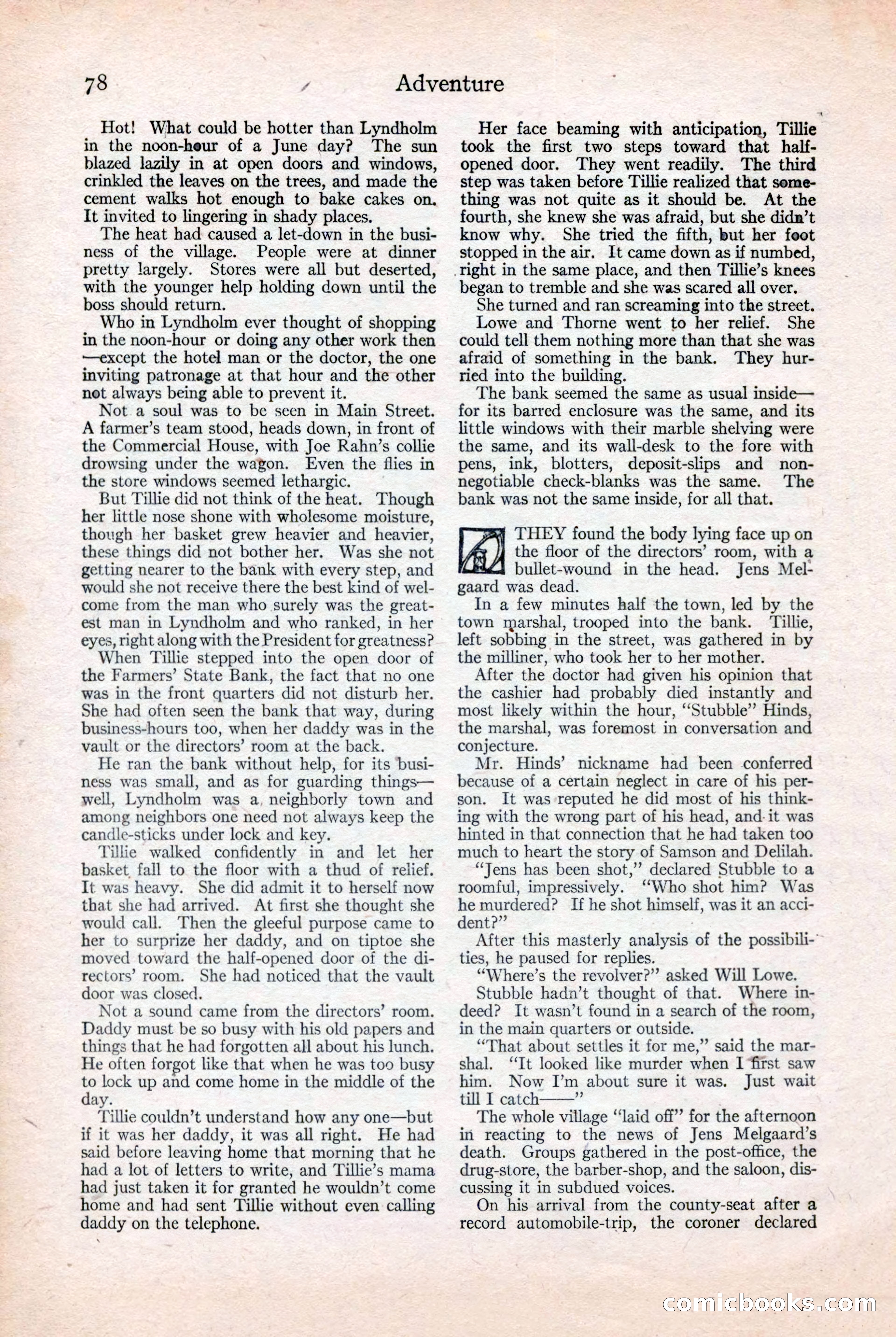
A restored page from Pulp Fiction, 1920. Page through the whole issue in the reader above.
📄 Transcribed text from this page (OCR, searchable)
Machine-transcribed from the original scan — historical spelling and the odd misread are preserved.
78 ; Hot! What could be hotter than Lyndholm in the noon-heur of a June day? The sun blazed lazily in at open doors and windows, crinkled the leaves on the trees, and made the cement walks hot enough to bake cakes on. It invited to lingering in shady places. The heat had caused a let-down in the busi- ness of the village. People were at dinner pretty largely. Stores were all but deserted, with the younger help holding down until the boss should return. Who in Lyndholm ever thought of shopping in the noon-hour or doing any other work then —except the hotel man or the doctor, the one inviting patronage at that hour and the other not always being able to prevent it. Not a soul was to be seen in Main Street. A farmer’s team stood, heads down, in front of the Commercial House, with Joe Rahn’s collie drowsing under the wagon. Even the flies in the store windows seemed lethargic. But Tillie did not think of the heat. Though her little nose shone with wholesome moisture, though her basket grew heavier and heavier, these things did not bother her. Was she not getting nearer to the bank with every step, and would she not receive there the best kind of wel- come from the man who surely was the great- est man in Lyndholm and who ranked, in her eyes, right along with the President for greatness? When Tillie stepped into the open door of the Farmers’ State Bank, the fact that no one was in the front quarters did not disturb her. She had often seen the bank that way, during business-hours too, when her daddy was in the vault or the directors’ room at the back. He ran the bank without help, for its busi- ness was small, and as for guarding things— well, Lyndholm was a, neighborly town and among neighbors one need not always keep the candle-sticks under lock and key. Tillie walked confidently in and let her basket. fall to the floor with a thud of relief. It was heavy. She did admit it to herself now that she had arrived. At first she thought she would call. Then the gleeful purpose came to her to surprize her daddy, and on tiptoe she moved toward the half-opened door of the di- rectors’ room. She had noticed that the vault door was closed. Not a sound came from the directors’ room. Daddy must be so busy with his old papers and things that he had forgotten all about his lunch. He often forgot like that when he was too busy to lock up and come home in the middle of the day. Tilhe couldn’t understand how any one—but if it was her daddy, it was all right. He had said before leaving home that morning that he had a lot of letters to write, and Tillie’s mama had just taken it for granted he wouldn’t come home and had sent Tillie without even calling daddy on the telephone. Adventure Her face beaming with anticipation, Tillie took the first two steps toward that half- opened door. They went readily. The third step was taken before Tillie realized that some- thing was not quite as it should be. At the fourth, she knew she was afraid, but she didn’t know why. She tried the fifth, but her foot stopped in the air. It came down as if numbed, Tight in the same place, and then Tillie’s knees began to tremble and she was scared all over. She turned and ran screaming into the street. Lowe and Thorne went to her relief. She could tell them nothing more than that she was afraid of something in the bank. They hur- ried into the building. The bank seemed the same as usual inside— for its barred enclosure was the same, and its little windows with their marble shelving were the same, and its wall-desk to the fore with pens, ink, blotters, deposit-slips and non- negotiable check-blanks was the same. The bank was not the same inside, for all that. V4 the floor of the directors’ room, with a MEALY bullet-wound in the head. Jens Mel- gaard was dead. In a few minutes half the town, led by the town marshal, trooped into the bank. Tillie, left sobbing in the street, was gathered in by the milliner, who took her to her mother. After the doctor had given his opinion that the cashier had probably died instantly and most likely within the hour, ‘Stubble’ Hinds, the marshal, was foremost in conversation and conjecture. Mr. Hinds’ nickname had been conferred because of a certain neglect in care of his per- son. It was reputed he did most of his think- ing with the wrong part of his head, and-it was hinted in that connection that he had taken too much to heart the story of Samson and Delilah. ‘Jens has been shot,’’ declared Stubble to a roomful, impressively. ‘Who shot him? Was he murdered? If he shot himself, was it an acci- dent?” THEY found the body lying face up on After this masterly analysis of the possibili-’ ties, he paused for replies. “Where’s the revolver?” asked Will Lowe. Stubble hadn’t thought of that. Where in- deed? It wasn’t found in a search of the room, in the main quarters or outside. “That about settles it for me,” said the mar- shal. “It looked like murder when I first saw him. Now I’m about sure it was. Just wait till I catch——”’ The whole village “‘laid off’’ for the afternoon in reacting to the news of Jens Melgaard’s death. Groups gathered in the post-office, the drug-store, the barber-shop, and the saloon, dis- cussing it in subdued voices. On his arrival from the county-seat after a record automobile-trip, the coroner declared COMME OOOKS (C@)