
Pulp Fiction, 1920 · page 83 of 172
Adventure, December 3, 1920 — page 83: what you’re looking at
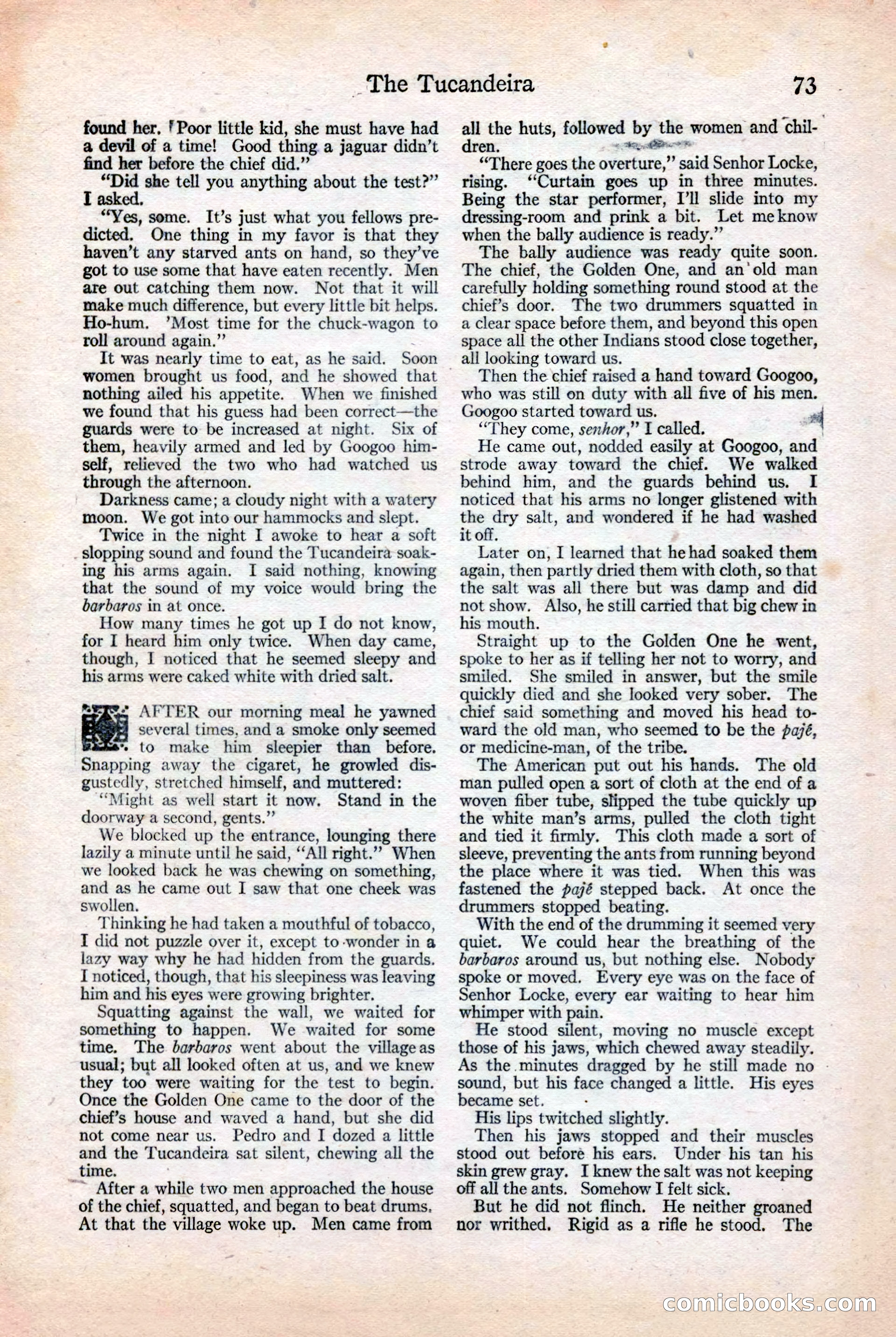
A restored page from Pulp Fiction, 1920. Page through the whole issue in the reader above.
📄 Transcribed text from this page (OCR, searchable)
Machine-transcribed from the original scan — historical spelling and the odd misread are preserved.
_ The Tucandeira found her, ' Poor little kid, she must have had a devil of a time! Good thing a jaguar didn’t find her before the chief did.” “Did she tell you anything about the test?” I asked. “Yes, some. It’s just what you fellows pre- dicted. One thing in my favor is that they haven’t any starved ants on hand, so they’ve got to use some that have eaten recently. Men are out catching them now. Not that it will make much difference, but every little bit helps. Ho-hum. ’Most time for the chuck-wagon to roll around again.” It was nearly time to eat, as he said. Soon women brought us food, and he showed that © nothing ailed his appetite. When we finished we found that his guess had been correct—the guards were to be increased at night. Six of them, heavily armed and led by Googoo him- self, relieved the two who had watched us through the afternoon. Darkness came; a cloudy night with a watery moon. We got into our hammocks and slept. Twice in the night I awoke to hear a soft . slopping sound and found the Tucandeira soak- ing his arms again, I said nothing, knowing that the sound of my voice would bring the barbaros in at once. How many times he got up I do not know, for I heard him only twice. When day came, though, I noticed that he seemed sleepy and his arms were caked white with dried salt. 9 oa Boe several times, and a smoke only seemed * to make him sleepier than before. Snapping away the cigaret, he growled dis- gustedly, stretched himself, and muttered: “Might as well start it now. Stand in the doorway a second, gents.” We blocked up the entrance, lounging there lazily a minute until he said, ‘‘All right.”” When we looked back he was chewing on something, and as he came out I saw that one cheek was swollen. Thinking he had taken a mouthful of tobacco, I did not puzzle over it, except to-wonder in a lazy way why he had hidden from the guards. I noticed, though, that his sleepiness was leaving him and his eyes were growing brighter. Squatting against the wall, we waited for something to happen. We waited for some time. The barbaros went about the village as usual; but all looked often at us, and we knew they too. were waiting for the test to begin. Once the Golden One came to the door of the chief’s house and waved a hand, but she did not come near us. Pedro and I dozed a little and the Tucandeira sat silent, chewing all the time. ~~ After a while two men approached the house of the chief, squatted, and began to beat drums, At that the village woke up. Men came from AFTER our morning meal he yawned 73 all the huts, followed by the women and chil- dren. a il “There goes the overture,” said Senhor Locke, rising. “Curtain goes up in three minutes. Being the star performer, I'll slide into my dressing-room and prink a bit. Let me know when the bally audience is ready.” The bally audience was ready quite soon. The chief, the Golden One, and an‘old man carefully holding something round stood at the chief’s door. The two drummers squatted in a clear space before them, and beyond this open space all the other Indians stood close together, all looking toward us. Then the chief raised a hand toward Googoo, who was still on duty with all five of his men. Googoo started toward us. re “They come, senhor,”’ I called. 4 He came out, nodded easily at Googoo, and strode away toward the chief. We walked behind him, and the guards behind us. I noticed that his arms no longer glistened with — salt, and wondered if he had washed it off. Later on, I learned that he had soaked them again, then partly dried them with cloth, so that the salt was all there but was damp and did not show. Also, he still carried that big chew in his mouth. Straight up to the Golden One he went, spoke to her as if telling her not to worry, an smiled. She smiled in answer, but the smile quickly died and she looked very sober. The chief said something and moved his head to- ward the old man, who seemed to be the pajé, or medicine-man, of the tribe. The American put out his hands. The old man pulled open a sort of cloth at the end of a woven fiber tube, slipped the tube quickly up the white man’s arms, pulled the cloth tight and tied it firmly. This cloth made a sort of sleeve, preventing the ants from running beyond the place where it was tied. When this was fastened the pajé stepped back. At once the drummers stopped beating. With the end of the drumming it seemed very quiet. We could hear the breathing of the barbaros around us, but nothing else. Nobody spoke or moved. Every eye was on the face of Senhor Locke, every ear waiting to hear him whimper with pain. He stood silent, moving no muscle except those of his jaws, which chewed away steadily. As the minutes dragged by he still made no - sound, but his face changed a little. His eyes became set. His lips twitched slightly. Then his jaws stopped and their muscles stood out before his ears. Under his tan his skin grew gray. I knew the salt was not keeping off all the ants. Somehow I felt sick. But he did not flinch. He neither groaned nor writhed. Rigid as a rifle he stood. The Gomichbooks (C@