
Pulp Fiction, 1920 · page 76 of 172
Adventure, December 3, 1920 — page 76: what you’re looking at
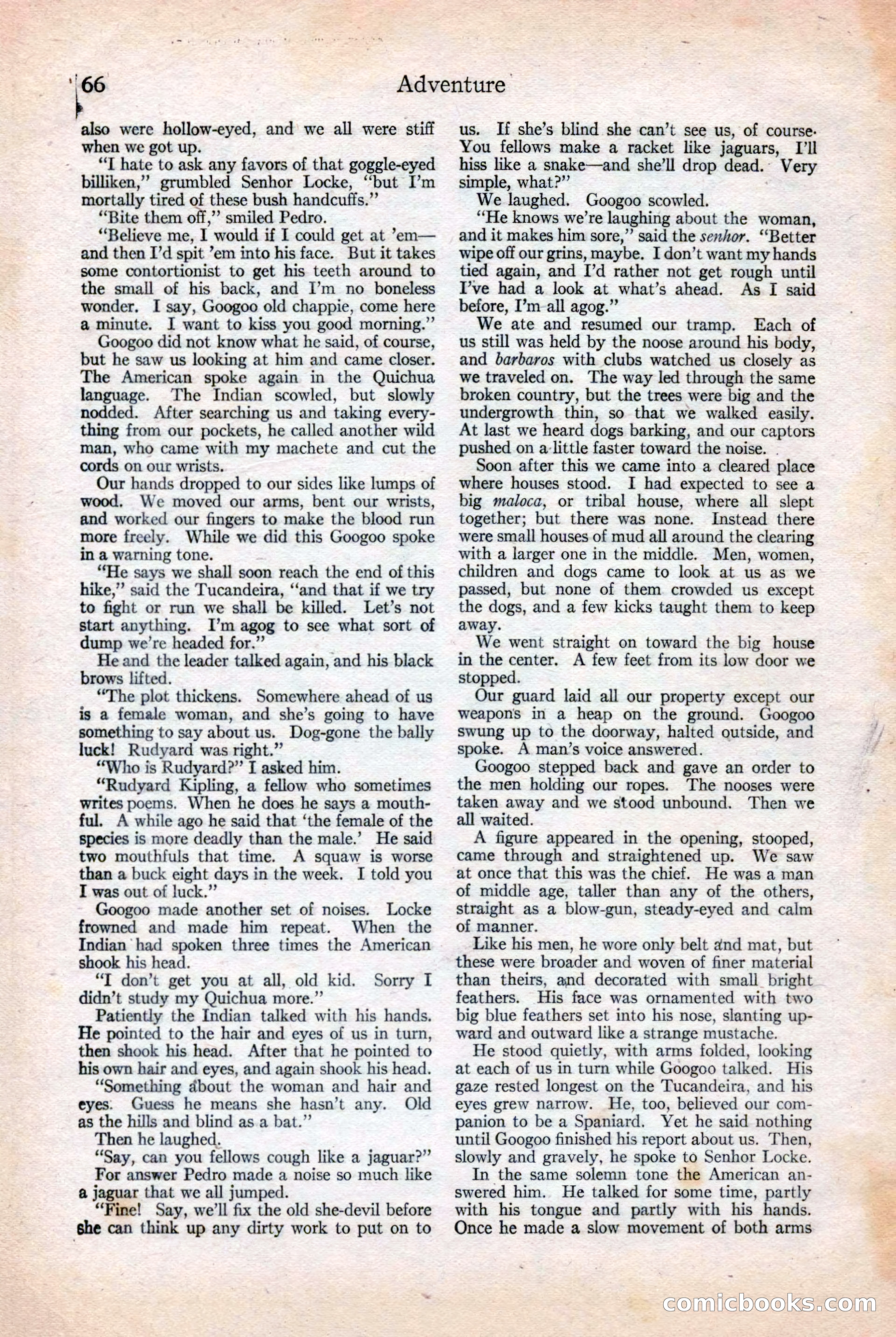
A restored page from Pulp Fiction, 1920. Page through the whole issue in the reader above.
📄 Transcribed text from this page (OCR, searchable)
Machine-transcribed from the original scan — historical spelling and the odd misread are preserved.
also were hollow-eyed, and we all were stiff when we got up. - ““T hate to ask any favors of that goggle-eyed billiken,’”’ grumbled Senhor Locke, “‘but I’m mortally tired of these bush handcuffs.” “Bite them off,” smiled Pedro. “Believe me, I would if I could get at ’em— and then I’d spit ’em into his face. But it takes some contortionist to get his teeth around to the small of his back, and I’m no boneless wonder. I say, Googoo old chappie, come here a minute. I want to kiss you good morning.” Googoo did not know what he said, of course, but he saw us looking at him and came closer. The American spoke again in the Quichua language. The Indian scowled, but slowly nodded. After searching us and taking every- thing from our pockets, he called another wild man, who came with my machete and cut the cords on our wrists. Our hands dropped to our sides like lumps of wood. We moved our arms, bent our wrists, and worked our fingers to make the blood run more freely. While we did this Googoo spoke in a warning tone. “He says we shall soon reach the end of this hike,” said the Tucandeira, ‘‘and that if we try to fight or run we shall be killed. Let’s not start anything. I’m agog to see what sort of dump we’re headed for.” He and the leader talked again, and his black brows lifted. “The plot thickens. Somewhere ahead of us is a female woman, and she’s going to have something to say about us. Dog-gone the bally luck! Rudyard was right.” “Who is Rudyard?” I asked him. “Rudyard Kipling, a fellow who sometimes writes poems. When he does he says a mouth- ful. A while ago he said that ‘the female of the Species is more deadly than the male.’ He said two mouthfuls that time. A squaw is worse than a buck eight days in the week. I told you I was out of luck.” Googoo made another set of noises. Locke frowned and made him repeat. When the Indian had spoken three times the American shook his head. “T don’t get you at all, old kid. Sorry I didn’t study my Quichua more.” Patiently the Indian talked with his hands. He pointed to the hair and eyes of us in turn, then shook his head. After that he pointed to his own hair and eyes, and again shook his head. “Something dbout the woman and hair and eyes. Guess he means she hasn’t any. Old as the hills and blind as a bat.” Then he laughed. “Say, can you fellows cough like a jaguar?” For answer Pedro made a noise so much like a jaguar that we all jumped. “Fine! Say, we’ll fix the old she-devil before ghe can think up any dirty work to put on to Adventure us. If she’s blind she can’t see us, of course. You fellows make a racket like jaguars, I'll hiss like a snake—and she’ll drop dead. Very simple, what?” We laughed. Googoo scowled. “He knows we’re laughing about the woman, and it makes him sore,” said the senhor. “Better wipe off our grins, maybe. I don’t want my hands tied again, and I’d rather not get rough until I’ve had a look at what’s ahead. As I said before, I’m-all agog.” We ate and resumed our tramp. Each of us still was held by the noose around his body, and barbaros with clubs watched us closely as we traveled on. The way led through the same broken country, but the trees were big and the undergrowth thin, so that we walked easily. At last we heard dogs barking, and our captors pushed on alittle faster toward the noise. . Soon after this we came into a cleared place where houses stood. I had expected to see a big maloca, or tribal house, where all slept together; but there was none. Instead there were small houses of mud all around the clearing with a larger one in the middle. Men, women, children and dogs came to look at us as we passed, but none of them crowded us except the dogs, and a few kicks taught them to keep away. We went straight on toward the big house in the center. A few feet from its low door we stopped. Our guard laid all our property except our weapons in a heap on the ground. Googoo swung up to the doorway, halted outside, and spoke. A man’s voice answered. Googoo stepped back and gave an order to the men holding our ropes. The nooses were taken away and we stood unbound. Then we all waited. A figure appeared in the opening, stooped, came through and straightened up. We saw at once that this was the chief. He was a man of middle age, taller than any of the others, straight as a blow-gun, steady-eyed and calm of manner. Like his men, he wore only belt and mat, but these were broader and woven of finer material than theirs, and decorated with small bright feathers. His face was ornamented with two big blue feathers set into his nose, slanting up- ward and outward like a strange mustache. He stood quietly, with arms folded, looking at each of us in turn while Googoo talked. His gaze rested longest on the Tucandeira, and his eyes grew narrow. He, too, believed our com- panion to be a Spaniard. Yet he said nothing until Googoo finished his report about us. Then, slowly and gravely, he spoke to Senhor Locke. In the same solemn tone the American an- swered him. He talked for some time, partly with his tongue and partly with his hands. Once he made a slow movement of both arms COMIC OOOKS (E@)