
Pulp Fiction, 1920 · page 52 of 172
Adventure, December 3, 1920 — page 52: what you’re looking at
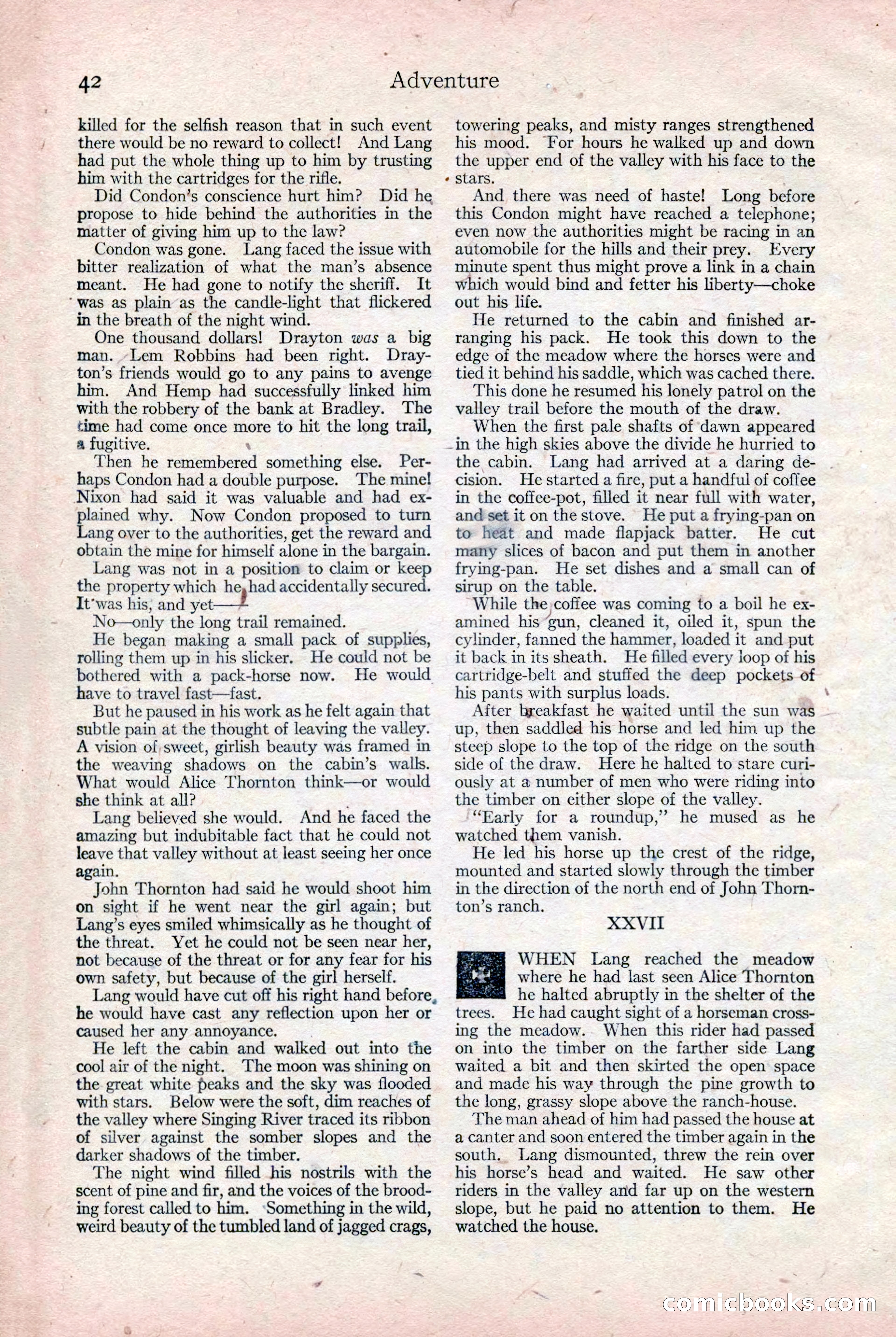
A restored page from Pulp Fiction, 1920. Page through the whole issue in the reader above.
📄 Transcribed text from this page (OCR, searchable)
Machine-transcribed from the original scan — historical spelling and the odd misread are preserved.
42 killed for the selfish reason that in such event there would be no reward to collect! And Lang had put the whole thing up to him by trusting him with the cartridges for the rifle. Did Condon’s conscience hurt him? Did he propose to hide behind the authorities in the matter of giving him up to the law? Condon was gone. Lang faced the issue with bitter realization of what the man’s absence meant. He had gone to notify the sheriff. It “was as plain as the candle-light that flickered in the breath of the night wind. One thousand dollars! Drayton was a big man. -Lem Robbins had been right. Dray- ton’s friends would go to any pains to avenge him. And Hemp had successfully linked him with the robbery of the bank at Bradley. The time had come once more to hit the long trail, a fugitive. ‘ Then he remembered something else. Per- haps Condon had a double purpose. The mine! Nixon had said it was valuable and had ex- plained why. Now Condon proposed to turn Lang over to the authorities, get the reward and obtain the mine for himself alone in the bargain. Lang was not in position to claim or keep the property which he,had accidentally secured. It’was his, and ra No—only the long trail remained. He began making a small pack of supplies, rolling them up in his slicker. He could not be bothered with a pack-horse now. He would have to travel fast—fast. But he paused in his work as he felt again that subtle pain at the thought of leaving the valley. A vision of sweet, girlish beauty was framed in the weaving shadows on the cabin’s walls. What would Alice Thornton think—or would she think at all? Lang believed she would. And he faced the amazing but indubitable fact that he could not leave that valley without at least seeing her once again. John Thornton had said he would shoot him on sight if he went near the girl again; but Lang’s eyes smiled whimsically as he thought of the threat. Yet he could not be seen near her, not because of the threat or for any fear for his own safety, but because of the girl herself. Lang would have cut off his right hand before, he would have cast any reflection upon her or caused her any annoyance. He left the cabin and walked out into the cool air of the night. The moon was shining on the great white peaks and the sky was flooded with stars. Below were the soft, dim reaches of the valley where Singing River traced its ribbon of silver against the somber slopes and the darker shadows of the timber. The night wind filled his nostrils with the scent of pine and fir, and the voices of the brood- ing forest called to him. ‘Something in the wild, weird beauty of the tumbled land of jagged crags, Adventure towering peaks, and misty ranges strengthened his mood. For hours he walked up and down the upper end of the valley with his face to the « stars. And there was need of haste! Long before this Condon might have reached a telephone; even now the authorities might be racing in an automobile for the hills and their prey. Every minute spent thus might prove a link in a chain which would bind and fetter his liberty—choke out his life. He returned to the cabin and finished ar- ranging his pack. He took this down to the edge of the meadow where the horses were and tied it behind his saddle, which was cached there. This done he resumed his lonely patrol on the valley trail before the mouth of the draw. When the first pale shafts of dawn appeared _in the high skies above the divide he hurried to the cabin. Lang had arrived at a daring de- | cision. He started a fire, put a handful of coffee in the coffee-pot, filled it near full with water, and set it on the stove. He put a frying-pan on to heat and made flapjack batter. He cut many slices of bacon and put them in another frying-pan. He set dishes and a small can of sirup on the table. While the coffee was coming to a boil he ex- amined his ‘gun, cleaned it, oiled it, spun the cylinder, fanned the hammer, loaded it and put it back in its sheath. He filled every loop of his cartridge-belt and stuffed the deep pockets of his pants with surplus loads. After breakfast he waited until the sun was up, then saddled his horse and led him up the steep slope to the top of the ridge on the south side of the draw. Here he halted to stare curi- ously at a number of men who were riding into the timber on either slope of the valley. “Early for a roundup,” he mused as he watched them vanish. He led his horse up the crest of the ridge, mounted and started slowly through the timber in the direction of the north end of John Thorn- ton’s ranch. XXVII WHEN Lang reached the meadow where he had last seen Alice Thornton #@—a he halted abruptly in the shelter of the trees. He had caught sight of a horseman cross- ing the meadow. When this rider had passed on into the timber on the farther side Lang waited a bit and then skirted the open space and made his way through the pine growth to the long, grassy slope above the ranch-house. The man ahead of him had passed the house at a canter and soon entered the timber again in the south. Lang dismounted, threw the rein over his horse’s head and waited. He saw other riders in the valley and far up on the western slope, but he paid no attention to them. He watched the house. CORMICLOOOKS (F@)