
Pulp Fiction, 1920 · page 27 of 172
Adventure, December 3, 1920 — page 27: what you’re looking at
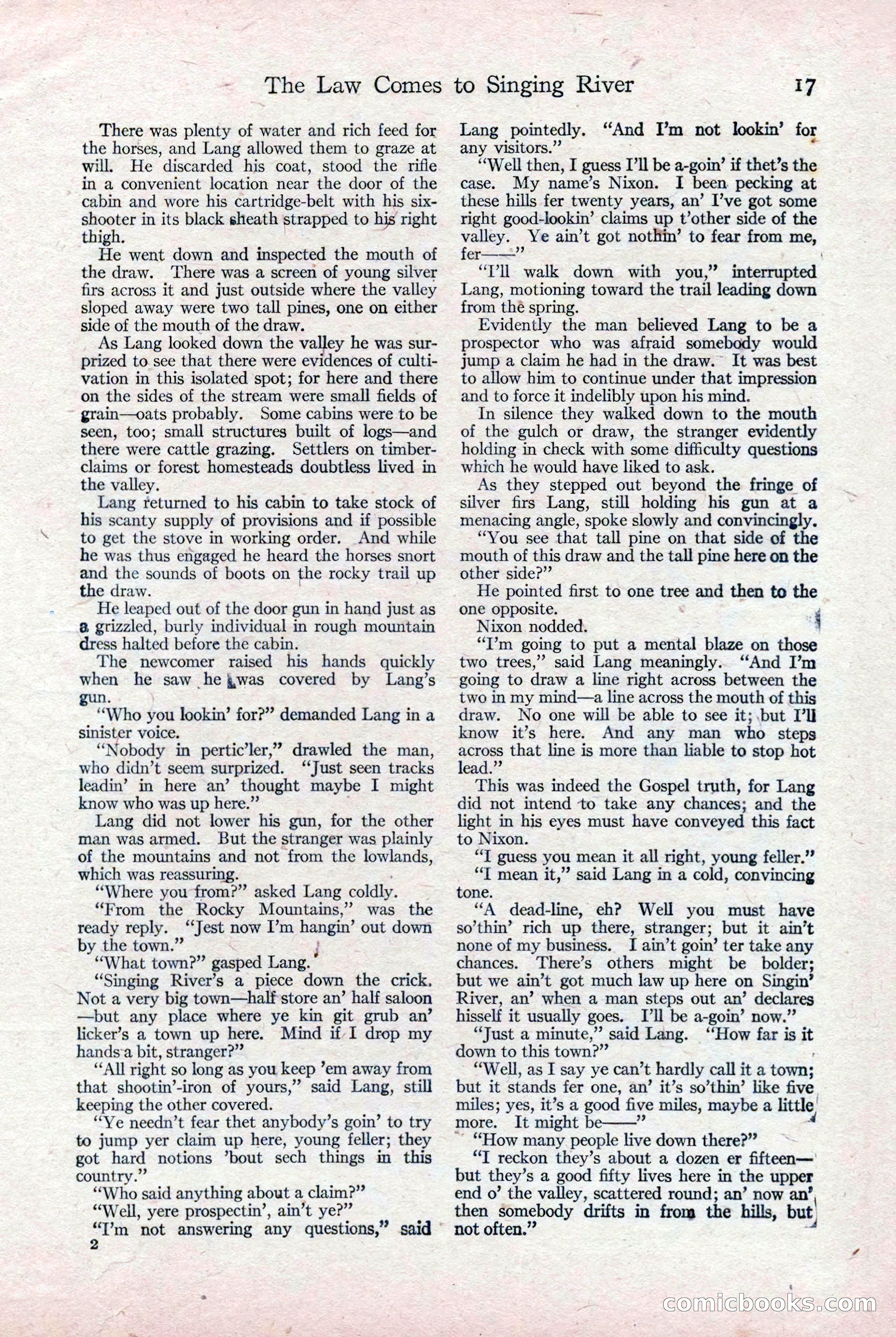
A restored page from Pulp Fiction, 1920. Page through the whole issue in the reader above.
📄 Transcribed text from this page (OCR, searchable)
Machine-transcribed from the original scan — historical spelling and the odd misread are preserved.
The Law Comes to Singing River There was plenty of water and rich feed for the horses, and Lang allowed them to graze at will. He discarded his coat, stood the rifle in a convenient location near the door of the cabin and wore his cartridge-belt with his six- — in its black sheath strapped to his right ig He went down and inspected the mouth of the draw. ‘There was a screen of young silver firs across it and just outside where the valley sloped away were two tall pines, one on either side of the mouth of the draw. As Lang looked down the valley he was sur- prized to see that there were evidences of culti- vation in this isolated spot; for here and there on the sides of the stream were small fields of grain—oats probably. Some cabins were to be seen, too; small structures built of logs—and there were cattle grazing. Settlers on timber- claims or forest homesteads doubtless lived in the valley. Lang returned to his cabin to take stock of his scanty supply of provisions and if possible to get the stove in working order. And while he was thus engaged he heard the horses snort and the sounds of boots on the rocky trail up the draw. He leaped out of the door gun in hand just as & grizzled, burly individual in rough mountain dress halted before the cabin. The newcomer raised his hands quickly when he saw he was covered by Lang’s gun. “Who you lookin’ for?” demanded Lang in a sinister voice. “Nobody in pertic’ler,” drawled the man, who didn’t seem surprized. “Just seen tracks leadin’ in here an’ thought maybe I might know who was up here.” Lang did not lower his gun, for the other man was armed. But the stranger was plainly of the mountains and not from the lowlands, which was reassuring. “Where you from?” asked Lang coldly. “From the Rocky Mountains,” was the ready reply. , Jest now I’m re out down by the town.” “What town?” gasped Lang.* “Singing River’s a piece down the crick, Not a very big town—half store an’ half saloon —but any place where ye kin git grub an’ licker’s a town up here. Mind if I drop my hands’a bit, stranger?” “All right so long as you keep * em away from that shootin’-iron of yours,” said Lang, still keeping the other covered. “Ve needn’t fear thet anybody’s goin’ to try to jump yer claim up here, young feller; they got hard notions "bout sech things in this country.” “Who said anything about a claim?” “Well, yere prospectin’, ain’t ye?” “T’m not answering any questions,” said - 2 17 Lang pointedly. “And I’m not lookin’ for any visitors.” “Well then, I guess I’ll be a-goin’ if thet’s the case. My name’s Nixon. I been pecking at these hills fer twenty years, an’ I’ve got some right good-lookin’ claims up t’other side of the ead ve ain’t got nothin’ to fear from me, er “Vll walk down with you,” interrupted Lang, motioning toward the trail leading down from thé spring. Evidently the man believed Lang to be a prospector who was afraid somebody would jump a claim he had in the draw. It was best to allow him to continue under that impression and to force it indelibly upon his mind. In silence they walked down to the mouth of the gulch or draw, the stranger evidently holding in check with some difficulty questions which he would have liked to ask. As they stepped out beyond the fringe of silver firs Lang, still holding his gun at a menacing angle, spoke slowly and convincingly. “Vou see that tall pine on that side of the mouth of this draw and the tall pine here on the other side?” He pointed first to one tree and then to the one opposite. : Nixon nodded. i “Pm going to put a mental blaze on those two trees,” said Lang meaningly. “And I’m going to draw a line right across between the two in my mind—a line across the mouth of this draw. No one will be able to see it; but I’lj know it’s here. And any man who steps ages that line is more than liable to stop hot ead. This was indeed the Gospel truth, for Lang did not intend to take any chances; and the light in his eyes must have conveyed this fact to Nixon. “TY guess you mean it all right, young feller.” “T mean it,” said Lang in a cold, convincing tone. “A dead-line, eh? Well you must have so’thin’ rich up there, stranger; but it ain’t none of my business. I ain’t goin’ ter take any chances. There’s others might be_ bolder; but we ain’t got much law up here on Singin’ River, an’ when a man steps out an’ declares hisself it usually goes. Tl be a-goin’ now.” “Just a minute,” said Lang. “How far is it down to this town?” “Well, as I say ye can’t hardly call it a town; but it stands fer one, an’ it’s so’thin’ like five miles; yes, it’s a good five miles, maybe a little more. It might be——” - “How many people live down there?” “T reckon they’s about a dozen er fifteen— but they’ s a good fifty lives here in the upper end o’ the valley, scattered round; an’ now an’ then somebody drifts in from the hills, but, not often.” COmMiICLOoks (C©