
Pulp Fiction, 1920 · page 168 of 172
Adventure, December 3, 1920 — page 168: what you’re looking at
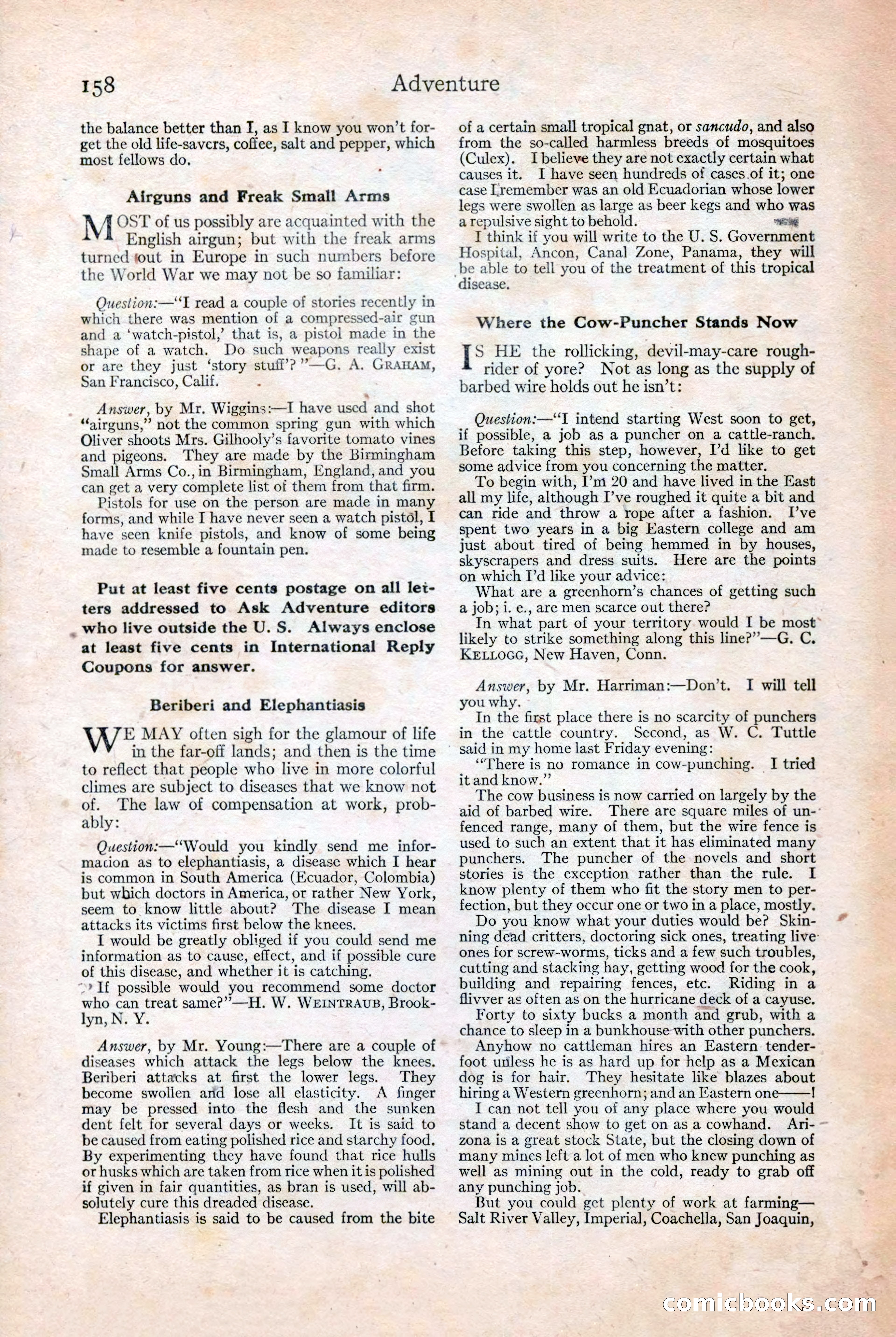
A restored page from Pulp Fiction, 1920. Page through the whole issue in the reader above.
📄 Transcribed text from this page (OCR, searchable)
Machine-transcribed from the original scan — historical spelling and the odd misread are preserved.
158 the balance better than I, as I know you won’t for- get the old life-savers, coffee, salt and pepper, which most fellows do. Airguns and Freak Small Arms M OST of us possibly are acquainted with the English airgun; but with the freak arms turned ut in Europe in such numbers before the World War we may not be so familiar: Question: —“T read a couple of stories recently in which there was mention of a compressed-air gun and a ‘watch-pistol,’ that is, a pistol made in the shape of a watch. Do such weapons really exist or are they just ‘story stuff’? ’—G. A. GRAHAM, San Francisco, Calif. f Answer, by Mr. Wiggins:—I have used and shot “airguns,” not the common spring gun with which Oliver shoots Mrs. Gilhooly’s favorite tomato vines and pigeons. They are made by the Birmingham Small Arms Co.,in Birmingham, England, and you can get a very complete list of them from that firm. Pistols for use on the person are made in many forms, and while I have never seen a watch pistol, I have seen knife pistols, and know of some being made to resemble a fountain pen. Put at least five cents postage on all lei- ters addressed to Ask Adventure editors who live outside the U.S. Always enclose at least five cents in International Reply Coupons for answer. Beriberi and Elephantiasis WE MAY often sigh for the glamour of life in the far-off lands; and then is the time to reflect that people who live in more colorful climes are subject to diseases that we know not of. The law of compensation at work, prob- ably: Question: —““Would you kindly send me infor- macion as to elephantiasis, a disease which I hear is common in South America (Ecuador, Colombia) but which doctors in America, or rather New York, seem to know little about? The disease I mean attacks its victims first below the knees. I would be greatly obliged if you could send me information as to cause, effect, and if possible cure of this disease, and whether it is catching. ~» If possible would you recommend some doctor who can treat same?” —H. W. WEINTRAUB, Brook- lyn, N. Y. Answer, by Mr. Young:—There are a couple of diseases which attack the legs below the knees. Beriberi attacks at first the lower legs. They become swollen arid lose all elasticity. A finger may be pressed into the flesh and the sunken dent felt for several days or weeks. It is said to be caused from eating polished rice and starchy food, By experimenting they have found that rice hulls or husks which are taken from rice when it is polished if given in fair quantities, as bran is used, will ab- solutely cure this dreaded disease. Elephantiasis is said to be caused from the bite Adventure of a certain small tropical gnat, or sancudo, and also from the so-called harmless breeds of mosquitoes (Culex). I believe they are not exactly certain what causes it. I have seen hundreds of cases.of it; one case remember was an old Ecuadorian whose lower legs were swollen as large as beer kegs and who was a repulsive sight to behold. Eg I think if you will write to the U. S$. Government Hospital, Ancon, Canal Zone, Panama, they will be able to tell you of the treatment of this tropical disease. Where the Cow-Puncher Stands Now [IS HE the rollicking, devil-may-care rough- rider of yore? Not as long as the supply of barbed wire holds out he isn’t: Question: —“T intend starting West soon to get, if possible, a job as a puncher on a cattle-ranch. Before taking this step, however, I’d like to get some advice from you concerning the matter. To begin with, I’m 20 and have lived in the East all my life, although I’ve roughed it quite a bit and can ride and throw a rope after a fashion. I’ve spent two years in a big Eastern college and am just about tired of being hemmed in by houses, skyscrapers and dress suits. Here are the points on which I’d like your advice: What are a greenhorn’s chances of getting such a job; i. e., are men scarce out there? In what part of your territory would I be most* likely to strike something along this line?’’—G. C. KELLOGG, New Haven, Conn. Answer, by Mr. Harriman:—Don’t. I will tell you why. In the first place there is no scarcity of punchers in the cattle country. Second, as W. C. Tuttle ' said in my home last Friday evening: “There is no romance in cow-punching. I tried it and know.” The cow business is now carried on largely by the aid of barbed wire. fenced range, many of them, but the wire fence is used to such an extent that it has eliminated many punchers. The puncher of the novels and short stories is the exception rather than the rule. I know plenty of them who fit the story men to per- fection, but they occur one or two in a place, mostly. Do you know what your duties would be? Skin- ning dead critters, doctoring sick ones, treating live’ ones for screw-worms, ticks and a few such troubles, cutting and stacking hay, getting wood for the cook, building and repairing fences, etc. Riding in a flivver as often as on the hurricane deck of a cayuse. Forty to sixty bucks a month and grub, with a chance to sleep in a bunkhouse with other punchers. Anyhow no cattleman hires an Eastern tender- foot unless he is as hard up for help as a Mexican dog is for hair. They hesitate like blazes about hiring a Western greenhorn; and an Eastern one——! I can not tell you of any place where you would There are square miles of un-’ stand a decent show to get on as a cowhand. Ari- ~ zona is a great stock State, but the closing down of many mines left a lot of men who knew punching as well as mining out in the cold, ready to grab off any punching job. But you could get plenty of work at farming— Salt River Valley, Imperial, Coachella, San Joaquin, Gomichboo (E@)