
Pulp Fiction, 1920 · page 157 of 172
Adventure, December 3, 1920 — page 157: what you’re looking at
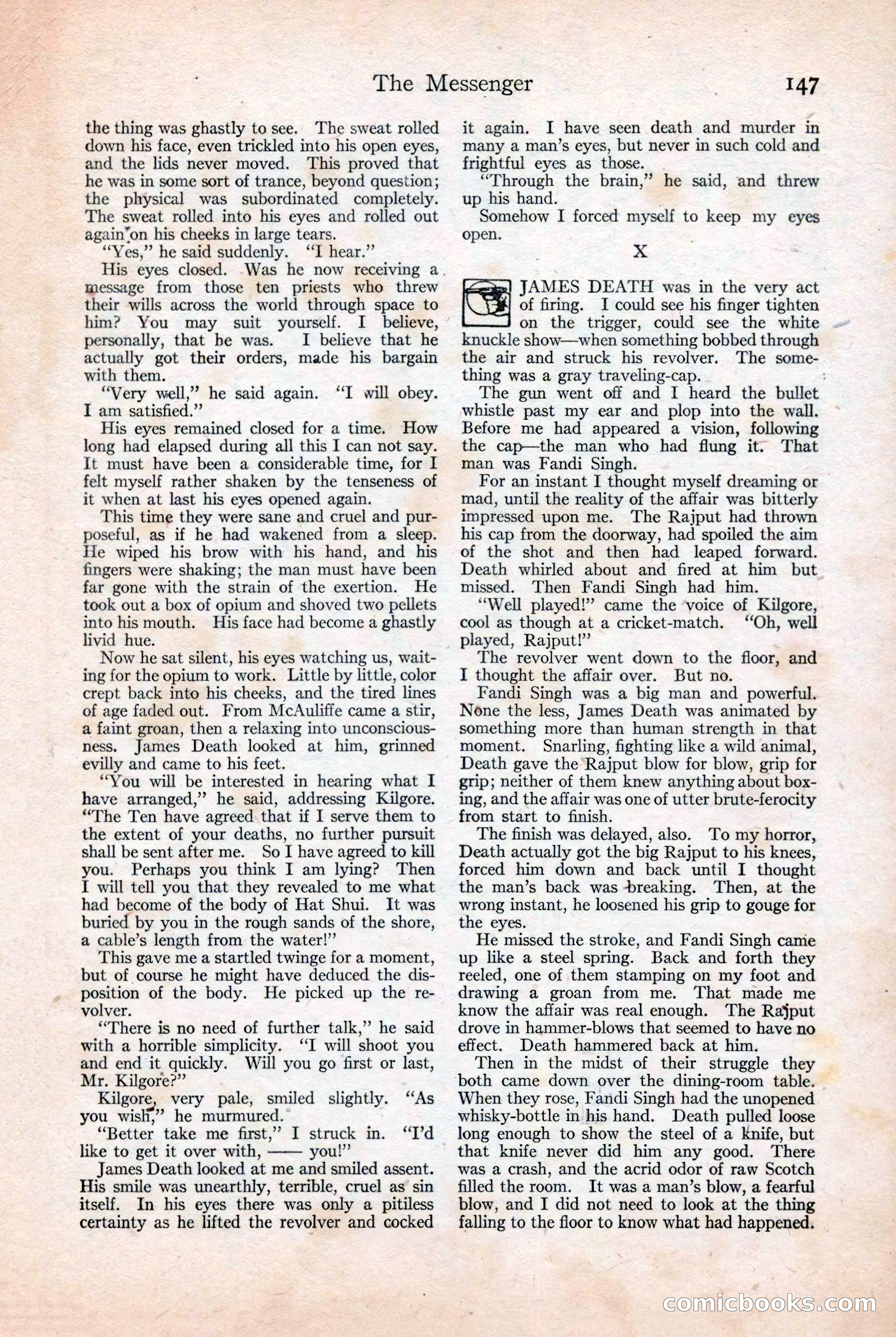
A restored page from Pulp Fiction, 1920. Page through the whole issue in the reader above.
📄 Transcribed text from this page (OCR, searchable)
Machine-transcribed from the original scan — historical spelling and the odd misread are preserved.
The Messenger the thing was ghastly to see. The sweat rolled down his face, even trickled into his open eyes, and the lids never moved. This proved that he was in some sort of trance, beyond question; the physical was subordinated completely. The sweat rolled into his eyes and rolled out againon his cheeks in large tears. “Ves,” he said suddenly. “TI hear.”’ His eyes closed. Was he now receiving a. message from those ten priests who threw their wills across the world through space to him? You may suit yourself. I believe, personally, that be was. I believe that he actually got their orders, made his bargain with them. “Very well,” he said again. I am satisfied.” His eyes remained closed for a time. How long had elapsed during all this I can not say. It must have been a considerable time, for I felt myself rather shaken by the tenseness of it when at last his eyes opened again. This time they were sane and cruel and pur- poseful, as if he had wakened from a sleep. He wiped his brow with his hand, and his fingers were shaking; the man must have been far gone with the strain of the exertion. He took out a box of opium and shoved two pellets into his mouth. His face had become a ghastly livid hue. Now he sat silent, his eyes watching us, wait- ing for the opium to work. Little by little, color crept back into his cheeks, and the tired lines of age faded out. From McAuliffe came a stir, a faint groan, then a relaxing into unconscious- ness. James Death looked at him, grinned evilly and came to his feet. “You will be interested in hearing what I have arranged,” he said, addressing Kilgore. “The Ten have agreed that if I serve them to the extent of your deaths, no further pursuit shall be sent after me. So I have agreed to kill you. Perhaps you think I am lying? Then I will tell you that they revealed to me what had become of the body of Hat Shui. It was buried by you in the rough sands of the shore, a cable’s length from the water!’’ This gave me a startled twinge for a moment, but of course he might have deduced the dis- position of the body. He picked up the re- volver. “There is no need of further talk,” he said with a horrible simplicity. “I will shoot you and end it quickly. Will you go first or last, Mr. Kilgore?” “T will obey. Kilgore, very pale, smiled slightly. “As you wish,” he murmured. “Better take me first,” I struck in. “I’d ?) like to get it over with, —— you James Death looked at me and smiled assent. His smile was unearthly, terrible, cruel as sin itself. In his eyes there was only a pitiless certainty as he lifted the revolver and cocked 147 it again. I have seen death and murder in many a man’s eyes, but never in such cold and frightful eyes as those. “Through the brain,” he said, and threw up his hand. Somehow I forced myself to keep my eyes open. Xx Kare) JAMES DEATH was in the very act \ GH of firing. I could see his finger tighten on the trigger, could see the white knuckle show—when something bobbed through the air and struck his revolver. thing was a gray traveling-cap. The gun went off and I heard the bullet whistle past my ear and plop into the wall. Before me had appeared a vision, following the cap—the man who had flung it. That man was Fandi Singh. For an instant I thought myself dreaming or mad, until the reality of the affair was bitterly impressed upon me. The Rajput had thrown his cap from the doorway, had spoiled the aim of the shot and then had leaped forward. Death whirled about and fired at him but missed. Then Fandi Singh had him, “Well played!” came the ‘voice of Kilgore, cool as though at a cricket-match. “Oh, well played, Rajput!” The revolver went down to the floor, and I thought the affair over. But no. Fandi Singh was a big man and powerful. None the less, James Death was animated by something more than human strength in that moment. Snarling, fighting like a wild animal, Death gave the Rajput blow for blow, grip for grip; neither of them knew anything about box- ing, and the affair was one of utter brute-ferocity from start to finish. The finish was delayed, also. To my horror, Death actually got the big Rajput to his knees, forced him down and back until I thought the man’s back was breaking. Then, at the wrong instant, he loosened his grip to gouge for the eyes. He missed the stroke, and Fandi Singh came up like a steel spring. Back and forth they reeled, one of them stamping on my foot and drawing a groan from me. That made me know the affair was real enough. The Rajput drove in hammer-blows that seemed to have no effect. Death hammered back at him. Then in the midst of their struggle they both came down over the dining-room table. When they rose, Fandi Singh had the unopened whisky-bottle in his hand. Death pulled loose long enough to show the steel of a knife, but that knife never did him any good. There was a crash, and the acrid odor of raw Scotch filled the room. It was a man’s blow, a fearful blow, and I did not need to look at the thing falling to the floor to know what had happened. Gomichbook The some- (C@