
Pulp Fiction, 1920 · page 15 of 172
Adventure, December 3, 1920 — page 15: what you’re looking at
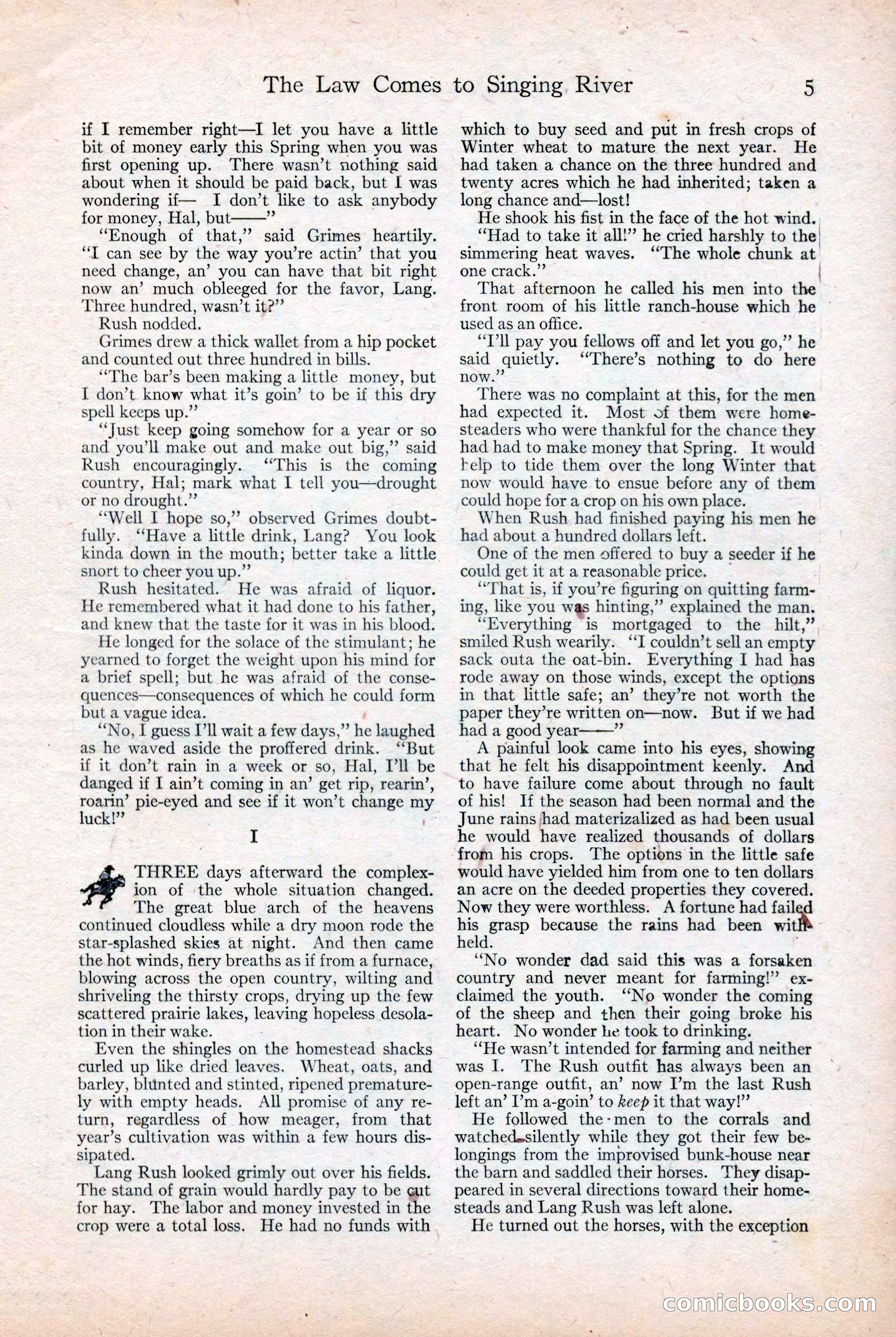
A restored page from Pulp Fiction, 1920. Page through the whole issue in the reader above.
📄 Transcribed text from this page (OCR, searchable)
Machine-transcribed from the original scan — historical spelling and the odd misread are preserved.
The Law Comes to Singing River 5 if I remember right—I let you have a little bit of money early this Spring when you was first opening up. There wasn’t nothing said about when it should be paid back, but I was wondering if— I don’t like to ask anybody for money, Hal, but e “Enough of that,’’ said Grimes heartily. “T can see by the way you’re actin’ that you need change, an’ you can have that bit nght now an’ much obleeged for the favor, Lang. Three hundred, wasn’t it?” Rush nodded. Grimes drew a thick wallet from a hip pocket and counted out three hundred in bills. “The bar’s been making a little money, but I don’t know what it’s goin’ to be if this dry spell keeps up.” ‘Just keep going somehow for a year or so and you’ll make out and make out big,” said Rush encouragingly. “This is the coming country, Hal; mark what I tell you—drought or no drought.” ‘Well I hope so,’’ observed Grimes doubt- fully. ‘Have a little drink, Lang? You look kinda down in the mouth; better take a little snort to cheer you up.” Rush hesitated. He was afraid of liquor. He remembered what it had done to his father, and knew that the taste for it was in his blood. He longed for the solace of the stimulant; he yearned to forget the weight upon his mind for a brief spell; but he was afraid of the conse- quences—consequences of which he could form but a vague idea. “No, I guess I'll wait a few days,” he laughed as he waved aside the proffered drink. “But if it don’t rain in a week or so, Hal, Vil be danged if [ ain’t coming in an’ get rip, rearin’, roarin’ pie-eyed and see if it won’t change my luck!” I yf ion of the whole situation changed. The great blue arch of the heavens continued cloudless while a dry moon rode the star-splashed skies at night. And then came the hot winds, fiery breaths as if from a furnace, blowing across the open country, wilting and shriveling the thirsty crops, drying up the few scattered prairie lakes, coving hopeless desola- tion in their wake. Even the shingles on the homestead shacks curled up like dried leaves. Wheat, oats, and barley, blunted and stinted, ripened premature- ly with empty heads. All promise of any re- turn, regardless of how meager, from that year’s cultivation was within a few hours dis- sipated. Lang Rush looked grimly out over his fields. The stand of grain would hardly pay to be gut for hay. The labor and money invested in the crop were a total loss. He had no funds with THREE days afterward the complex- which to buy seed and put in fresh crops of Winter wheat to mature the next year. He had taken a chance on the three hundred and twenty acres which he had inherited; taken a long chance and—lost! He shook his fist in the face of the hot wind. “Had to take it all!” he cried harshly to the! simmering heat waves. “The whole chunk at. one crack.” That afternoon he called his men into the front room of his little ranch-house which he — used as an office. “ll pay you fellows off and let you go,” he said quietly. ‘‘There’s nothing to do here now.” There was no complaint at this, for the men had expected it. Most of them were home- steaders who were thankful for the chance they had had to make money that Spring. It would telp to tide them over the long Winter that now would have to ensue before any of them could hope for a crop on his own place. When Rush had finished paying his men he had about a hundred dollars leit. One of the men offered to buy a seeder if he could get it ata reasonable price. “That is, if you’re figuring on quitting farm- ing, like you was hinting,’’ explained the man, “Everything is mortgaged to the hilt,” smiled Rush wearily. “‘I couldn’t sell an empty sack outa the oat-bin. Everything I had has rode away on those winds, except the options in that little safe; an’ they’re not worth the paper they’re written on—now. But if we had had a good year A painful look came into his eyes, showing that he felt his disappointment keenly. And to have failure come about through no fault of his! If the season had been normal and the June rains had materizalized as had been usual he would have realized thousands of dollars from his crops. The options in the little safe would have yielded him from one to ten dollars an acre on the deeded properties they covered. Now they were worthless. A fortune had fail his grasp because the rains had been wit held. “No wonder dad said this was a forsaken country and never meant for farming!” ex- claimed the youth. “No wonder the coming of the sheep and then their going broke his heart. No wonder he took to drinking. ‘“‘He wasn’t intended for farming and neither was I. The Rush outfit has always been an open-range outfit, an’ now I’m the last Rush left an’ I’m a-goin’ to keep it that way!’ He followed the-men to the corrals and watchedesilently while they got their few be- longings from the improvised bunk-house near the barn and saddled their horses. They disap- peared in several directions toward their home- steads and Lang Rush was left alone. He turned out the horses, with the exception CORMICLOO© (C@