
Pulp Fiction, 1920 · page 145 of 172
Adventure, December 3, 1920 — page 145: what you’re looking at
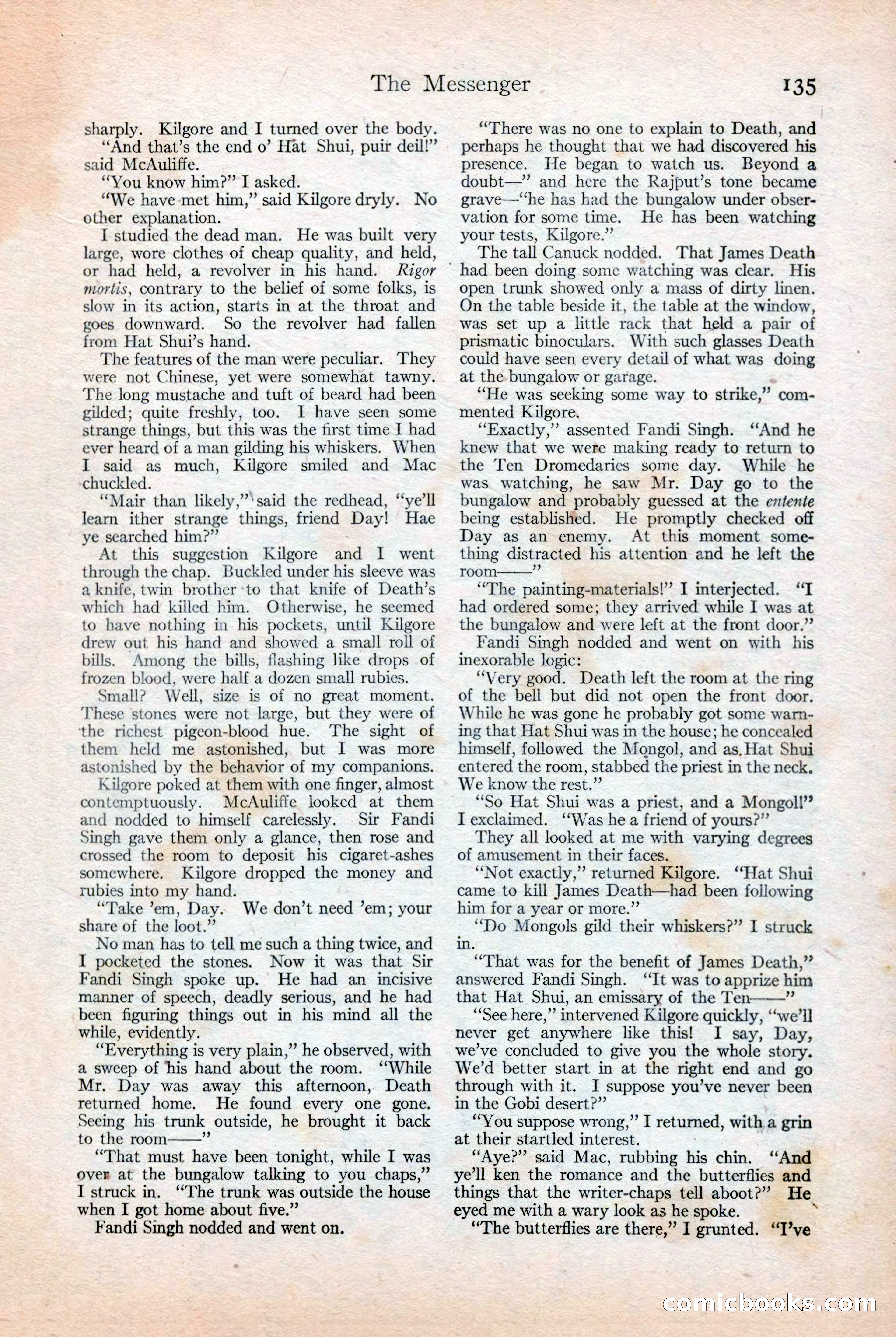
A restored page from Pulp Fiction, 1920. Page through the whole issue in the reader above.
📄 Transcribed text from this page (OCR, searchable)
Machine-transcribed from the original scan — historical spelling and the odd misread are preserved.
The Messenger sharply. Kilgore and I turned over the body. “And that’s the end o’ Hat Shui, puir deil!”’ said McAuliffe. “You know him?” I asked. “We have met him,” said Kilgore dryly. other explanation. I studied the dead man. He was built very large, wore clothes of cheap quality, and held, or had held, a revolver in his hand. kvzgor mortis, contrary to the belief of some folks, is slow in its action, starts in at the throat and goes downward. So the revolver had fallen from Hat Shui’s hand. The features of the man were peculiar. They were not Chinese, yet were somewhat tawny. The long mustache and tuft of beard had been gilded; quite freshly, too. I have seen some strange things, but this was the first time I had ever heard of a man gilding his whiskers. When I said as much, Kilgore smiled and Mac ‘chuckled. “Mair than likely,’’said the redhead, “ye’ll learn ither strange things, friend Day! Hae ye searched him?” At this suggestion Kilgore gad I went through the chap. Buckled under his sleeve was a knife, twin brother to that knife of Death’s which had killed him. Otherwise, he seemed to have nothing in his pockets, until Kilgore drew out his hand and showed a small roll of bills. Among the bills, flashing like drops of frozen blood, were half a dozen small rubies. Small? Well, size is of no great moment. These stones were not large, but they were of the richest pigeon-blood hue. The sight of them held me astonished, but I was more astonished by the behavior of my companions. Kilgore poked at them with one finger, almost contemptuously. McAuliffe looked at them and nodded to himself carelessly. Sir Fandi Singh gave them only a glance, then rose and crossed the room to deposit his cigaret-ashes somewhere. Kilgore dropped the money and rubies into my hand. “Take ’em, Day. We don’t need ’em; your share of the loot.” No man has to tell me such a thing twice, and I pocketed the stones. Now it was that Sir Fandi Singh spoke up. He had an incisive manner of speech, deadly serious, and he had been figuring things out in his mind all the while, evidently. “Everything is very plain,” he observed, with a sweep of his hand about the room. ‘While Mr. Day was away this afternoon, Death returned home. He found every one gone. Seeing his trunk outside, he brought it back to the room——”’ “That must have been tonight, while I was over at the bungalow talking to you chaps,” I struck in. “The trunk was outside the house when I got home about five.” Fandi Singh nodded and went on. No ' had been doing some watching was clear. 135 “There was no one to explain to Death, and perhaps he thought that we had discovered his presence. He began to watch us. Beyond a doubt—” and here the Rajput’s tone became grave—‘‘he has had the bungalow under obser- vation for some time. He has been watching your tests, Kilgore.” The tall Canuck nodded. That James Death His open trunk showed only a mass of dirty linen. On the table beside it, the table at the window, was set up a little rack that held a pair of prismatic binoculars. With such glasses Death could have seen every detail of what was doing at the- bungalow or garage. “He was seeking some way to strike,” mented Kilgore. “Exactly,” assented Fandi Singh. “And he knew that we were making ready to return to the Ten Dromedaries some day. While he was watching, he saw Mr. Day go to the bungalow and probably guessed at the entenie being established. He promptly checked off Day as an enemy. At this moment some- thing distracted his attention and he left the room: “: “The painting-materials!”’ I interjected. “T had ordered some; they arrived while I was at the bungalow and were left at the front door.” Fandi Singh nodded and went on with his inexorable logic: “Very good. Death left the room at the ring of the bell but did not open the front door. While he was gone he probably got some warn- ing that Hat Shui was in the house; he concealed himself, followed the Mongol, and as,Hat Shui entered the room, stabbed the priest in the neck. We know the rest.” “So Hat Shui was a priest, and a Mongoll’? I exclaimed. ‘Was hea friend of yours?” They all looked at me with varying degrees of amusement in their faces. “Not exactly,” returned Kilgore. “Hat Shui came to kill James Death—had been following him for a year or more.’ _ “Do Mongols gild their whiskers?” I struck in com- “That was for the benefit of James Death,” answered Fandi Singh. “It was to apprize him that Hat Shui, an emissary of the Ten ‘See here,” intervened Kilgore quickly, “‘we’ll never get anywhere like this! I say, Day, we’ve concluded to give you the whole story. We'd better start in at the right end and go through with it. I suppose you’ve never been in the Gobi desert?” “You suppose wrong,” I returned, with. a grin at their startled interest. “Aye?” said Mac, rubbing his chin. “And yell ken the romance and the butterflies and things that the writer-chaps tell aboot?” He eyed me with a wary look as he spoke. ~ “The butterflies are there,” I grunted. “T’ve CORMNICLOOOLK (©)