
Pulp Fiction, 1920 · page 120 of 172
Adventure, December 3, 1920 — page 120: what you’re looking at
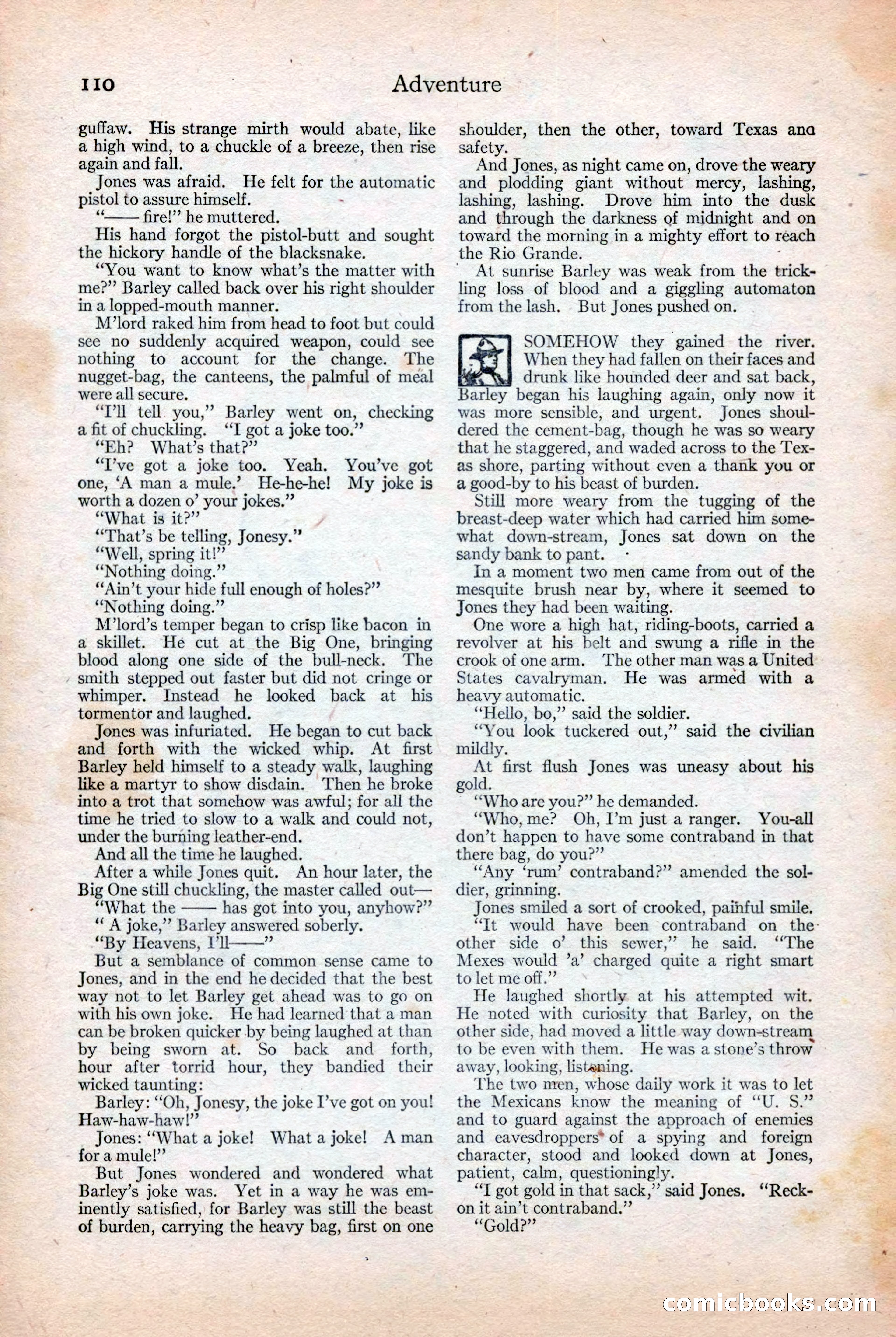
A restored page from Pulp Fiction, 1920. Page through the whole issue in the reader above.
📄 Transcribed text from this page (OCR, searchable)
Machine-transcribed from the original scan — historical spelling and the odd misread are preserved.
IIo guffaw. His strange mirth would abate, like a high wind, to a chuckle of a breeze, then rise again and fall. Jones was afraid. He felt for the automatic pistol to assure himself. —— fire!”’ he muttered. His hand forgot the pistol-butt and sought the hickory handle of the blacksnake. “You want to know what’s the matter with me?” Barley called back over his right shoulder in a lopped-mouth manner. M’lord raked him from head to foot but could see no suddenly acquired weapon, could see nothing to account for the change. The nugget-bag, the canteens, the palmful of meal were all secure. “Tl tell. you,” Barley went on, checking a fit of chuckling. “TI got a joke too.” “Eh? What’s that?” “T’ve got a joke too. Yeah. You’ve got one, ‘A man a mule.’ He-he-he! My joke is worth a dozen 0’ your jokes.” “What is it?” “That’s be telling, Jonesy.” “Well, spring it!” “Nothing doing.” “Ain’t your hide full enough of holes?” “Nothing doing.” M’lord’s temper began to crisp like bacon in a skillet. He cut at the Big One, bringing blood along one side of the bull-neck. The . smith stepped out faster but did not cringe or whimper. Instead he looked back at his tormentor and laughed. Jones was infuriated. He began to cut back and forth with the wicked whip. At first Barley held himself to a steady walk, laughing like a martyr to show disdain. ‘Then he broke into a trot that somehow was awful; for all the time he tried to slow to a walk and could not, under the burning leather-end. And all the time he laughed. After a while Jones quit. An hour later, the Big One still chuckling, the master called out— “What the has got into you, anyhow?” “A joke,” Barley answered soberly. “By Heavens, l’Il/—— But a semblance of common sense came to Jones, and in the end he decided that the best way not to let Barley get ahead was to go on with his own joke. He had learned that a man can be broken quicker by being laughed at than by being sworn at. So back and_ forth, hour after torrid hour, they bandied their wicked taunting: Barley: “Oh, Jonesy, the joke I’ve got on you! Haw-haw-haw!” Jones: “What a joke! for a mule!” But Jones wondered and wondered what Barley’s joke was. Yet in a way he was em- inently satisfied, for Barley was still the beast of burden, carrying the heavy bag, first on one What a joke! A man Adventure shoulder, then the other, toward Texas ana safety. And Jones, as night came on, drove the weary and plodding giant without mercy, lashing, lashing, lashing. Drove him into the dusk and through the darkness of midnight and on toward the morning in a mighty effort to reach the Rio Grande. - At sunrise Barley was weak from the trick- ling loss of blood and a giggling automaton from the lash. But Jones pushed on. SOMEHOW they gained the river. When they had fallen on their faces and drunk like hounded deer and sat back, Barley began his laughing again, only now it was more sensible, and urgent. Jones shoul- dered the cement-bag, though he was so weary that he staggered, and waded across to the Tex- as shore, parting without even a thank you or a good-by to his beast of burden. Still more weary from the tugging of the breast-deep water which had carried him some- what down-stream, Jones sat down on the sandy bank to pant. In a moment two men came from out of the mesquite brush near by, where it seemed to Jones they had been waiting. One wore a high hat, riding-boots, carried a revolver at his belt and swung a rifle in the crook of one arm. ‘The other man was a United States cavalryman. He was armed with a heavy automatic. “Hello, bo,” said the soldier. “You look tuckered out,” said the civilian mildly. At first flush Jones was uneasy about his gold. “Who are your” he demanded. “Who,me? Oh, I’m just a ranger. You-all don’t happen to have some contraband in that there bag, do you?” “Any ‘rum’ contraband?” amended the sol- dier, grinning. Jones smiled a sort of crooked, painful smile. “Tt would have been contraband on the: this sewer,” he said. “The ’a’ charged quite a right smart other side 0’ Mexes would to let me off.” He laughed shortly at his attempted wit. He noted with curiosity that Barley, on the other side, had moved a little way down-stream to be even with them. He was a stone’s throw away, looking, listaning. The two nren, whose daily work it was to let the Mexicans know the meaning of “U. S.” and to guard against the approach of enemies and eavesdroppers* of a spying and foreign character, stood and looked down at Jones, patient, calm, questioningly. “T got gold in that sack,” said Jones. ‘“Reck- on it ain’t contraband.”’ ; “Golde” ; COMMle! Noxol< (eC) A =} fr, iY We haa | . 2 yA ’ a Ge ; nae | Hp P be fh yh '