
Pulp Fiction, 1920 · page 113 of 172
Adventure, December 3, 1920 — page 113: what you’re looking at
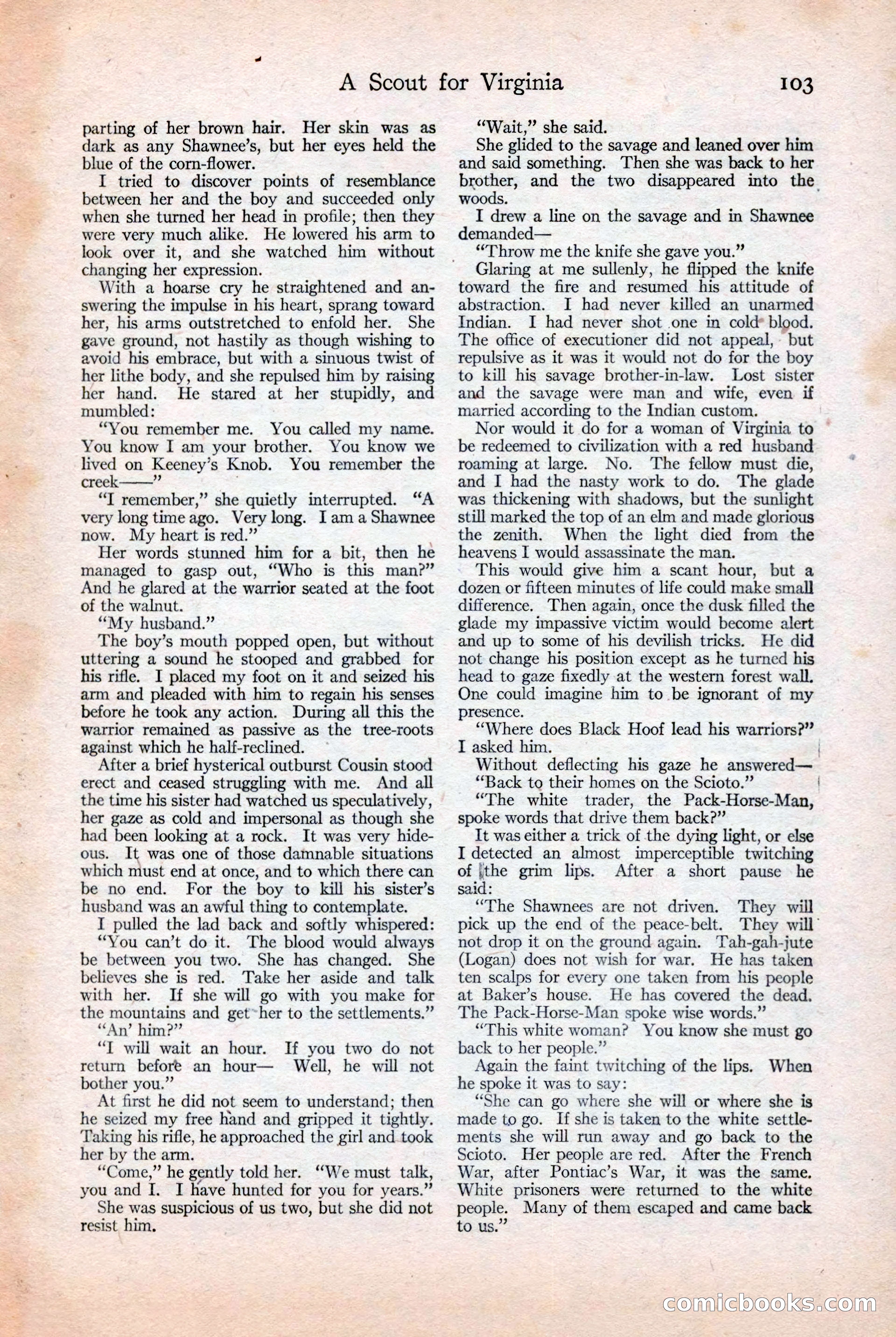
A restored page from Pulp Fiction, 1920. Page through the whole issue in the reader above.
📄 Transcribed text from this page (OCR, searchable)
Machine-transcribed from the original scan — historical spelling and the odd misread are preserved.
A Scout for Virginia parting of her brown hair. Her skin was as dark as any Shawnee’s, but her eyes held the blue of the corn-flower. I tried to discover points of resemblance between her and the boy and succeeded only when she turned her head in profile; then they were very much alike. He lowered his arm to look over it, and she watched him without changing her expression. With a hoarse cry he straightened and an- swering the impulse in his heart, sprang toward her, his arms outstretched to enfold her. She gave ground, not hastily as though wishing to avoid his embrace, but with a sinuous twist of her lithe body, and she repulsed him by raising her hand. He stared at her stupidly, and mumbled: “You remember me. You called my name. You know I am your brother. You know we lived on Keeney’ s Knob. You remember the creek —— “I remember,” she quietly interrupted. “A very long time ago. Very long. I am a Shawnee now. My heart is red.” Her words stunned him for a bit, then he managed to gasp out, “Who is this man?” And he glared at the warrior seated at the foot of the walnut. “My husband.” The boy’s mouth popped open, but without uttering a sound he stooped and grabbed for his rifle. I placed my foot on it and seized his arm and pleaded with him to regain his senses before he took any action. During all this the warrior remained as passive as the tree-roots against which he half-reclined. After a brief hysterical outburst Cousin stood erect and ceased struggling with me. And all the time his sister had watched us speculatively, her gaze as cold and impersonal as though she had been looking at a rock. It was very hide- ous. It was one of those damnable situations which must end at once, and to which there can be no end. For the boy to kill his sister’s husband was an awful thing to contemplate. I pulled the lad back and softly whispered: “You can’t do it. The blood would always be between you two. She has changed. She believes she is red. Take her aside and talk with her. If she will go with you make for the mountains and gether to the settlements.” An’ him?” “T will wait an hour. return before an hour— bother you.” At first he did not seem to understand; then he seized my free hand and gripped it tightly. Taking his rifle, he approached the girl and took her by the arm. “Come,” he gently told her. “We must talk, you and L. I have hunted for you for years.” She was suspicious of us two, but she did not resist him. If you two do not Well, he will not 103 “Wait,” she said. She glided to the savage and leaned over him and said something. Then she was back to her brother, and the two disappeared into the woods. I drew a line on the savage and in Shawnee demanded— ‘Throw me the knife she gave you.” Glaring at me sullenly, he flipped the knife toward the fire and resumed his attitude of abstraction. I had never killed an unarmed Indian. I had never shot .one in cold* blood. The office of executioner did not appeal, but repulsive as it was it would not do for the boy to kill his savage brother-in-law. Lost sister and the savage were man and wife, even if married according to the Indian custom. Nor would it do for a woman of Virginia to — be redeemed to civilization with a red husband roaming at large. No. The fellow must die, and I had the nasty work to do. The glade was thickening with shadows, but the sunlight still marked the top of an elm and made glorious the zenith. When the light died from the heavens I would assassinate the man. This would give him a scant hour, but a dozen or fifteen minutes of life could make small difference. Then again, once the dusk filled the glade my impassive victim would become alert and up to some of his devilish tricks. He did not change his position except as he turned his head to gaze fixedly at the western forest wall. One could imagine him to be ignorant of my presence. “Where does Black Hoof lead his warriors?” I asked him. Without deflecting his gaze he answered— “Back to their homes on the Scioto.” “The white trader, the Pack-Horse-Man, spoke words that drive them back?” It was either a trick of the dying light, or else I detected an almost imperceptible twitching of the grim lips. After a short pause he said: “The Shawnees are not driven. They will pick up the end of the peace-belt. They will not drop it on the ground again. Tah-gah-jute (Logan) does not wish for war. He has taken ten scalps for every one taken from his people at Baker’s house. He has covered the dead. The Pack-Horse-Man spoke wise words.” “This white woman? You know she must go back to her people.” Again the faint twitching of the lips. When he spoke it was to say: “She can go where she will or where she is made to go. If she is taken to the white settle- ments she will run away and go back to the Scioto. Her people are red. After the French War, after Pontiac’s War, it was the same, White prisoners were returned to the white people. Many of them escaped and came back to us. COPMIEOOOKS (F@)