
Pulp Fiction, 1920 · page 97 of 172
Adventure Magazine Cover — page 97: what you’re looking at
A restored page from Pulp Fiction, 1920. Page through the whole issue in the reader above.
📄 Transcribed text from this page (OCR, searchable)
Machine-transcribed from the original scan — historical spelling and the odd misread are preserved.
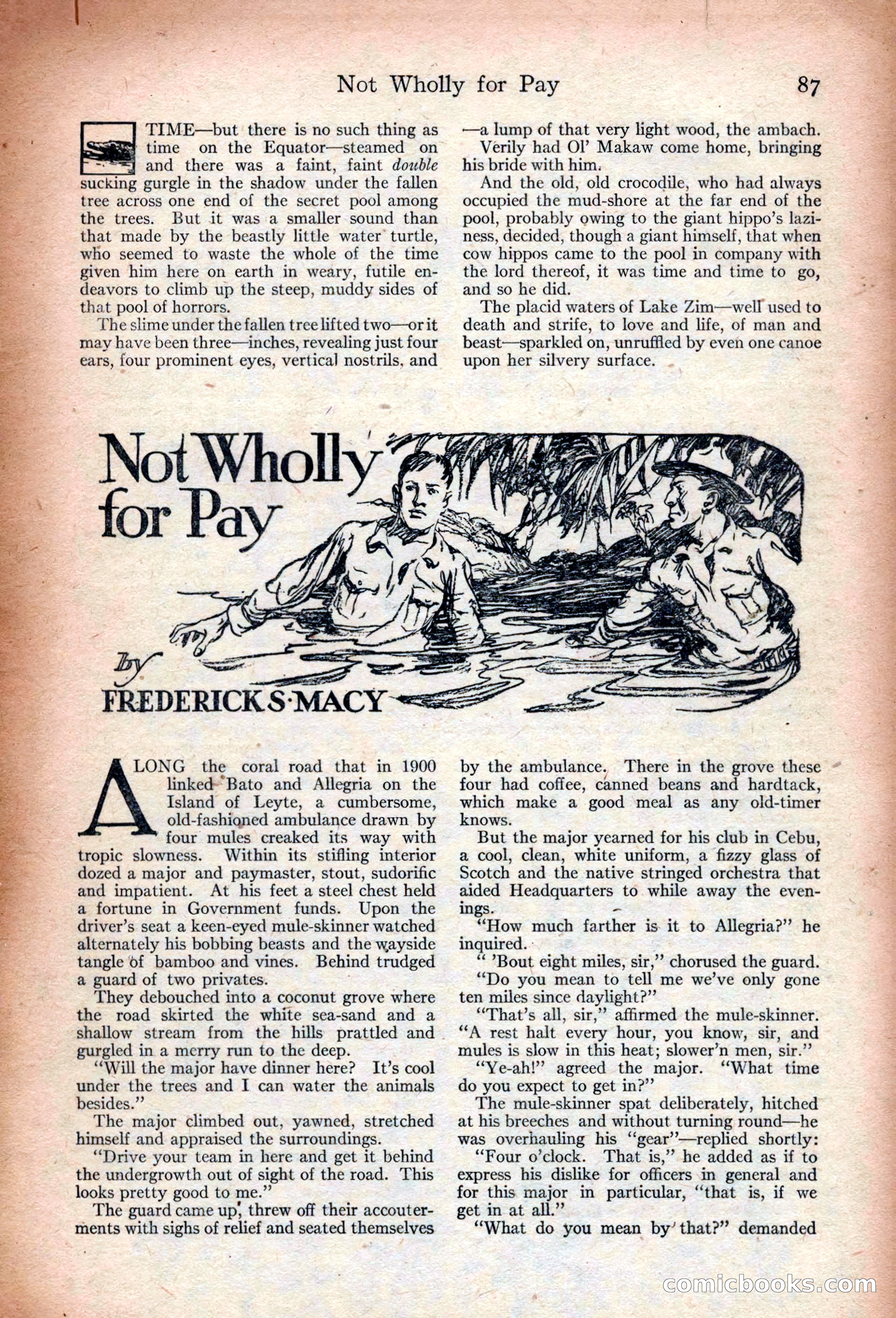
Not Wholly for Pay TIME—but there is no such thing as at time on the Equator—steamed on ashe and there was a faint, faint double sucking gurgle in the shadow under the fallen tree across one end of the secret pool among the trees. But it was a smaller sound than that made by the beastly little water turtle, who seemed to waste the whole of the time given him here on earth in weary, futile en- deavors to climb up the steep, muddy sides of that pool of horrors. The slime under the fallen tree lifted two—or it may have been three—inches, revealing just four ears, four prominent eyes, vertical nostrils, and 87 —a lump of that very light wood, the ambach. Verily had Ol’ Makaw come home, bringing his bride with him. And the old, old crocodile, who had always occupied the mud-shore at the far end of the pool, probably owing to the giant hippo’s lazi- ness, decided, though a giant himself, that when cow hippos came to the pool in company with the lord thereof, it was time and time to go, and so he did. The placid waters of Lake Zim—well used to death and strife, to love and life, of man and beast—sparkled on, unruffled by even one canoe upon her silvery surface. LONG the coral road that in 1900 linked“Bato and Allegria on the Island of Leyte, a cumbersome, old-fashiqgned ambulance drawn by four mules creaked its way with tropic slowness. Within its stifling interior dozed a major and paymaster, stout, sudorific and impatient. At his feet a steel chest held a fortune in Government funds. Upon the driver’s seat a keen-eyed mule-skinner watched alternately his bobbing beasts and the wayside tangle of bamboo and vines. Behind trudged a guard of two privates. They debouched into a coconut grove where the road skirted the white sea-sand and a shallow stream from the hills prattled and - gurgled in a merry run to the deep. “Will the major have dinner here? It’s cool under the trees and I can water the animals besides.” The major climbed out, yawned, stretched himself and appraised the surroundings. “Drive your team in here and get it behind the undergrowth out of sight of the road. This looks pretty good to me.’ The guard came up; threw off their accouter- ments with sighs of relief and seated themselves by the ambulance. There in the grove these four had coffee, canned beans and hardtack, which make a good meal as any old-timer knows. But the major yearned for his club in Cebu, a cool, clean, white uniform, a fizzy glass of Scotch and the native stringed orchestra that aided Headquarters to while away the even- ings. - “How much farther is it to Allegria?”’ he inquired. - “Bout eight miles, sir,’’ chorused the guard. “Do you mean to tell me we’ve only gone ten miles since daylight?” *‘That’s all, sir,” affirmed the mule-skinner. “A rest halt every hour, you know, sir, and mules is slow in this heat; slower’n men, sir.”’ “Ye-ah!’”’ agreed the major. ‘‘What time do you expect to get in?” The mule-skinner spat deliberately, hitched at his breeches and without turning round—he was overhauling his “gear’’—replied shortly: “Four o’clock. That is,’ he added as if to express his dislike for officers in general and for this major in particular, “that is, if we get in at all.” “What do you mean by’ that?” demanded COMMICLOookKs # (C@ Sh ssid eh Leth UB oaths ie “h at vi $yp at. A vy ’ ae hig