
Pulp Fiction, 1920 · page 86 of 172
Adventure Magazine Cover — page 86: what you’re looking at
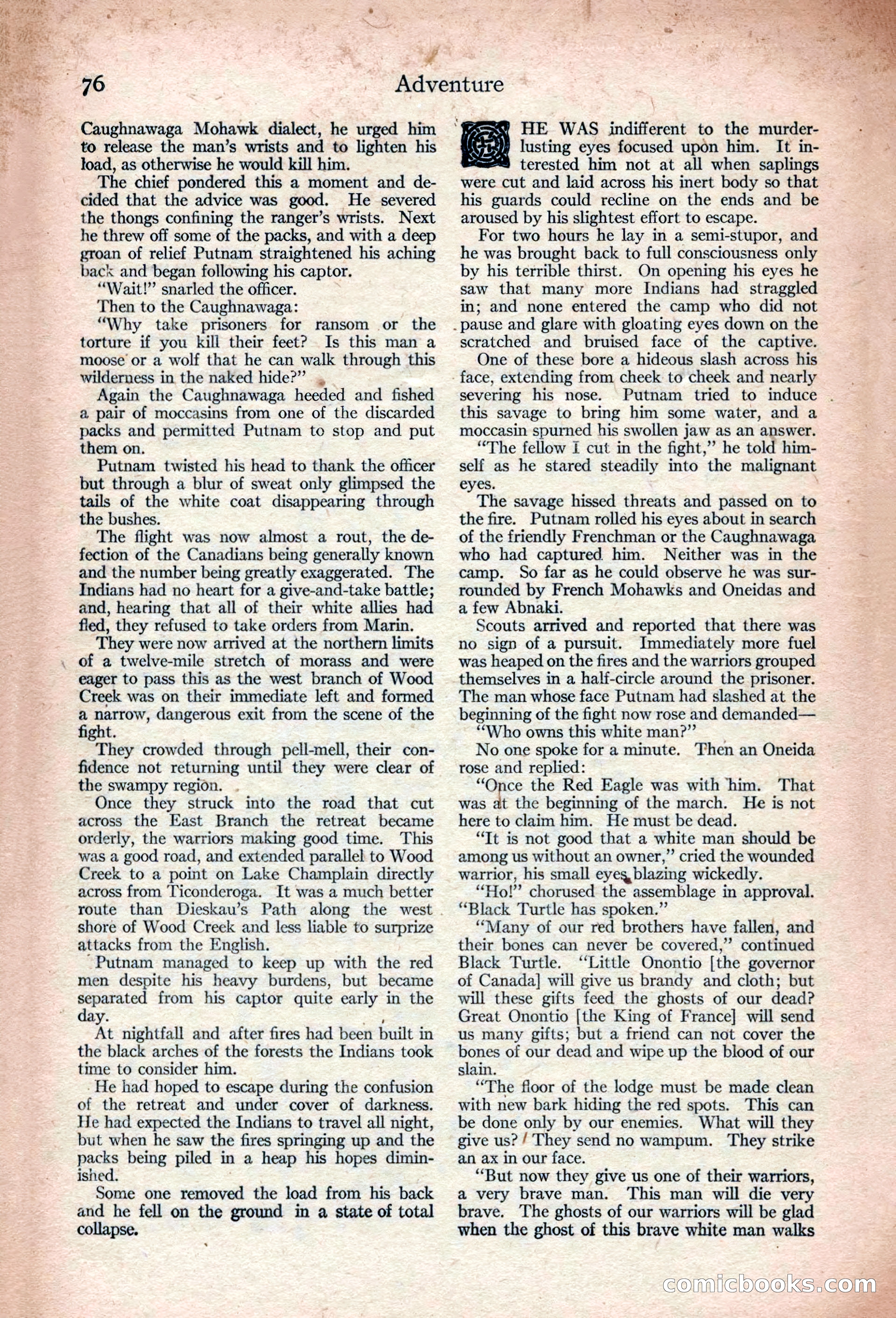
A restored page from Pulp Fiction, 1920. Page through the whole issue in the reader above.
📄 Transcribed text from this page (OCR, searchable)
Machine-transcribed from the original scan — historical spelling and the odd misread are preserved.
: - Caughnawaga Mohawk dialect, he urged him to release the man’s wrists and to lighten his load, as otherwise he would kill him. The chief pondered this a moment and de- cided that the advice was good. He severed the thongs confining the ranger’s wrists. Next he threw off some of the packs, and with a deep groan of relief Putnam straightened his aching back and began following his captor. “Wait!” snarled the officer. Then to the Caughnawaga: “Why take prisoners for ransom or the torture if you kill their feet? Is this man a moose or a wolf that he can walk through this wilderness in the naked hide?” , Again the Caughnawaga heeded and fished a pair of moccasins from one of the discarded packs and permitted Putnam to stop and put them on. Putnam twisted his head to thank the officer but through a blur of sweat only glimpsed the tails of the white coat disappearing through the bushes. The flight was now almost a rout, the de- fection of the Canadians being generally known and the number being greatly exaggerated. The Indians had no heart for a give-and-take battle; and, hearing that all of their white allies had fled, they refused to take orders from Marin. They were now arrived at the northern limits . of a twelve-mile stretch of morass and were eager to pass this as the west branch of Wood Creek was on their immediate left and formed - narrow, dangerous exit from the scene of the ght. They crowded through pell-mell, their con- fidence not returning until they were clear of the swampy region. . Once they struck into the road that cut across the East Branch the retreat became orderly, the warriors making good time. This was a good road, and extended parallel to Wood Creek to a point on Lake Champlain directly across from Ticonderoga. It was a much better route than Dieskau’s Path along the west . shore of Wood Creek and less liable to surprize attacks from the English. ~Putnam managed to keep up with the red men despite his heavy burdens, but became un from his captor quite early in the At nightfall and after fires had been built in the black arches of the forests the Indians took time to consider him. -He had hoped to escape during the confusion of the retreat and under cover of darkness. He had expected the Indians to travel all night, but when he saw the fires springing up and the art being piled in a heap his hopes dimin- ishe Some one removed the load from his back and he fell on the ground in a state of total collapse. Adventure “) HE WAS indifferent to the murder- i) lusting eyes focused upon him. It in- ; terested him not at all when saplings were cut and laid across his inert body so that his guards could recline on the ends and be aroused by his slightest effort to escape. For two hours he lay in a semi-stupor, and he was brought back to full consciousness only by his terrible thirst. On opening his eyes he saw that many more Indians had straggled in; and none entered the camp who did not _ pause and glare with gloating eyes down on the scratched and bruised face of the captive. One of these bore a hideous slash across his -face, extending from cheek to cheek and nearly Putnam tried to induce . severing his nose. this savage to bring him some water, and a moccasin spurned his swollen jaw as an answer. “The fellow i cut in the fight,” he told him- self as he stared steadily into the malignant eyes. The savage hissed threats and passed on to the fire. Putnam rolled his eyes about in search of the friendly Frenchman or the Caughnawaga who had captured him. Neither was in the camp. So far as he could observe he was sur- ~ rounded by French Mohawks and Oneidas and a few Abnaki. Scouts arrived and reported that there was no sign of a pursuit. Immediately more fuel was heaped on the fires and the warriors grouped themselves in a half-circle around the prisoner. The man whose face Putnam had slashed at the beginning of the fight now rose and demanded— ‘“‘Who owns this white man?” No one spoke for a minute. Then an Oneida rose and replied: “Once the Red Eagle was with him. That was at the beginning of the march. He is not here to claim him. He must be dead. “Tt is not good that a white man should be among us without an owner,” cried the wounded warrior, his small eyes blazing wickedly. “Hol? chorused the assemblage in approval. “Black Turtle has spoken.” “Many of our red brothers have fallen, and their bones can never be covered,” continued Black Turtle. ‘Little Onontio [the governor of Canada] will give us brandy and cloth; but will these gifts feed the ghosts of our dead? Great Onontio [the King of France] will send us many gifts; but a friend can not cover the bones of our dead and wipe up the blood of our slain. “The floor of the lodge must be made clean with new bark hiding the red spots. This can be done only by our enemies. What will they give us? / They send no wampum. They strike an ax in our face. “But now they give us one of their warriors, a very brave man. This man will die very brave. The ghosts of our warriors will be glad when the ghost of this brave white man walks COMNICLOOOKS (E@) m 7 -