
Pulp Fiction, 1920 · page 77 of 172
Adventure Magazine Cover — page 77: what you’re looking at
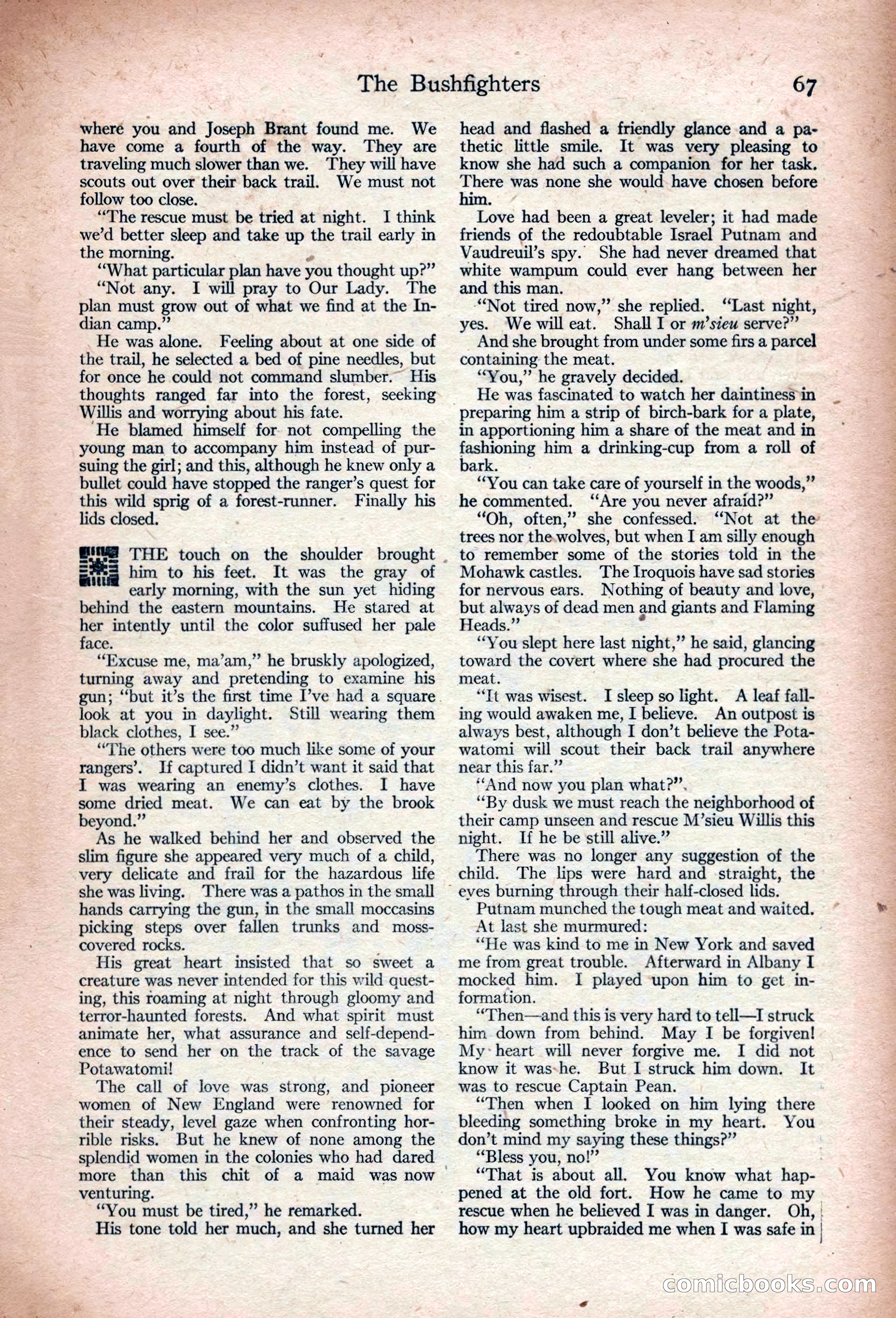
A restored page from Pulp Fiction, 1920. Page through the whole issue in the reader above.
📄 Transcribed text from this page (OCR, searchable)
Machine-transcribed from the original scan — historical spelling and the odd misread are preserved.
ane enl (ab og wheré you and Joseph Brant found me. We have come a fourth of the way. They are traveling much slower than we. They will have scouts out over their back trail. We must not follow too close. : “The rescue must be tried at night. I think we'd better sleep and take up the trail early in the morning. “What particular plan have you thought up?” “Not any. I will pray to Our Lady. The plan must grow out of what we find at ite In- dian camp.’ He was alone. Feeling about at one side of the trail, he selected a bed of pine needles, but for once he could not command slumber.” His thoughts ranged far into the forest, seeking illis and worrying about his fate. ‘He blamed himself for not compelling the young man to accompany him instead of pur- suing the girl; and this, although he knew only a bullet could have stopped the ranger’s quest for this wild sprig of a forest-runner. Finally his lids closed. gm THE touch on the shoulder brought . mit him to his feet. It was the gray of early morning, with the sun yet hiding behind the eastern mountains. He stared at her intently until the color suffused her pale face. “excuse me, ma’am,” he bruskly apologized, turning away and pretending to examine his gun; “but it’s the first time I’ve had a square. look at you in daylight. Still wearing them black clothes, I see.” “The others were too much like some of your rangers’. If captured I didn’t want it said that I was wearing an enemy’s clothes. I have some dried meat. We can eat by the brook beyond.” As he walked behind her and observed the slim figure she appeared very much of a child, very delicate and frail for the hazardous life she was living. There was a pathos in the small hands carrying the gun, in the small moccasins picking steps over fallen trunks and moss- covered rocks. His great heart insisted that so sweet a creature was never intended for this wild quest- ing, this roaming at night through gloomy and terror-haunted forests. And what spirit must animate her, what assurance and self-depend- ence to send her on the track of the savage Potawatomi! The call of love was strong, and pioneer women of New England were renowned for their steady, level gaze when confronting hor- rible risks. But he knew of none among the splendid women in the colonies who had dared more than this venturing. “You must be tired,” he remarked. His tone told her much, and she turned her The Bushfighters chit of a maid was now 67 head and flashed a friendly glance and a pa- thetic little smile. It was very pleasing to know she had such a companion for her task. There was none she would have chosen before Love had been a great leveler; it had made friends of the redoubtable Israel Putnam and Vaudreuil’s spy. She had never dreamed that white wampum could ever hang between her and this man. “Not tired now,” she replied. “Last night, yes. Wewilleat. Shall I or m’sieu serve?” And she brought from under some firs a parcel containing the meat. “You,” he gravely decided. He was fascinated to watch her daintiness in preparing him a strip of birch-bark for a plate, in apportioning him a share of the meat and in fashioning him a drinking-cup from a roll of bark. “You can take care of yourself in the woods,” he commented. ‘‘Are you never afraid?” “Oh, often,” she confessed. “Not at the trees nor the.wolves, but when I am silly enough to remember some of the stories told in the Mohawk castles. The Iroquois have sad stories for nervous ears. Nothing of beauty and love, but always of dead men and giants and Flaming Heads.” “You slept here last night,” he said, glancing toward the covert where she had procured the meat. “Tt was wisest. Isleep so light. A leaf fall- ing would awaken me, I believe. An outpost is always best, although I don’t believe the Pota- watomi will scout their back trail anywhere near this far.” ‘And now you plan what?”’, “By dusk we must reach the neighborhood of their camp unseen and rescue M’sieu Willis this night. If he be still alive.” There was no longer any suggestion of the child. The lips were hard and straight, the eves burning through their half-closed lids. Putnam munched the tough meat and waited. At last she murmured: “He was kind to me in New York and saved me from great trouble. Afterward in Albany I mocked him. I played upon him to get in- formation. “‘Then—and this is very hard to tell—I struck him down from behind. May I be forgiven! My heart will never forgive me. I did not know it was-he. But I struck him down. It was to rescue Captain Pean. “Then when I looked on him lying there bleeding something broke in my heart. You don’t mind my saying these things?” “Bless you, no!” “That is about all. You know what hap- pened at the old fort. How he came to my rescue when he believed I was in danger. Oh, | how my heart upbraided me when I was safe in | COMmicloooks (C@ o ‘ Se.) oe ro 7 "i aed < 4 avs sys Fan ’ ah he Te : bi iat eee ab 7”, een “2 = in a } Vie ee apd See ~ Lae Oy | seb) “ fe iG by, ies 5 tthe sf eRe bd de eee re ae 4 LA b 9) Pée Petes pate ese Tete. oa ages OS ta Mee te evi h | ae ‘ } Shai ' if, Jin bi. bh ae 4s 4 talbel! P ae eh ah ee, ver &} | ee ASP i bY, Ros lad Re SN PM | Oe ear RO Pree an Rie Bey