
Pulp Fiction, 1920 · page 66 of 172
Adventure Magazine Cover — page 66: what you’re looking at
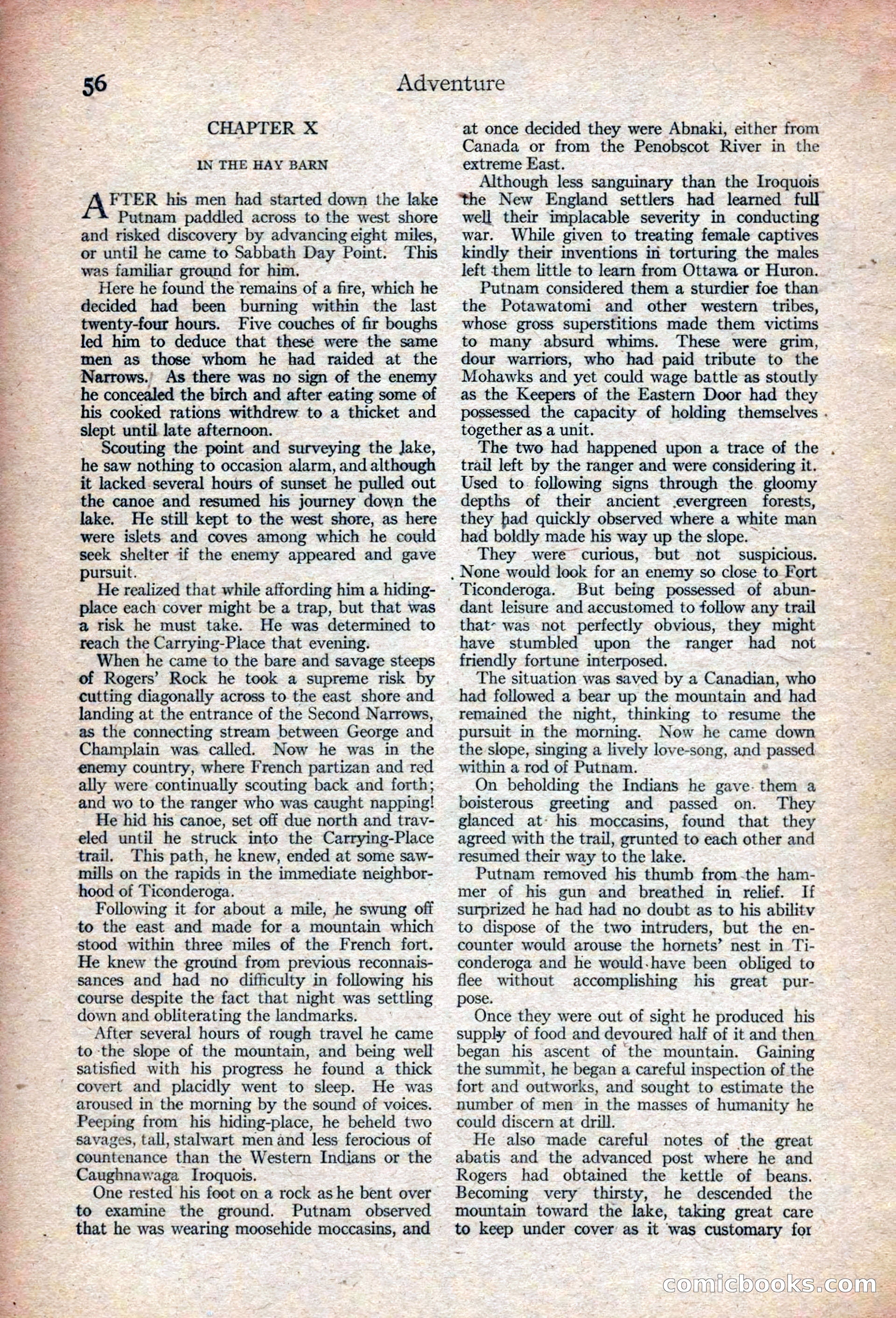
A restored page from Pulp Fiction, 1920. Page through the whole issue in the reader above.
📄 Transcribed text from this page (OCR, searchable)
Machine-transcribed from the original scan — historical spelling and the odd misread are preserved.
= Pr + a i st ap eT Geet Let Oe RATT SR SLL AE MCMC 1 EPMA PEN ee ERAN GA NET Wy RN VERS Te Ie" Aes te ad die ‘5 | - ~ ; AS OCR Se ry . Cae Pee CHAPTER X IN THE HAY BARN FTER his men had started down the lake Putnam paddled across to the west shore and risked discovery by advancing eight miles, or until he came to Sabbath Day Point. This was familiar ground for him. Here he found the remains of a fire, which he decided had been burning within the last twenty-four hours. Five couches of fir boughs led him to deduce that thesé were the same men as those whom he had raided at the Narrows.’ As there was no sign of the enemy he concealed the birch and after eating some of his cooked rations withdrew to a thicket and slept until late afternoon. - Scouting the point and surveying the Jake, he saw nothing to occasion alarm, and although it lacked several hours of sunset he pulled out the canoe and resumed his journey down the lake. He still kept to the west shore, as here were islets and coves among which he could seek shelter if the enemy appeared and gave pursuit. He realized that while affording him a hiding- place each cover might be a trap, but that was a risk he must take. He was determined to reach the Carrying-Place that evening. - When he came to the bare and savage steeps . of Rogers’ Rock he took a supreme risk by cutting diagonally across to the east shore and landing at the entrance of the Second Narrows, . as the connecting stream between George and Champlain was called. Now he was in the enemy country, where French partizan and red ally were continually scouting back and forth; ‘and wo to the ranger who was caught napping! He hid his canoe, set off due north and trav- eled until he struck into the Carrying-Place trail. This path, he knew, ended at some saw- mills on the rapids in the immediate neighbor- hood of Ticonderoga. Following it for about a mile, he swung off to the east and made for a mountain which stood within three miles of the French fort. He knew the ground from previous reconnais- sances and had no difficulty in following his course despite the fact that night was settling down and obliterating the landmarks. “After several hours of rough travel he came to-the slope of the mountain, and being well satisfied with his progress he found a thick ' covert and placidly went to sleep. He was aroused in the morning by the sound of voices. Peeping from his hiding-place, he beheld two savages, tall, stalwart men and less ferocious of countenance than the Western Indians or the Caughnawaga Iroquois. One rested his foot on a rock as he bent over to examine the ground. Putnam observed that he was wearing moosehide moccasins, and Adventure at once decided they were Abnaki, either from Canada or from the Penobscot River in the extreme East. Although less sanguinary than the Iroquois the New England settlers had learned full well their implacable severity in conducting war. While given to treating female captives kindly their inventions in torturing the males left them little to learn from Ottawa or Huron. Putnam considered them a sturdier foe than the Potawatomi and other western tribes, whose gross superstitions made them victims to many absurd whims. These were grim, dour warriors, who had paid tribute to the Mohawks and yet could wage battle as stoutly as the Keepers of the Eastern Door had they possessed the capacity of holding themselves . together as a unit. The two had happened upon a trace of the , trail left by the ranger and were considering it. Used to: following signs through the. gloomy depths of their ancient evergreen forests, they had quickly observed where a white man had boldly made his way up the slope. They were curious, but not suspicious. Ticonderoga. But being possessed of abun- dant leisure and accustomed to follow any trail that- was not perfectly obvious, they might have stumbled upon the ranger had not friendly fortune interposed. The situation was saved by a Canadian, who had followed a bear up the mountain and had remained the night, thinking to resume the pursuit in the morning. Now he came down the slope, singing a lively love-song, and passed within a rod of Putnam. On beholding the Indians he gave. thier a boisterous greeting and passed on. They glanced at: his moccasins, found that they agreed with the trail, grunted to each other and resumed their way to the lake. Putnam removed his thumb from-the ham- mer of his gun and breathed in relief. If surprized he had had no doubt as to his abilitv to dispose of the two intruders, but the en- counter would arouse the hornets’ nest in Ti- conderoga and he would.have been obliged to flee without accomplishing his great pur- pose. Once they were out of sight he produced his supply of food and devoured half of it and then. began his ascent of the mountain. Gaining the summit, he began a careful inspection of the fort and outworks, and sought to estimate the number of men in the masses of humanity he could discern at drill. He also made careful notes of the great abatis and the advanced post where he and Rogers had obtained the kettle of beans. . None would look for an enemy so close to Fort | Becoming very thirsty, he descended the | mountain toward the lake, taking great care to keep under cover: as it was customary for (CO) HOOKS AMC