
Pulp Fiction, 1920 · page 61 of 172
Adventure Magazine Cover — page 61: what you’re looking at
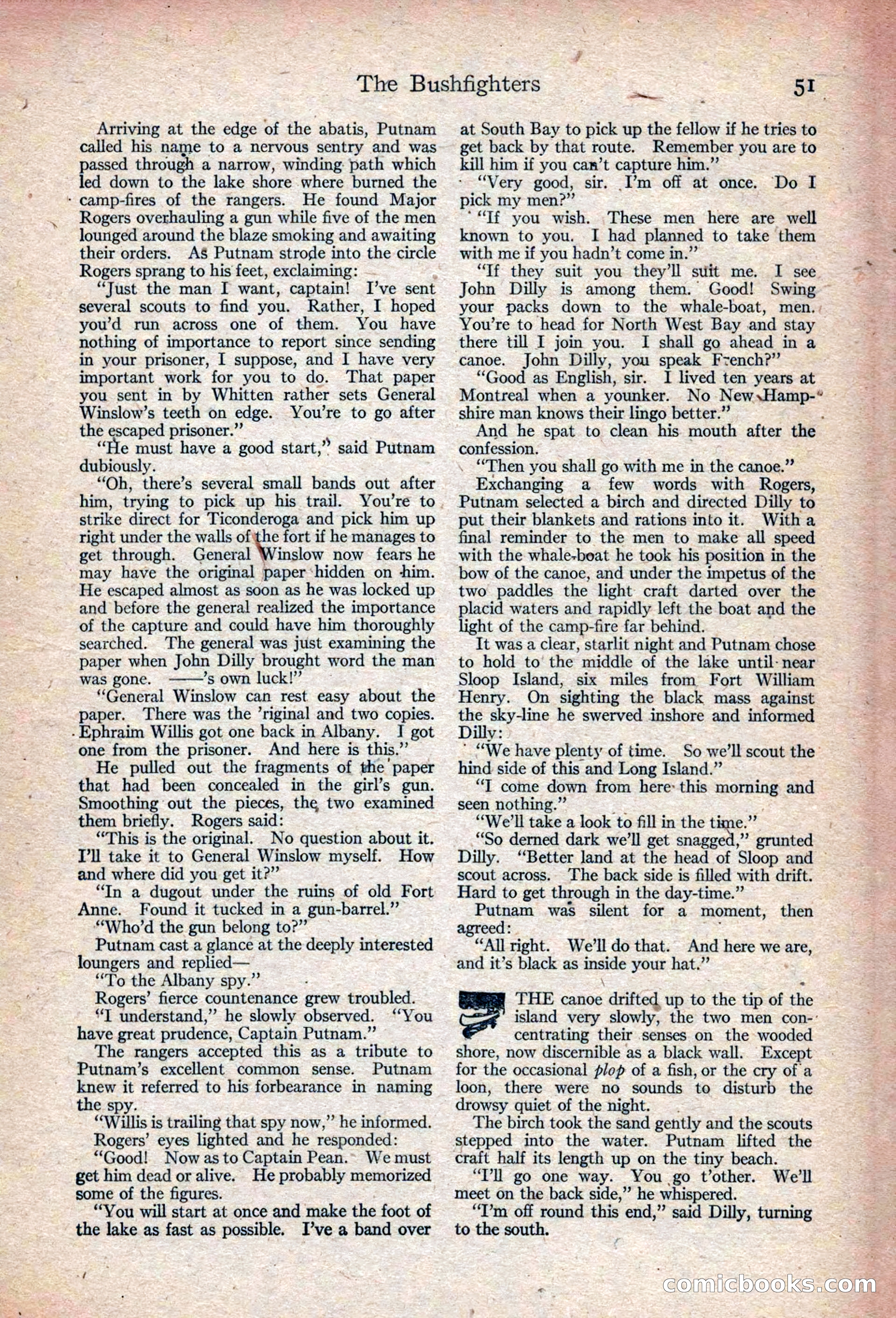
A restored page from Pulp Fiction, 1920. Page through the whole issue in the reader above.
📄 Transcribed text from this page (OCR, searchable)
Machine-transcribed from the original scan — historical spelling and the odd misread are preserved.
Nr a ee “lo - - camp-fires of the rangers. — ee. ae me... ‘i The Bushfighters Arriving at the edge of the abatis, Putnam called his name to a nervous sentry and was passed through a narrow, winding: path which led down to the lake shore where burned the He found Major Rogers overhauling a gun while five of the men louriged around the blaze smoking and awaiting their orders. AS Putnam strode into the circle Rogers sprang to his feet, exclaiming: “Tust the man I want, captain! I’ve sent several scouts to find you. Rather, I hoped you’d run across one of them. You have nothing of importance to report since sending in your prisoner, I suppose, and I have very important work for you to do. That paper you sent in by Whitten rather sets General Winslow’s teeth on edge. You're to go after the escaped prisoner.’ e must have a good start,’ dubiously. “Oh, there’s several small bands out after > said Putnam him, trying to pick up his trail. You're to. strike direct for Ticonderoga and pick him up right under the walls ofthe fort if he manages to get through. General Winslow now fears he may have the original paper ‘hidden on shim. He escaped almost as soon as he was locked up and before the general realized the importance of the capture and could have him thoroughly searched. ‘The general was just examining the paper when John Dilly brought word the man was gone. ——’s own luck!” ‘General Winslow can rest easy about the paper. There was the ’riginal and two copies. - Ephraim Willis got one back in Albany. I got one from the prisoner. And here is this.’’ He pulled out the fragments of the paper that had been concealed in the girl’s gun. Smoothing out the pieces, the two examined them briefly. Rogers said: “This is the original. No question about it. T’ll take it to General Winslow myself. How and where did you get it?” “In a dugout under the ruins of old Fort Anne. Found it tucked in a gun-barrel.” “Who'd the gun belong to?” Putnam cast a glance at the deeply interested loungers and replied— - “To the Albany spy.” Rogers’ fierce countenance orew troubled. “TJ understand,” he slowly observed. ‘You have great prudence, Captain Putnam.” The rangers accepted this as a tribute to Putnam’s excellent common sense. Putnam knew it referred to his forbearance in naming the spy. “Willis is trailing that spy now,” he informed. Rogers’ eyes lighted and he responded: “Good! Now asto Captain Pean.- We must get him dead or alive. He probably memorized some of the figures. “You will start at once and make the foot of the lake as fast as possible. I’ve a band over — at South Bay to pick up the fellow if he tries to get back by that route. Remember you are to kill him if you can’t capture him.” “Very good, sir. I’m off at once. pick my men?” ‘“Tf you wish. These men here are well known to you. I had planned to take them with me if you hadn’t come in.” “Tf they suit you they’ll suit me. John Dilly is among them. Good! I see You're to head for North West Bay and stay there till I join you. I shall go ahead in a canoe. John Dilly, you speak French?” “Good as English, sir. I lived ten years at Montreal when a younker. No New .Hamp-* shire man knows their lingo better.” And he spat to clean his mouth after the confession. . “Then you shall go with me in the canoe.’ Exchanging a few words with ee Putnam selected a birch and directed Dilly to put their blankets and rations into it. With a final reminder to the men to make all speed with the whale-beat he took his position in the bow of the canoe, and under the impetus of the two paddles the light craft darted over the placid waters and rapidly left the boat and the light of the camp-fire far behind. It was a clear, starlit night and Putnam chose to hold to the middle of the lake until- near Sloop Island, six miles from Fort William Henry. On sighting the black mass against a sky-line he swerved inshore and informed y: ' “We have plenty of time. hind side of this and Long Island.” “T come down from here> this morning and seen nothing.” ; “We'll take a look to fill in the time.’ eee derned dark we'll get snagged,”’ a y. scout across. The back side is filled with drift. Hard to get through in the day-time.” ee was silent for a moment, then ee We'll do that. “All right. And here we arts and it’s black as eee your hat.” THE canoe drifted up to ‘the tip of the = centrating their senses on the wooded shore, now discernible as a black wall. Except for the occasional plop of a fish, or the cry of a loon, there were no sounds to disturb the drowsy quiet of the night. The birch took the sand gently and the scouts stepped into the water. Putnam lifted the craft half its length up on the tiny beach. “T’ll go one way. You go tother. We'll meet on the back side,” he whispered. “Tm off round this end,” said Dilly, turning to the south. vOoOK 51 So we'll scout the’ island very slowly, the two men con-: Becks Swing ~ your packs down to the whale-boat, men.. “Better land at the head of Sloop and — (E@) 4 t € - a