
Pulp Fiction, 1920 · page 54 of 172
Adventure Magazine Cover — page 54: what you’re looking at
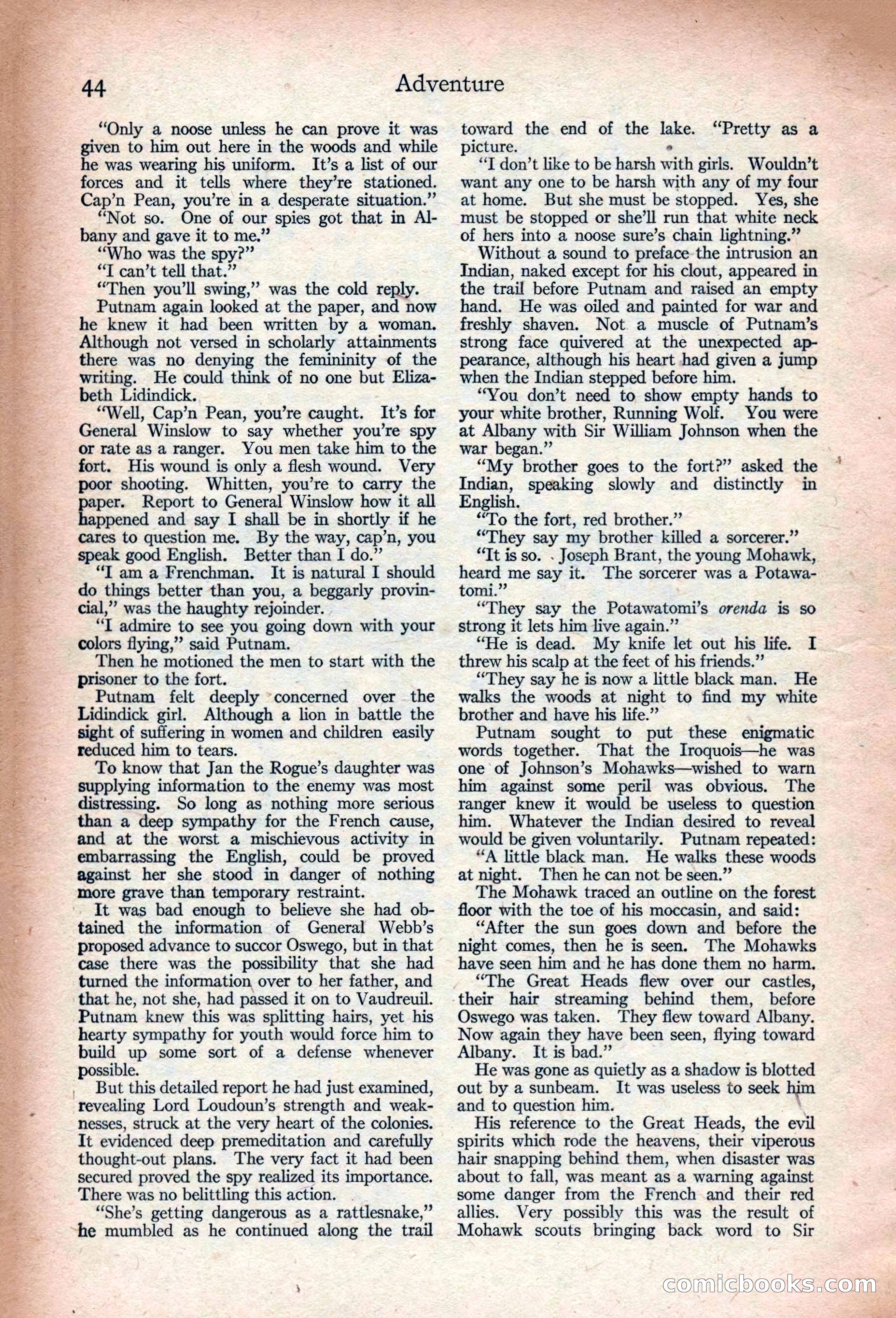
A restored page from Pulp Fiction, 1920. Page through the whole issue in the reader above.
📄 Transcribed text from this page (OCR, searchable)
Machine-transcribed from the original scan — historical spelling and the odd misread are preserved.
“Only a noose unless he can prove it was given to him out here in the woods and while he was wearing his uniform. It’s a list of our forces and it tells where they’re stationed. Cap’n Pean, you’re in a desperate situation.” “Not so. One of our spies got that in Al- bany and gave it to me.” “Who was the spy?” “T can’t tell that.” “Then you'll swing,” was the cold reply. Putnam again looked at the paper, and now he knew it had been written by a woman. Although not versed in scholarly attainments there was no denying the femininity of the writing. He could think of no one but Eliza- beth Lidindick. “Well, Cap’n Pean, you’re caught. It’s for General Winslow to say whether you’re spy or rate as a ranger. You men take him to the fort. His wound is only a flesh wound. Very poor shooting. Whitten, you’re to carry the per. Report to General Winslow how it all ppened and say I shall be in shortly if he cares to question me. By the way, cap’n, you speak good English. Better than I do.” “I am a Frenchman. It is natural I should do things better than you, a beggarly provin- cial,” was the haughty rejoinder. “T admire to see you going down with your colors flying,” said Putnam. Then he motioned the men to start with the prisoner to the fort. Putnam felt deeply “concerned over the Lidindick girl. Although a lion in battle the sight of suffering in women and children easily reduced him to tears. To know that Jan the Rogue’s daughter was supplying information to the enemy was most distressing. So long as nothing more serious than a deep sympathy for the French cause, and at the worst a mischievous activity in embarrassing the English, could be proved against her she stood in danger of nothing more grave than temporary restraint. . It was bad enough to believe she had ob- tained the information of General Webb’s proposed advance to succor Oswego, but in that case there was the possibility that she had turned the information over to her father, and that he, not she, had passed it on to Vaudreuil. Putnam knew this was splitting hairs, yet his hearty sympathy for youth would force him to build up some sort of a defense whenever possible. . But this detailed report he had just examined, ‘revealing Lord Loudoun’s strength and weak- nesses, struck at the very heart of the colonies. It evidenced deep premeditation and carefully thought-out plans. The very fact it had been secured proved the spy realized its importance. There was no belittling this action. “She’s getting dangerous as a rattlesnake,” -he mumbled as he continued along the trail Adventure “Pretty as a toward the end of the LES picture. “T don’t like to be harsh with girls. Wouldn’t want any one to be harsh with any of my four at home. But she must be stopped. Yes, she must be stopped or she’ll run that white neck of hers into a noose sure’s chain lightning.” Without a sound to preface the intrusion an Indian, naked except for his clout, appeared in the trail before Putnam and raised an empty hand. He was oiled and painted for war and freshly shaven. Not a muscle of Putnam’s strong face quivered at the unexpected ap- pearance, although his heart had given a jump when the Indian stepped before him. “You don’t need to show empty hands to your white brother, Running Wolf. You were at Albany with Sir William Johnson when the war began.” “My brother goes to the fort?” asked the Indian, speaking slowly and distinctly in English. “To the fort, red brother.” “They say my brother killed a sorcerer.’ “Tt is so. . Joseph Brant, the young Mohawk, heard me say it. The sorcerer was a Potawa- tomi.” “They say the Potawatomi’s orenda is so strong it lets him live again.” “He is dead. My knife let out his life. I threw his scalp at the feet of his friends.” “They say he is now a little black man. He walks the woods at night to find my white brother and have his life.” Putnam sought to put these enigmatic words together. That the Iroquois—he was one of Johnson’s Mohawks—wished to warn him against some peril was obvious. The ranger knew it would be useless to question him. Whatever the Indian desired to reveal would be given voluntarily. Putnam repeated: “A little black man. He walks these woods at night. Then he can not be seen.” The Mohawk traced an outline on the forest floor with the toe of his moccasin, and said: “After the sun goes down and before the night comes, then he is seen. The Mohawks have seen him and he has done them no harm, “The Great Heads flew over our castles, their hair streaming behind them, before Oswego was taken. They flew toward Albany. Now again they have been seen, flying toward Albany. It is bad.” He was gone as quietly as a shadow is blotted out by a sunbeam. It was useless to seek him and to question him. His reference to the Great Heads, the evil spirits which rode the heavens, their viperous hair snapping behind them, when disaster was about to fall, was meant as a warning against some danger from the French and their red allies. Very possibly this was the result of Mohawk scouts bringing back word to Sir GomiGchdooks (CO)