
Pulp Fiction, 1920 · page 47 of 172
Adventure Magazine Cover — page 47: what you’re looking at
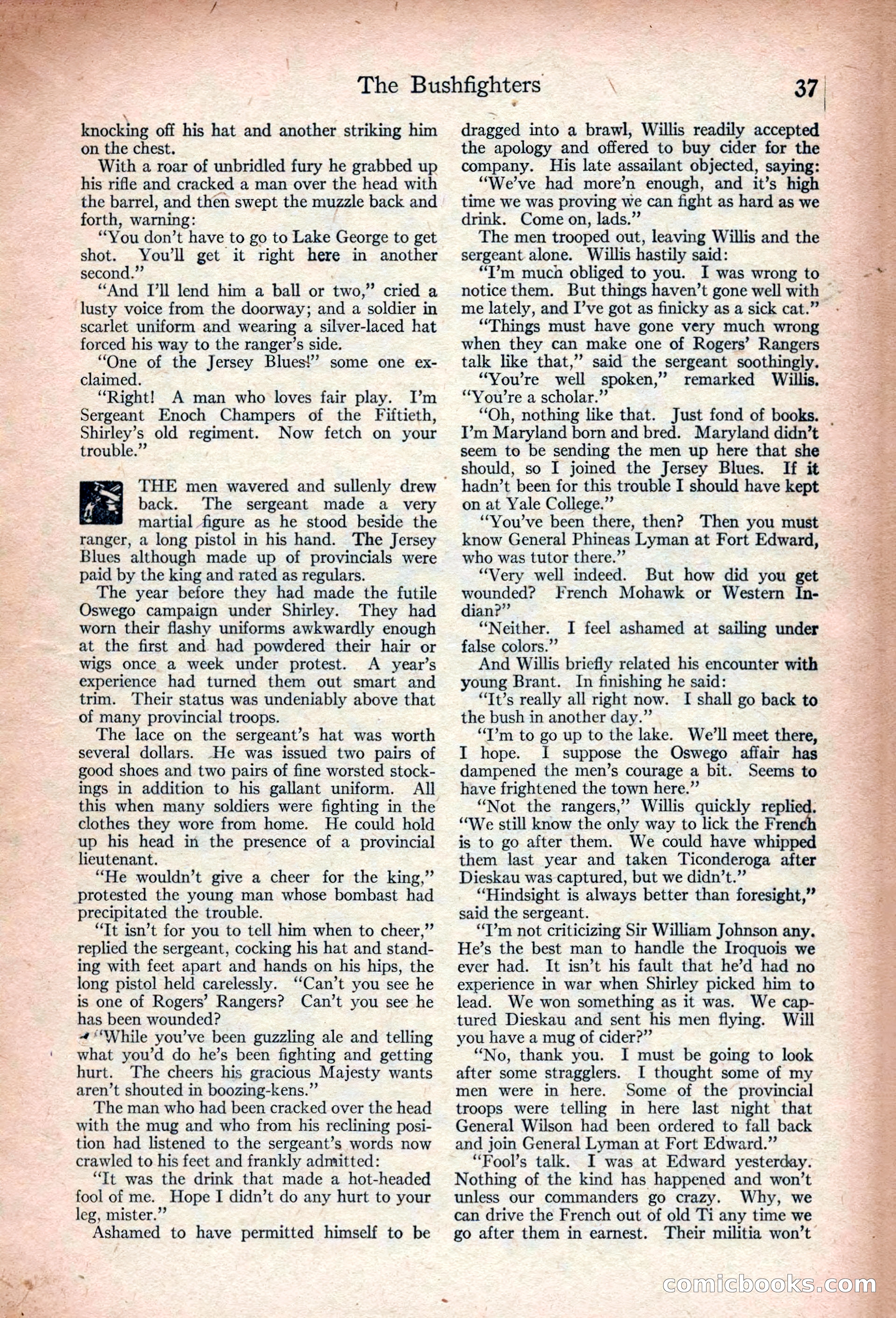
A restored page from Pulp Fiction, 1920. Page through the whole issue in the reader above.
📄 Transcribed text from this page (OCR, searchable)
Machine-transcribed from the original scan — historical spelling and the odd misread are preserved.
a: i, ir. knocking off his hat and another striking him on the chest. With a roar of unbridled fury he grabbed up his rifle and cracked a man over the head with the barrel, and then swept the muzzle back and forth, warning: “You don’t have to go to Lake George to get shot. You'll get it right here in another second.” “And I’ll lend him a ball or two,” cried a lusty voice from the doorway; and a soldier in scarlet uniform and wearing a silver-laced hat forced his way to the ranger’s side. “One of the Jersey Blues!” some one ex- claimed. “Right! A man who loves fair play. I’m Sergeant Enoch Champers of the Fiftieth, Shirley’s old regiment. Now fetch on your trouble.” back. The sergeant made a _ very martial figure as he stood beside the ranger, a long pistol in his hand. The Jersey Blues although made up of provincials were paid by the king and rated as regulars. The year before they had made the futile Oswego campaign under Shirley. They had worn their flashy uniforms awkwardly enough at the first and had powdered their hair or wigs once a week under protest. A year’s experience had turned them out smart and trim. Their status was undeniably above that of many provincial troops. The lace on the sergeant’s hat was worth several dollars. He was issued two pairs of good shoes and two pairs of fine worsted stock- ings in addition to his gallant uniform. All this when many soldiers were fighting in the clothes they wore from home. He could hold up his head in the presence of a provincial lieutenant. “He wouldn’t give a cheer for the king,” protested the young man whose bombast had precipitated the trouble. “Tt isn’t for you to tell him when to cheer,” replied the sergeant, cocking his hat and stand- ing with feet apart and hands on his hips, the long pistol held carelessly. ‘‘Can’t you see he is one of Rogers’ Rangers? Can’t you see he has been wounded? «While you’ve been guzzling ale and telling what you’d do he’s been fighting and getting hurt. The cheers his gracious Majesty wants aren’t shouted in boozing-kens.” The man who had been cracked over the head with the mug and who from his reclining posi- tion had listened to the sergeant’s words now crawled to his feet and frankly admitted: “Tt was the drink that made a hot-headed fool of me. Hope I didn’t do any hurt to your leg, mister.” Ashamed to have permitted himself to be The Bushfighters \ THE men wavered and sullenly drew dragged into a brawl, Willis readily accepted the apology and offered to buy cider for the company. His late assailant objected, saying: “We’ve had more’n enough, and it’s high time we was proving we can fight as hard as we drink. Come on, lads.” The men trooped out, leaving Willis and the sergeant alone. Willis hastily said: “T’m mucn obliged to you. I was wrong to notice them. But things haven’t gone well with — me lately, and I’ve got as finicky as a sick cat.” “Things must have gone very much wrong when they can make one of Rogers’ Rangers talk like that,” said the sergeant soothingly. “You're well spoken,” remarked Willis. “You're a scholar.” “Oh, nothing like that. Just fond of books. I’m Maryland born and bred. Maryland didn’t © seem to be sending the men up here that she should, so I joined the Jersey Blues. If it hadn’t been for this trouble I should have kept on at Yale College.” ‘““Vou’ve been there, then? Then you must know General Phineas Lyman at Fort Edward, who was tutor there.” “Very well indeed. But how did you get wounded? French Mohawk or Western In- dian?” I feel ashamed at sailing under “Neither. false colors.” And Willis briefly related his encounter with young Brant. In finishing he said: “Tt’s really all right now. I shall go back to the bush in another day.” “T’m to go up to the lake. We’ll meet there, I hope. I suppose the Oswego affair has dampened the men’s courage a bit. Seems to have frightened the town here.”’ “Not the rangers,’ Willis quickly repli “We still know the only way to lick the Fren is to go after them. We could have whipped them last year and taken Ticonderoga after Dieskau was captured, but we didn’t.” “Hindsight is always better than foresight,” said the sergeant. “T’m not criticizing Sir William Johnson any. He’s the best man to handle the Iroquois we ever had. It isn’t his fault that he’d had no experience in war when Shirley picked him to lead. We won something as it was. We cap- tured Dieskau and sent his men flying. Will you have a mug of cider?” “No, thank you. I must be going to look after some stragglers. I thought some of my men were in here. Some of the provincial troops were telling in here last night that General Wilson had been ordered to fall back and join General Lyman at Fort Edward.” “Fool’s talk. I was at Edward yesterday. Nothing of the kind has happened and won’t unless our commanders go crazy. Why, we can drive the French out of old Ti any time we go after them in earnest. Their militia won’t COMnICLOO S (C@ livsi ee PRE ARAN a RT dba the be 7 A ty a . le i Pe ra \ P {! a. ae! ho Fel 7 d 12 ied t aay + um * da) tb Raa ae Pace 5 a Gaane ts AA Ee * re é. d witch tale, \ a ag BY t ate bf o » 4 Meee Tbe 34 t i ; vy er o Wee a Ay We for we ru ees He AP Reyne vie MAG ley i vy) 4 aes Ra Rat Ene © ttle \ Sh WD Vem” 2) a ol Oe ‘uj Alig “ ~ Poll bf fy “ ‘y Ve bis AN, Wea) ey OT iS AY. ayy’ ‘ay ae Cr 7 See de Di my ~ ha gle ‘> bce * eae _* - AV BUSH ’ it aR Wile ae og ~* ws RAL & oe 4] ¥ a ro the Fay “ Ry ae M4 Fara 4@) 3 Ey, Hy 4s iT \ tt 8 Ane ie s o2at lpatea anh ey eC : - ghthy “, ek Np,