
Pulp Fiction, 1920 · page 42 of 172
Adventure Magazine Cover — page 42: what you’re looking at
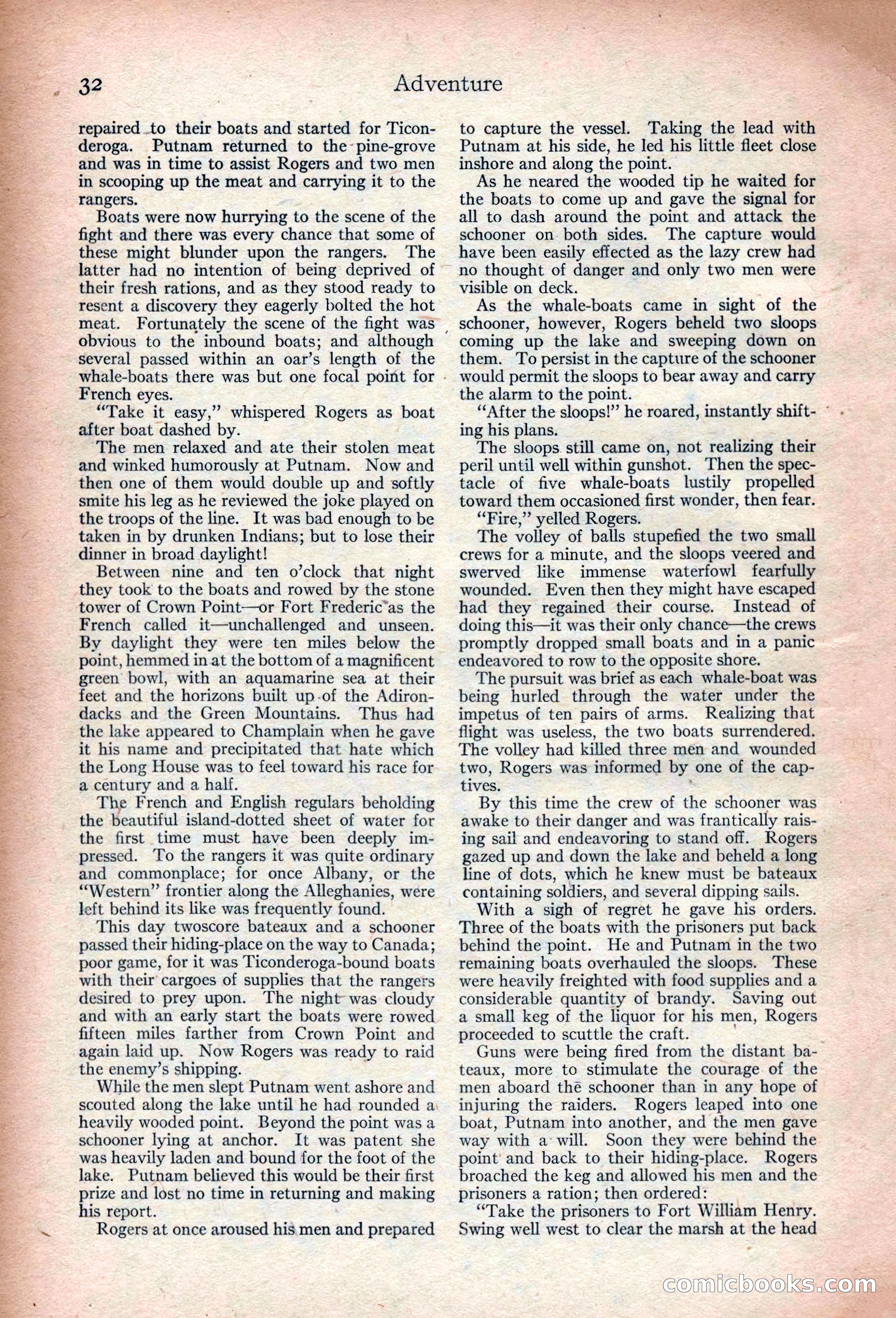
A restored page from Pulp Fiction, 1920. Page through the whole issue in the reader above.
📄 Transcribed text from this page (OCR, searchable)
Machine-transcribed from the original scan — historical spelling and the odd misread are preserved.
* re Te » > * ee fi S igha. a RAR RODE TNT) ph ae MPS © 7S. OEP an Mee Tee repaired to their boats and started for Ticon- deroga. Putnam returned to the pine-grove and was in time to assist Rogers and two men in scooping up the meat and carrying it to the rangers. Boats were now hurrying to the scene of the fight and there was every chance that some of these might blunder upon the rangers. The latter had no intention of being deprived of their fresh rations, and as they stood ready to resent a discovery they eagerly bolted the hot meat. Fortunately the scene of the fight was obvious to the inbound boats; and although several passed within an oar’s length of the whale-boats there was but one focal point for - French eyes. “Take it easy,’ whispered Rogers as boat after boat dashed by. The men relaxed and ate their stolen meat and winked humorously at Putnam. Now and then one of them would double up and softly smite his leg as he reviewed the joke played on the troops of the line. It was bad enough to be taken in by drunken Indians; but to lose their dinner in broad daylight! Between nine and ten o’clock that night they took to the boats and rowed by the stone tower of Crown Point—or Fort Frederic’as the French called it—unchallenged and unseen. By daylight they were ten miles below the point, hemmed in at the bottom of a magnificent green bowl, with an aquamarine sea at their feet and the horizons built up-of the Adiron- dacks and the Green Mountains. Thus had the lake appeared to Champlain when he gave it his name and precipitated that hate which the Long House was to feel toward his race for a century and a half. The French and English regulars beholding the beautiful island-dotted sheet of water for the first time must have been deeply im- pressed. To the rangers it was quite ordinary and commonplace; for once Albany, or the “Western” frontier along the Alleghanies, were left behind its like was frequently found. This day twoscore bateaux and a schooner passed their hiding-place on the way to Canada; poor game, for it was Ticonderoga-bound boats with their cargoes of supplies that the rangers desired to prey upon. The night was cloudy and with an early start the boats were rowed fifteen miles farther from Crown Point and again laid up. Now Rogers was ready to raid the enemy’s shipping. While the men slept Putnam went ashore and scouted along the lake until he had rounded a. heavily wooded point. Beyond the point was a schooner lying at anchor. It was patent she was heavily laden and bound for the foot of the lake. Putnam believed this would be their first prize and lost no time in returning and making his report. Rogers at once aroused his men and prepared Adventure to capture the vessel. Taking the lead with Putnam at his side, he led his little fleet close inshore and along the point. As he neared the wooded tip he waited for the boats to come up and gave the signal for all to dash around the point and attack the schooner on both sides. The capture would have been easily effected as the lazy crew had no thought of danger and only two men were visible on deck. As the whale-boats came in sight of the schooner, however, Rogers beheld two sloops ' coming up the lake and sweeping down on them. To persist in the capture of the schooner would permit the sloops to bear away and carry the alarm to the point. ‘“‘After the sloops!”’ he roared, instantly shift- ~ ing his plans. The sloops. still came on, not realizing their peril until well within gunshot. Then the spec- tacle of five whale-boats lustily propelled toward them occasioned first wonder, then fear. “Fire,” yelled Rogers. The volley of balls stupefied the two small crews for a minute, and the sloops veered and swerved like immense waterfowl fearfully wounded. Even then they might have escaped had they regained their course. Instead of doing this—it was their only chance—the crews promptly dropped small boats and in a panic endeavored to row to the opposite shore. The pursuit was brief as each whale-boat was being hurled through the water under the impetus of ten pairs of arms. Realizing that flight was useless, the two boats surrendered. The volley had killed three men and wounded two, Rogers was informed by one of the cap- tives. By this time the crew of the schooner was awake to their danger and was frantically rais- ing sail and endeavoring to stand off. Rogers gazed up and down the lake and beheld a long line of dots, which he knew must be bateaux containing soldiers, and several dipping sails. With a sigh of regret he gave his orders. Three of the boats with the prisoners put back behind the point. He and Putnam in the two remaining boats overhauled the sloops. These were heavily freighted with food supplies and a considerable quantity of brandy. Saving out a small keg of the liquor for his men, Rogers proceeded to scuttle the craft. Guns were being fired from the distant ba- teaux, more to stimulate the courage of the men aboard the schooner than in any hope of injuring the raiders. Rogers leaped into one boat, Putnam into another, and the men gave way with a‘will. Soon they were behind the point and back to their hiding-place. Rogers broached the keg and allowed his men and the prisoners a ration; then ordered: “Take the prisoners to Fort William Henry. Swing well west to clear the marsh at the head CORMICLOO Sj com |