
Pulp Fiction, 1920 · page 39 of 172
Adventure Magazine Cover — page 39: what you’re looking at
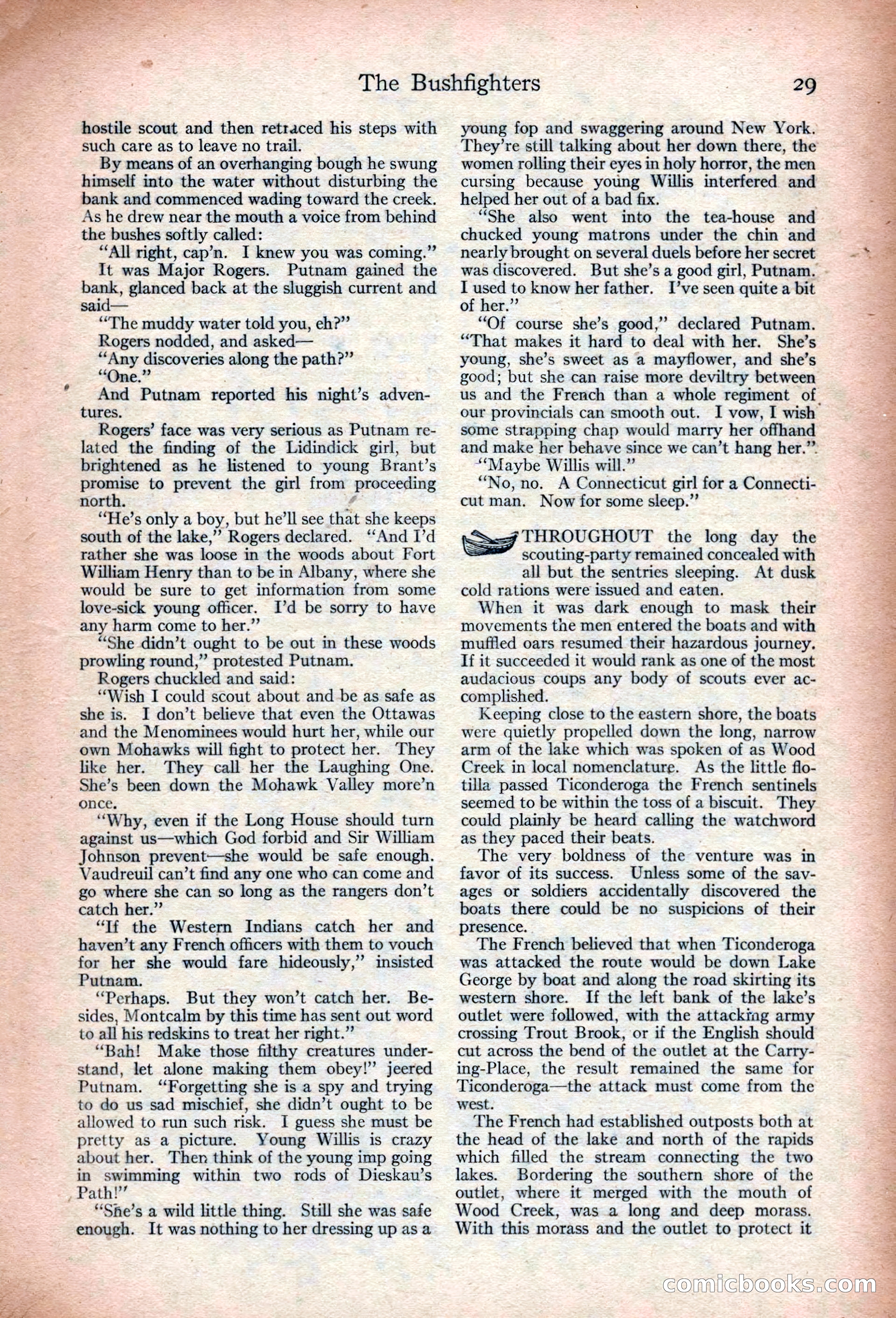
A restored page from Pulp Fiction, 1920. Page through the whole issue in the reader above.
📄 Transcribed text from this page (OCR, searchable)
Machine-transcribed from the original scan — historical spelling and the odd misread are preserved.
hostile scout and then retraced his steps with such care as to leave no trail. By means of an overhanging bough he swung himself into the water without disturbing the bank and commenced wading toward the creek. As he drew near the mouth a voice from behind the bushes softly called: “All right, cap’n. I knew you was coming.” It was Major Rogers. Putnam gained the a glanced back at the sluggish current and said— “The muddy water told you, eh?” Rogers nodded, and asked— ““Any discoveries along the path?” “One. > And Putnam reported his night’s adven- tures. Rogers’ face was very serious as Putnam re- lated the finding of the Lidindick girl, but brightened as he listened to young Brant’s promise to prevent the girl from pececenne north. “He’s only a boy, but he’ll see that she keeps south of the lake,” Rogers declared. “And I’d rather she was loose in the woods about Fort William Henry than to be in Albany, where she would be sure to get information from some love-sick young officer. I’d be sorry to have any harm come to her.” “She didn’t ought to be out in these woods prowling round,” protested Putnam. Rogers chuckled and said: “Wish I could scout about and be as safe as she is. I don’t believe that even the Ottawas and the Menominees would hurt her, while our own Mohawks will fight to protect her. ‘They like her. They call her the Laughing One. She’s been down the Mohawk Valley more’n once. “Why, even if the Long House should turn against us—which God forbid and Sir William Johnson prevent—she would be safe enough. Vaudreuil can’t find any one who can come and go where she can so long as the rangers don’t catch her.” “If the Western Indians catch her and haven’t any French officers with them to vouch for her she would fare hideously,” insisted Putnam. “Perhaps. But they won’t catch her. Be- sides, Montcalm by this time has sent out word to all his redskins to treat her right.” “Bah! Make those filthy creatures under- stand, let alone making them obey!” jeered Putnam. “Forgetting she is a spy and trying to do us sad mischief, she didn’t ought to be allowed to run such risk. I guess she must be pretty as a picture. Young Willis is crazy about her. Then think of the young imp going in swimming within two rods of Dieskau’s , Path!’ “Sne’s a wild little thing. Still she was safe enough. It was nothing to her dressing up as a The Bushfighters 29 young fop and swaggering around New York. They’re still talking about her down there, the women rolling their eyes in holy horror, the men cursing because young Willis interfered and helped her out of a bad fix. “She also went into the tea-house and chucked young matrons under the chin and nearly brought on several duels before her secret was discovered. But she’s a good girl, Putnam. - I used to know her father. of her.” “Of course she’s good,” declared Putnam. “That makes it hard to deal with her. She’s young, she’s sweet as a mayflower, and she’s good; but she can raise more deviltry between I’ve seen quite a bit us and the French than a whole regiment of. our provincials can smooth out. I vow, I wish some strapping chap would marry her offhand and make her behave since we can’t hang her.” “Maybe Willis will.” “No, no. A Connecticut girl for a Connecti- cut man. Now for some sleep.” THROUGHOUT the long day the scouting-party remained concealed with all but the sentries sleeping. At dusk cold rations were issued and eaten. When it was dark enough to mask their movements the men entered the boats and with muffled oars resumed their hazardous journey. If it succeeded it would rank as one of the most audacious coups any body of scouts ever ac- complished. Keeping close to the eastern shore, the boats were quietly propelled down the long, narrow arm of the lake which was spoken of as Wood Creek in local nomenclature. As the little flo- tilla passed Ticonderoga the French sentinels seemed to be within the toss of a biscuit. They could plainly be heard calling the watchword as they paced their beats. The very boldness of the venture was in favor of its success. Unless some of the sav- ages or soldiers accidentally discovered the boats there could be no suspicions of their presence. The French believed that when Ticonderoga was attacked the route would be down Lake George by boat and along the road skirting its western shore. If the left bank of the lake’s outlet were followed, with the attacking army crossing Trout Brook, or if the English should cut across the bend of the outlet at the Carry- ing-Place, the result remained the same for Ticonderoga—the attack must come from the west. The French had established outposts both at the head of the lake and north of the rapids which filled the stream connecting the two lakes. Bordering the southern shore of the outlet, where it merged with the mouth of Wood Creek, was a long and deep morass. With this morass and the outlet to protect it COMMICLOOO© (C eS (C@ “ae = at = . — a —. P's # ae es = ict ~_ = i a, = ‘2 : -= ~ a = = —- — i = = = a “ga ws 5 Se 3 “7 Vireo) ad. AT , io~, / ra iM lea ean Bh i