
Pulp Fiction, 1920 · page 29 of 172
Adventure Magazine Cover — page 29: what you’re looking at
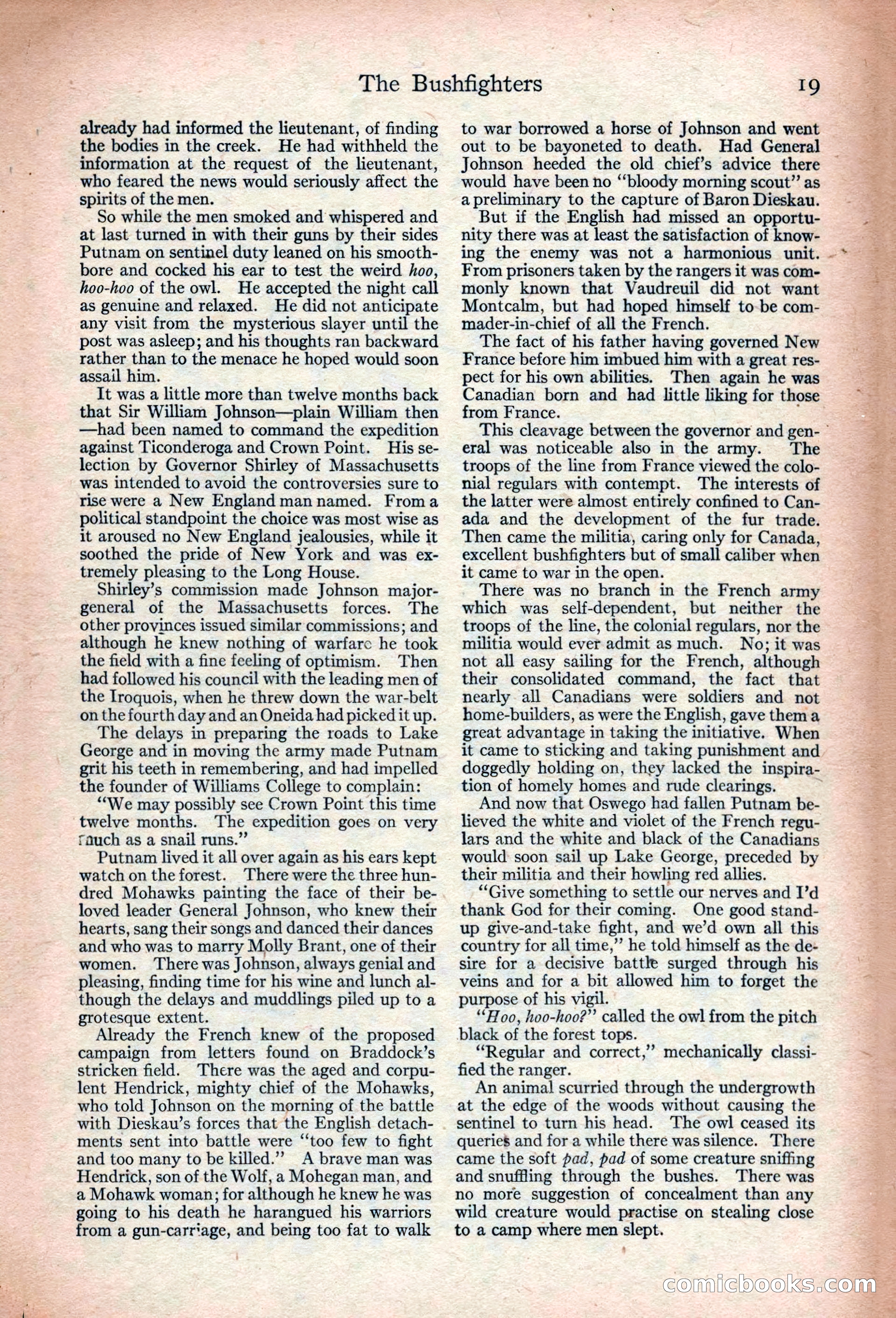
A restored page from Pulp Fiction, 1920. Page through the whole issue in the reader above.
📄 Transcribed text from this page (OCR, searchable)
Machine-transcribed from the original scan — historical spelling and the odd misread are preserved.
twelve months. The Bushfighters already had informed the lieutenant, of finding the bodies in the creek. He had withheld the information at the request of the lieutenant, who feared the news would seriously affect the spirits of the men. So while the men smoked and whispered and at last turned in with their guns by their sides Putnam on sentinel duty leaned on his smocth- bore and cocked his ear to test the weird hoo, hoo-hoo of the owl. He accepted the night call as genuine and relaxed. He did not anticipate any visit from the mysterious slayer until the post was asleep; and his thoughts ran backward rather than to the menace he hoped would soon assail him. It was a little more than twelve months back that Sir William Johnson—plain William then —had been named to command the expedition against Ticonderoga and Crown Point. His se- lection by Governor Shirley of Massachusetts was intended to avoid the controversies sure to rise were a New England mannamed. Froma political standpoint the choice was most wise as it aroused no New England jealousies, while it soothed the pride of New York and was ex- tremely pleasing to the Long House. Shirley’s commission made Johnson major- general of the Massachusetts forces. The other provinces issued similar commissions; and although he knew nothing of warfare he took the field with a fine feeling of optimism. Then had followed his council with the leading men of the Iroquois, when he threw down the war-belt on the fourth day and an Oneida had picked it up. The delays in preparing the roads to Lake George and in moving the army made Putnam grit his teeth in remembering, and had impelled the founder of Williams College to complain: “‘We may possibly see Crown Point this time The expedition goes on very rauch as a snail runs.” Putnam lived it all over again as his ears kept watch on the forest. There were the three hun- dred Mohawks painting the face of their be- loved leader General Johnson, who knew their hearts, sang their songs and danced their dances and who was to marry Molly Brant, one of their women. There was Johnson, always genial and pleasing, finding time for his wine and lunch al- though the delays and muddlings piled up to a grotesque extent. Already the French knew of the proposed campaign from letters found on Braddock’s stricken field. There was the aged and corpu- lent Hendrick, mighty chief of the Mohawks, who told Johnson on the morning of the battle with Dieskau’s forces that the English detach- ments sent into battle were “‘too few to fight and too many to be killed.”” A brave man was Hendrick, son of the Wolf, a Mohegan man, and a Mohawk woman; for although he knew he was going to his death he harangued his warriors from a gun-carriage, and being too fat to walk 19 to war borrowed a horse of Johnson and went out to be bayoneted to death. Had General Johnson heeded the old chief’s advice there © would have been no “bloody morning scout” as a preliminary to the capture of Baron Dieskau. But if the English had missed an opportu- nity there was at least the satisfaction of know- ing the enemy was not a harmonious unit. From prisoners taken by the rangers it was com- monly known that Vaudreuil did not want Montcalm, but had hoped himself to-be com- mader-in-chief of all the French. The fact of his father having governed New France before him imbued him with a great res- pect for his own abilities. Then again he was Canadian born and had little liking for those from France. - 5 - ¢ VULLAD te L« , Ay Ni; » at *%. This cleavage between the governor and gen- " eral was noticeable also in the army. The troops of the line from France viewed the colo- nial regulars with contempt. The interests of the latter were almost entirely confined to Can- ada and the development of the fur trade. Then came the militia, caring only for Canada, excellent bushfighters but of small caliber when it came to war in the open. There was no branch in the French army which was self-dependent, but neither the troops of the line, the colonial regulars, nor the militia would ever admit as much. No; it was not all easy sailing for the French, although their consolidated command, the fact that nearly all Canadians were soldiers and not home-builders, as were the English, gave them a great advantage in taking the initiative. When it came to sticking and taking punishment and doggedly holding on, they lacked the inspira- tion of homely homes and rude clearings. And now that Oswego had fallen Putnam be- lieved the white and violet of the French regu- lars and the white and black of the Canadians would soon sail up Lake George, preceded by their militia and their howling red allies. ““Give something to settle our nerves and I’d thank God for their coming. One good stand- up give-and-take fight, and we’d own all this country for all time,” he told himself as the de- sire for a decisive battle surged through his veins and for a bit allowed him to forget the purpose of his vigil. “Hoo, hoo-hoo?”’ called the owl from the pitch black of the forest tops. “Regular and correct,’’ mechanically classi- fied the ranger. An animal scurried through the undergrowth at the edge of the woods without causing the sentinel to turn his head. The owl ceased its queries and for a while there was silence. There came the soft pad, pad of some creature sniffing and snuffling through the bushes. There was no more suggestion of concealment than any wild creature would practise on stealing close to a camp where men slept. comniclboolk (C@) ‘ P . “’ ; ; : a > ; ny = ae ull : $ 4 ; 4 ats VT " i "e SARL ha e7 4, Vi , Arey’ Y ‘ , Wi diy .. wit isda ed ful ‘ AY Yank) ena! Rate oI4 4 AAP / Jigy ‘ Y sf tes st meer a o ¥ ‘ ome CR WD saad ile HE UA Mon Wak rn fe MANS ‘ ore ta ths ios UE Par ay er te, ead A - ~~ & a4, "eh A ~ a 4 CAL a pis as! ey ‘ is . Ay as yolk aL We lt; wah } } Mh gs 5s be \ : Marl yA! AT » 4! Heise ti ny i iol S f wy Vi PGi ov. < - r’ bh Wy a6