
Pulp Fiction, 1920 · page 26 of 172
Adventure Magazine Cover — page 26: what you’re looking at
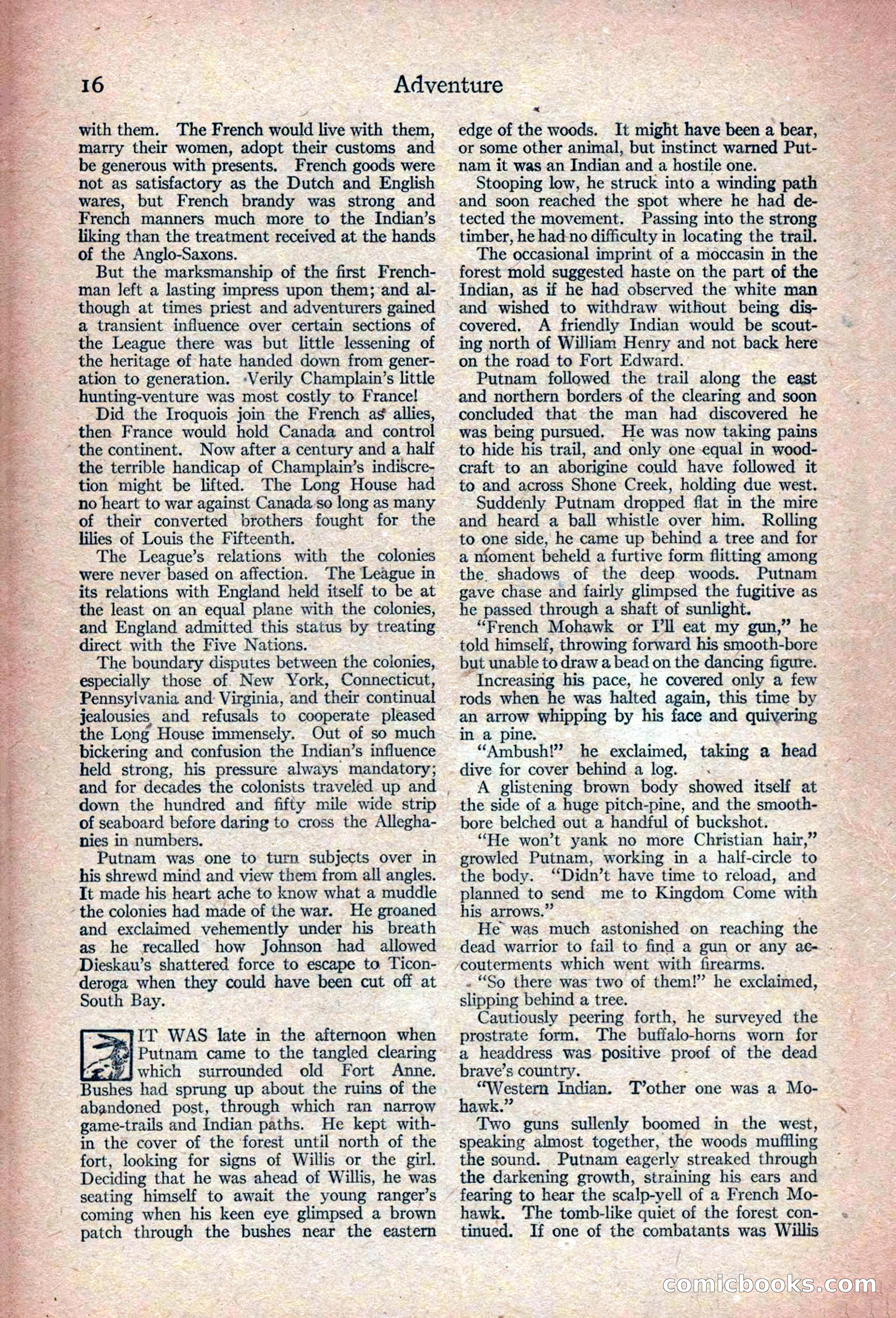
A restored page from Pulp Fiction, 1920. Page through the whole issue in the reader above.
📄 Transcribed text from this page (OCR, searchable)
Machine-transcribed from the original scan — historical spelling and the odd misread are preserved.
ae oie s : : Sn! te \ ~ a iis Ay apnea Semen Ae Cau? 4 Re CES 9: ROPE ss. pM ei Sere Ae Te Oe oe Re “ye 1 AS: 33% f ae et ESHER ES. ¢ GY: Ad oa baad ene, e Mee A ey ate Amy $ wa ro ad * yoy ad ae ’ i. Pes | POs aes) fe. y. REE CSU KONA Ns ae I a SEER UAE Se or ged Fa See, AO ae ee y : ; me Ate ay F 7 . oe ia Nay * the continent. a EA Lae he ag as Loi sh gia ¥ ow a ~~ : 16 with them. The French would live with them, marry their women, adopt their customs and be generous with presents. French goods were not as satisfactory as the Dutch and English wares, but French brandy was strong and French manners much more to the Indian’s liking than the treatment received at the hands of the Anglo-Saxons. But the marksmanship of the first French- man left a lasting impress upon them; and al- though at times priest and adventurers gained a transient influence over certain sections of the League there was but little lessening of the heritage of hate handed down from gener- ation to generation. -Verily Champlain’s little hunting-venture was most costly to France! Did the Iroquois join the French ag allies, then France would hold Canada and control Now after a century and a half the terrible handicap of Champlain’s indiscre- tion might be lifted. The Long House had no heart to war against Canada so long as many of their converted brothers fought for the lilies of Louis the Fifteenth. The League’s relations with the colonies were never based on affection. The League in its relations with England held itself to be at the least on an equal plane with the colonies, and England admitted this status by treating direct with the Five Nations. The boundary disputes between the colonies, especially those of New York, Connecticut, Pennsylvania and: Virginia, and their continual jealousies and refusals to cooperate pleased the Long House immensely. Out of so much bickering and confusion the Indian’s influence held strong, his pressure always mandatory; and for decades the colonists traveled up and , down the hundred and fifty mile wide strip of seaboard before daring to cross the Allegha- nies in numbers. Putnam was one to turn subjects over in his shrewd mind and view them from all angles. It made his heart ache to know what a muddle ‘the colonies had made of the war. He groaned and exclaimed vehemently under his breath as he recalled how Johnson had allowed Dieskau’s shattered force to escape to Ticon- deroga when they could have been cut off at South Bay. IT WAS late in the afternoon when 9 which surrounded old Fort Anne. Bushes had sprung up about the ruins of the abandoned post, through which ran narrow game-trails and Indian paths. He kept with- in the cover of the forest until north of the fort, looking for signs of Willis or the girl. Deciding that he was ahead of Willis, he was seating himself to await the young ranger’s coming when his keen eye glimpsed a brown patch through the bushes near the eastern #3} Putnam came to the tangled clearing § Adventure < edge of the woods. or some other animal, but instinct warned Put- nam it was an Indian and a hostile one. Stooping low, he struck into a winding path and soon reached the spot where he had de- tected the movement. Passing into the strong timber, he had-no difficulty in locating the trail. The occasional imprint of a moccasin in the forest mold suggested haste on the part of the Indian, as if he had observed the white man and wished to withdraw without being dis- covered. A friendly Indian would be scout- ing north of William Henry and not back here on the road to Fort Edward. It might have been a bear, — Putnam followed the trail along the east | and northern borders of the clearing and soon concluded that the man had discovered he was being pursued. He was now taking pains to hide his trail, and only one equal in wood- craft to an aborigine could have followed it to and across Shone Creek, holding due west. Suddenly Putnam dropped flat in the mire and heard a ball whistle over him. Rolling to one side, he came up behind a tree and for a nfoment beheld a furtive form flitting among the. shadows of the deep woods. Putnam gave chase and fairly glimpsed the fugitive as he passed through a shaft of sunlight. “French Mohawk or I'll eat my gun,” he told himself, throwing forward his smooth-bore but unable to draw a bead on the dancing figure. Increasing his pace, he covered only a few rods when he was halted again, this time by an arrow whipping by his face and quivering in a pine. “Ambush!” he exclaimed, taking a head dive for cover behind a log. . A glistening brown body showed itself at the side of a huge pitch-pine, and the smooth- bore belched out a handful of buckshot. “He won’t yank no more Christian hair,” growled Putnam, working in a half-circle to the body. “Didn’t have time to reload, and planned to. send me to Kingdom Come with his arrows.’ He was much astonished on reaching the dead warrior to fail to find a gun or any ac - ‘couterments which went with firearms. - “So there was two of them!” he exclaimed, slipping behind a tree. Cautiously peering forth, he surveyed the prostrate form. The buffalo-horns worn for a headdress was positive proof of the dead brave’s country. “Western Indian. T’other one was a Mo- hawk.” Two guns sullenly boomed in the west, speaking almost together, the woods muffling the sound. Putnam eagerly streaked through the darkening growth, straining his ears and fearing to hear the scalp-yell of a French Mo- hawk. The tomb-like quiet of the forest con- tinued. If one of the combatants was Willis COPMICG OOO KS (E@)