
Pulp Fiction, 1920 · page 21 of 172
Adventure Magazine Cover — page 21: what you’re looking at
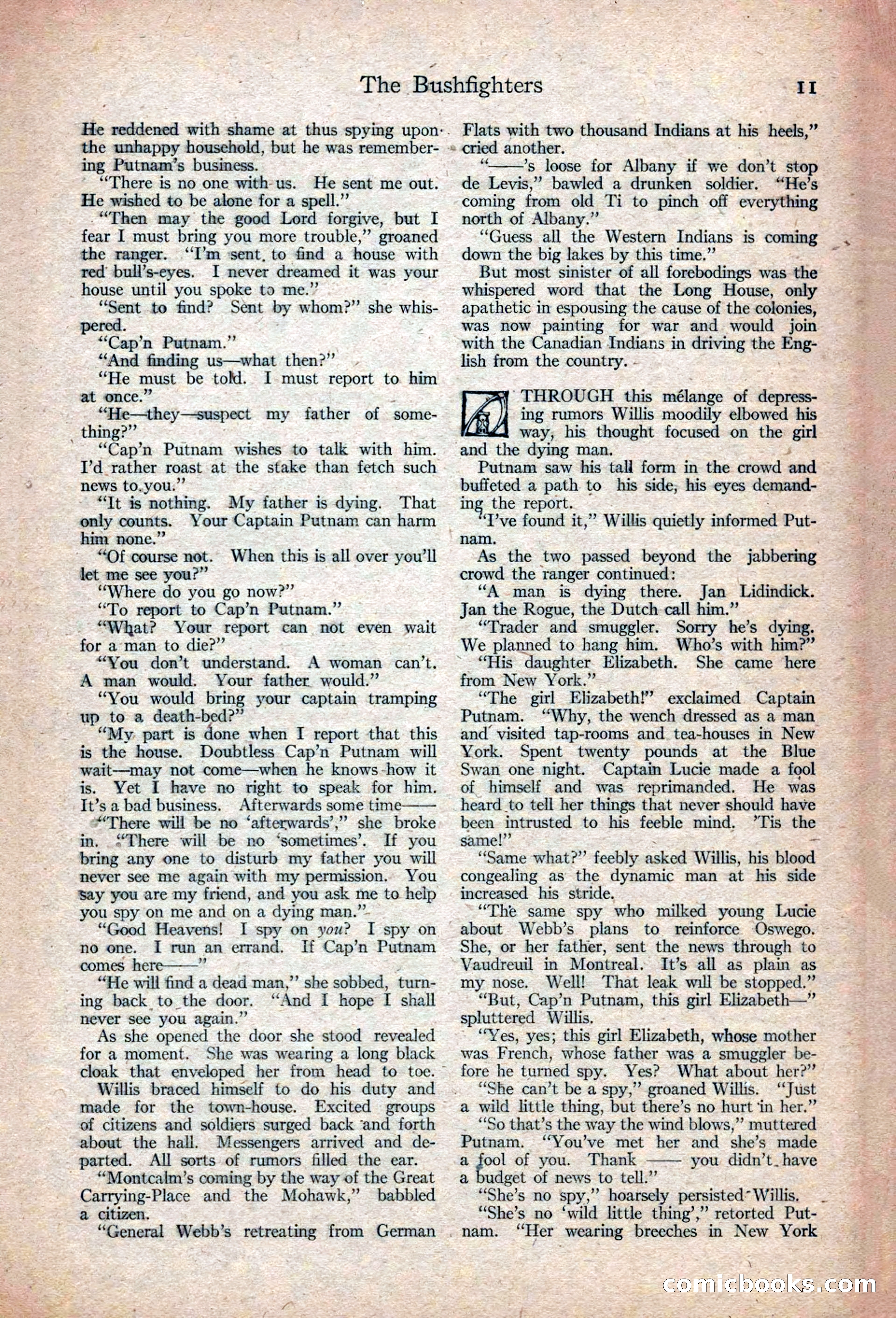
A restored page from Pulp Fiction, 1920. Page through the whole issue in the reader above.
📄 Transcribed text from this page (OCR, searchable)
Machine-transcribed from the original scan — historical spelling and the odd misread are preserved.
The Bushfighters He reddened with shame at thus spying upon:. the unhappy household, but he was remember- » ing Putnam’s business. ~ “There is no one with-us. He sent me out. He wished to be alone for a spell.” .“Then may the good Lord forgive, but I fear I must bring you more trouble,” groaned the “T’m ‘sent, to find a house with red’ bull’s-eyes. I never dreamed it was your _ house until you spoke to me.” “Sent to find? pered. “Cap’n Putnam.” “And finding us—what then?’ “He must be told. I must report to him at once.’ “He—they —suspect my father of some- Sent by whom?” she whis- _ thing?” “Cap'n Putnam wishes to talk with him. I’d rather roast at the stake than fetch such news to.you.” “Tt is nothing. My father is dying. That only counts, him none.’ “Of course not. When this is all over you’ll let me see you?” “Where do you go now?” “To report to Cap’n Putnam.” “What? Your report can not even wait for a-man to die?” “Vou don’t understand. A woman can’t. A man would. Your father would.” “You would bring your captain tramping up to a death-bed?” “My part is done when I report that this ds the house. Doubtless Cap’n Putnam will wait—may not come—when he knows-how it is. Yet I have no right to speak for him. It’s a bad business. Afterwards some time—— “There will be no ‘afterwards’,” she broke in, “There will be no ‘sometimes’. If you bring any one to disturb my father you will never see me again with my permission. You Say you are my friend, and you ask me to help you spy on me and on a dying man.’ “Good Heavens! I spy on you? I spy on no one. I run an errand, If Cap’n Putnam comes here——” “He will find a dead man,”’ she sobbed, turn- ing back to the door. “And I hope I shall never see you again.” As she opened the door she stood revealed for a moment. She was wearing a long black cloak that enveloped her from head to toe.” Willis braced himself to do his duty and made for the town-house. of citizens and soldiers surged back ‘and forth about the hall. Messengers arrived and de- parted. All sorts of rumors filled the ear. “Montcalm’s coming by the way of the Great Carrying-Place and the Mohawk,” babbled a citizen. “General Webb’s retreating from German Your Captain Putnam can harm — Excited groups © . Nam. Flats with two thousand Indians at his heels,”’ "cried another. de Levis,” bawled a drunken soldier. “He’s coming from old Ti to pinch off ee north of Albany.” “Guess all the Western Indians is coming down the big lakes by this time.” But most sinister of all forebodings was the whispered word that the Long House, only apathetic in espousing the cause of the colonies, was now painting for war and would join with the Canadian Indians in driving the bce lish from the country. - ) THROUGH this tablanigie of SSS fz}, ing rumors Willis moodily elbowed his / way; his thought focused on the ee ‘anal the dying man. Putnam saw his tall form in the crowd eiad : buffeted a path to his side; his eyes demand- ing the report. ‘I’ve found it,” Willis quietly stetrhaih Put- nam. crowd the ranger continued: “A man is dying there. Jan Lidindick. Jan the Rogue, the Dutch call him.” “Trader and smuggler. Sorry he’s dying. We planned to hang him. Who’s with him?” “His daughter, Elizabeth. She came here from New York.” “The girl Elizabeth!” exclaimed Cantnéi Putnam. “Why, the wench dressed as a man and visited tap-rooms and. tea-houses in New York. Spent twenty pounds at the Blue Swan one night. Captain Lucie made a fool of himself and was reprimanded. He was heard to tell her things that never should have been intrusted to his feeble mind. Tis the: same!”’ “Same what?” feebly asked Willis, his bleed: congealing as the dynamic man at his side increased his stride. “The same spy who milked young Lucie about Webb’s plans to reinforce Oswego. She, or her father, sent the news through to Vaudreuil in Montreal. It’s all as plain as my nose. Well! That leak will be stopped.” “But, Cap’n Putnam, this girl Elizabeth—” spluttered Willis, “Yes, yes; this girl Elizabeth, whose mother was French, whose father was a smuggler be- fore he turned spy. Yes? What about her?’ “She can’t be a spy,” groaned Willis. ‘Just a wild little thing, but there’s no hurt tin her.” _ “So that’s the way the wind blows,” muttered Putnam. ‘“You’ve met her and she’s made a fool of you. Thank you didn’t. have udget of news to tell.” “She’s no spy,” hoarsely persisted* Willis. “She’s no ‘wild little thing’,” retorted Put- (E@) AMC {1S ’s loose for Albany if we don’t stop | As the two passed beyond the jabbering “Her wearing breeches in New York IOOKS