
Pulp Fiction, 1920 · page 159 of 172
Adventure Magazine Cover — page 159: what you’re looking at
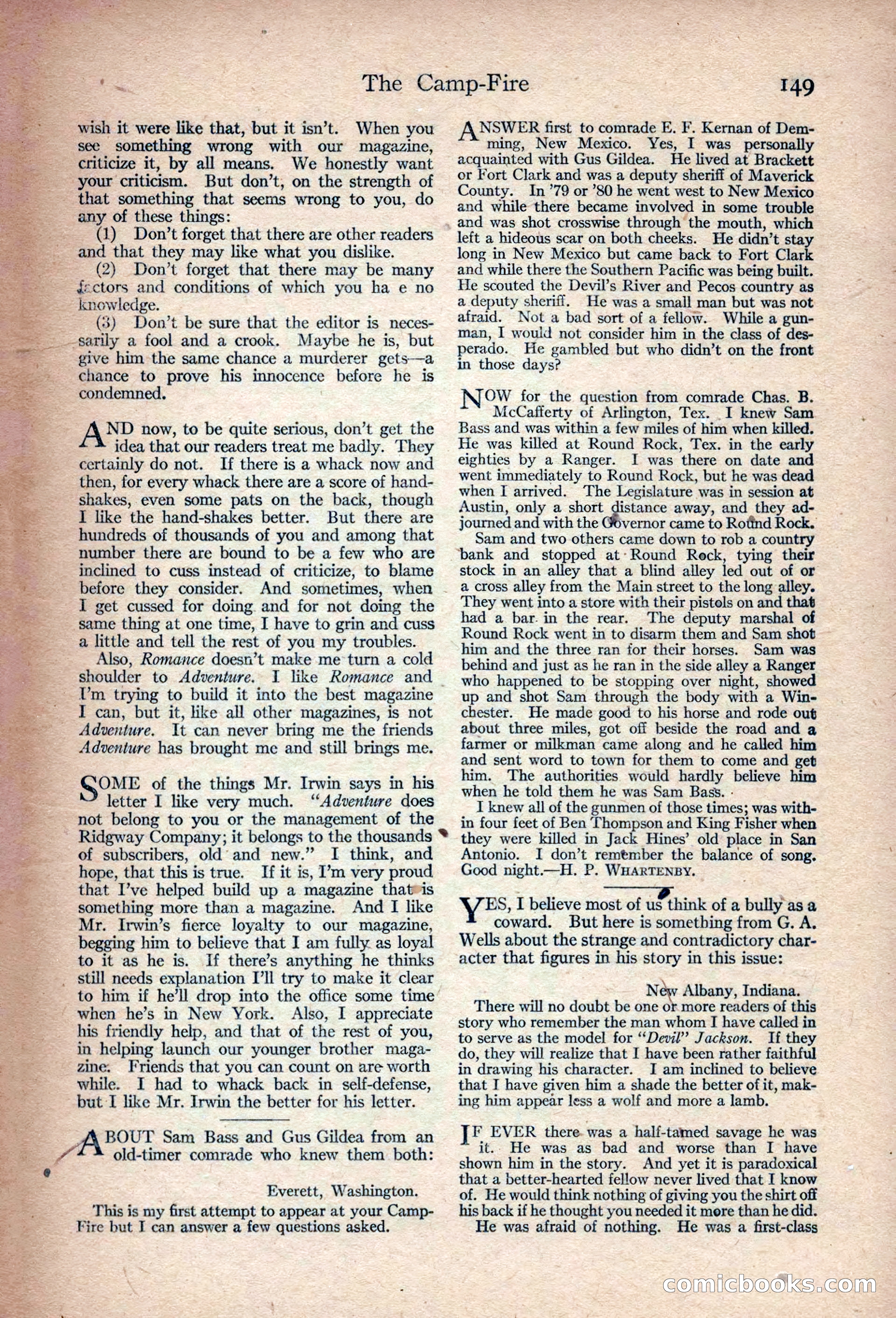
A restored page from Pulp Fiction, 1920. Page through the whole issue in the reader above.
📄 Transcribed text from this page (OCR, searchable)
Machine-transcribed from the original scan — historical spelling and the odd misread are preserved.
Ne ig ~ condemned. wish it were like that, but it isn’t. When you see something wrong with our magazine, ¢fiticize it, by all means. We honestly want _ your criticism. But don’t, on the strength of _ that something that seems wrong to you, do any of these things: (1) Don’t forget that there are other readers and that they may like what you dislike. (2) Don’t forget that there may be many dectors and conditions of which you ha e no _ knowledge. (3) Don’t be sure that the editor is neces- = __sarily a fool and a crook. Maybe he is, but give him the same chance a murderer gets—a chance to prove his innocence before he is “ SS ANP now, to be quite serious, don’t get the idea that our readers treat me badly. They certainly do not. If there is a whack now and then, for every whack there are a score of hand- shakes, even some pats on the back, though I like the hand-shakes better. But there are hundreds of thousands of you and among that number there are bound to be a few who are inclined to cuss instead of criticize, to blame before they consider. And sometimes, when - BS J get cussed for doing and for not doing the ‘same thing at one time, I have to grin and cuss 3 a little and tell the rest of you my troubles. Also, Romance doesn’t make me turn a cold shoulder to Adventure. I like Romance and | = Vm trying to build it into the best magazine I can, but it, like all other magazines, is not Adventure. It can never bring me the friends Adventure has brought me and still brings me. GOME of the things Mr. Irwin says in his letter I like very much. “Adventure does : ; _ not belong to you or the management of the __ Ridgway Company; it belongs to the thousands * of subscribers, old and new.” I think, and hope, that this is true. If it is, I’m very proud that I’ve helped build up a magazine that™is something more than a magazine. And I like Mr. Irwin’s fierce loyalty to our magazine, begging him to believe that I am fully as loyal to it as he is. If there’s anything he thinks _ still needs explanation Ill try to make it clear to him if he'll drop into the office some time - when he’s in New York. Also, I appreciate his friendly help, and that of the rest of you, in helping launch our younger brother maga- zine. Friends that you can count on are worth while. I had to whack back in self-defense, but I like Mr. Irwin the better for his letter. BOUT Sam Bass and Gus Gildea from an old-timer comrade who knew them both: Everett, Washington. This is my first attempt to appear at your Camp- Fire but I can answer a few questions asked. The Camp-Fire 149 ANSWER first to comrade E. F. Kernan of Dem- ming, New Mexico. Yes, I was _ personally acquainted with Gus Gildea. He lived at Brackett or Fort Clark and was a deputy sheriff of Maverick County. In’79 or ’80 he went west to New Mexico and while there became involved in some trouble _ and was shot crosswise through the mouth, which left a hideous scar on both cheeks. He didn’t sta long in New Mexico but came back to Fort Clar and while there the Southern Pacific was being built. He scouted the Devil’s River and Pecos country as a deputy sheriff. He was a small man but was not afraid. Not a bad sort of a fellow. While a gun- man, I would not consider him in the class of des- perado. He gambled but who didn’t on the front in those days? Now for the question from comrade Chas. B. McCafferty of Arlington, Tex. I knew Sam Bass and was within a few miles of him when killed. He was killed at Round Rock, Tex. in the early eighties by a Ranger. I was there on date and went immediately to Round Rock, but he was dead when I arrived. The Legislature was in session at Austin, only a short distance away, and they ad- journed and with the Governor came to Rotind Rock. Sam and two others came down to rob a country ‘bank and stopped at~Round Reck, tying their stock in an alley that a blind alley led out of or a cross alley from the Main street to the long alley. They went into a store with their pistols on and that had a bar. in the rear. The deputy marshal of Round Rock went in to disarm them and Sam shot him and the three ran for their horses. Sam was behind and just as he ran in the side alley a Ranger who happened to be stopping over night, showed up and shot Sam through the body with a Win- chester. He made good to his horse and rode out about three miles, got off beside the road and a farmer or milkman came along and he called him and sent word to town for them to come and get him. The authorities would hardly believe him when he told them he was Sam Bass. - I knew all of the gunmen of those times; was with- in four feet of Ben Thompson and King Fisher when they were killed in Jack Hines’ old place in San Antonio. I don’t remtmber the balance of song. Good night.—H. P. WHARTENBY. ES, I believe most of us think of a bully as a coward. But here is something from G. A. Wells about the strange and contradictory char- acter that figures in his story in this issue: New Albany, Indiana. There will no doubt be one or more readers of this story who remember the man whom I have called in to serve as the model for “Devil” Jackson. If they do, they will realize that I have been rather faithful in drawing his character. I am inclined to believe that I have given him a shade the better of it, mak- ing him appear less a wolf and more a lamb. JF EVER there. was a half-tamed savage he was it.. He was as bad and worse than I have shown him in the story. And yet it is paradoxical that a better-hearted fellow never lived that I know of. He would think nothing of giving you the shirt off his back if he thought you needed it more than he did. He was afraid of nothing. He was a first-class COPMNICGLOOOKS