
Pulp Fiction, 1920 · page 133 of 172
Adventure Magazine Cover — page 133: what you’re looking at
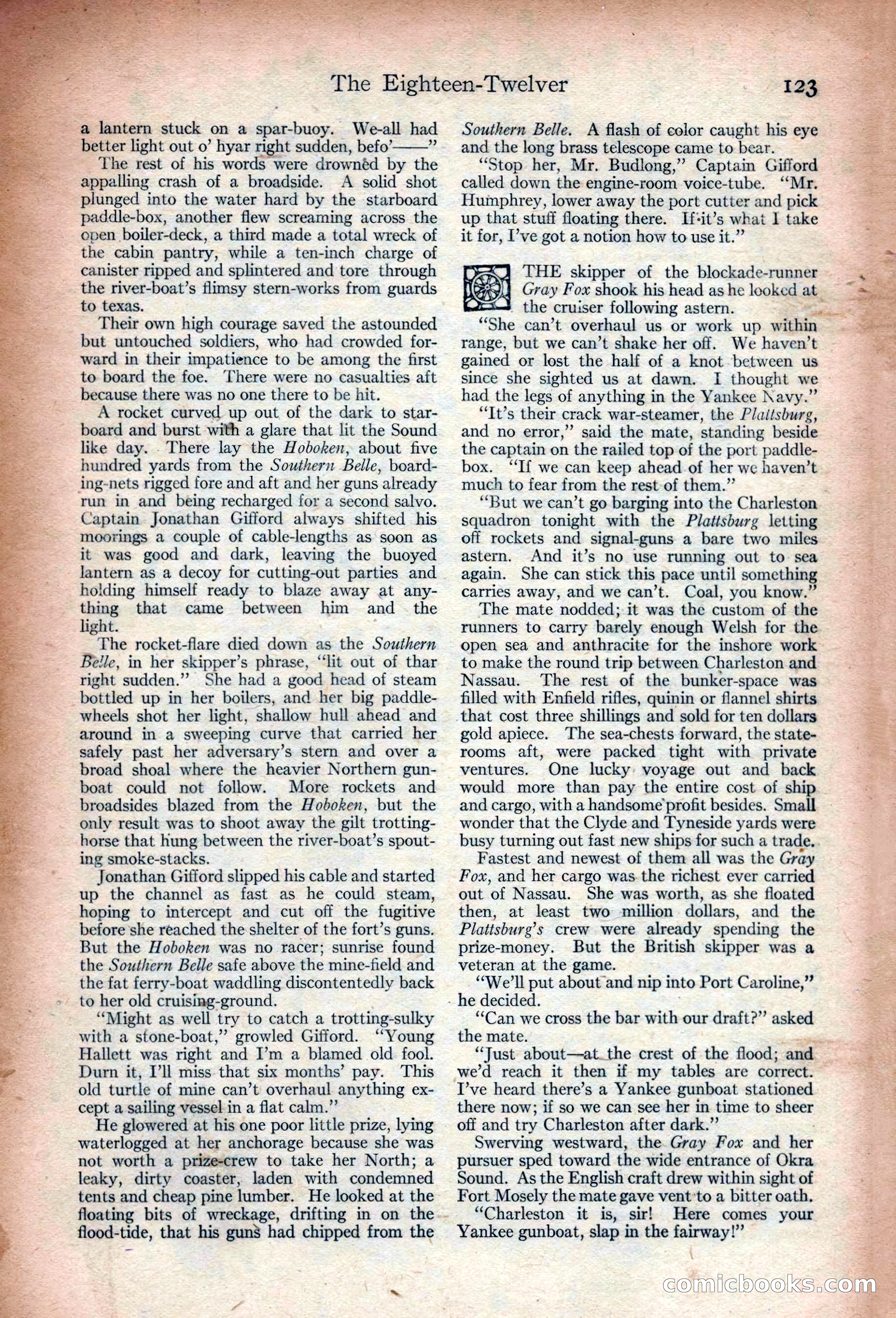
A restored page from Pulp Fiction, 1920. Page through the whole issue in the reader above.
📄 Transcribed text from this page (OCR, searchable)
Machine-transcribed from the original scan — historical spelling and the odd misread are preserved.
bat = € ‘appalling crash of a broadside. plunged into the water hard by the starboard The Eighteen-Twelver ef. Jantern stuck on a 5 arse. We-all had better light out o’ hyar right sudden, befo’—— The rest of his words were drownéd by the A solid shot paddle-box, another flew screaming across the epen boiler-deck, a third made a total wreck of the cabin pantry, while a ten-inch charge of canister ripped and splintered and tore through the river-boat’s flimsy stern-works from guards to texas. _ Their own high courage saved the astounded but untouched soldiers, who had crowded for- ward in their impatience to be among the first to board the foe. There were no casualties aft because there was no one there to be hit. A rocket curved up out of the dark to star- board and burst with a glare that lit the Sound like day. . There lay the Hoboken, about five hundred yards from the Southern Belle, board- ing-nets rigged fore and aft and her guns already run in and being recharged for a second salvo. Captain Jonathan Gifford always shifted his moorings a couple of cable-lengths as soon as it was good and dark, leaving the buoyed -_. Jantern as a decoy for cutting-out parties and holding himself ready to blaze away at any- thing that came between him and the light. The rocket-flare died down as the Southern Belle, in her skipper’s phrase, “lit out of thar right sudden.”” She had a good head of steam _bottled up in her boilers, and her big paddle- wheels shot her light, shallow hull ahead and around in a sweeping curve that carried her safely past her adversary’s stern and over a broad shoal where the heavier Northern gun- boat could not follow. More rockets and broadsides blazed from the Hoboken, but the only result was to shoot away the gilt trotting- horse that hung between the river-boat’s spout- ing smoke-stacks. Jonathan Gifford slipped his cable and started up the channel as fast as he could steam, hoping to intercept and cut off the fugitive before she reached the shelter of the fort’s guns. But the Hoboken was no racer; sunrise found the Southern Belle safe above the mine-field and the fat ferry-boat waddling discontentedly back _ to her old cruising-ground. ‘Might as well try to catch a trotting-sulky with a stone-boat,” growled Gifford. “Young Hallett was right and I’m a blamed old fool. Durn it, I’ll miss that six months’ pay. This old turtle of mine can’t overhaul anything ex- cept a sailing vessel in a flat calm.” He glowered at his one poor little prize, lying waterlogged at her anchorage because she was not worth a prize-crew to take her North; a leaky, dirty coaster, laden with condemned tents and cheap pine lumber. He looked at the floating bits of wreckage, drifting in on the - flood- tide, that his guns had chipped from the that cost three shillings and sold for ten dollars - he decided. we'd reach it then if my tables are correct. Southern Belle. A flash of color caught his eye — and the long brass telescope came to bear. “Stop her, Mr. Budlong,” Captain Gifford called down the engine-room voice-tube. “Mr. Humphrey, lower away the port cutter and pick up that stuff floating there. Ifit’s what I take it for, ’'ve got a notion how to use it.” THE skipper of the blockade-runner } Gray Fox shook his head as he looked ae . | . the cruiser following astern. i “She can’t overhaul us or work up within . — range, but we can’t shake her off. We haven’t gained or lost the half of a knot between us since she sighted us at dawn. I thought we had the legs of anything in the Yankee Navy.” “It’s their crack war-steamer, the Plaitsburg, re oe and no error,” said the mate, standing beside the captain on the railed top of the port paddle- box. “If we can keep ahead of her we haven’t Es much to fear from the rest of them.” : a “But we can’t go barging into the Charleston e° squadron tonight with the Platisburg letting — Papa off rockets and signal-guns a bare two miles em Fe astern. And it’s no use running out to sea = again. She can stick this pace until something $53 carries away, and we can’t. Coal, you know.” eS The mate nodded; it was the custom of the ae runners to carry barely enough Welsh for the = open sea and anthracite for the inshore work to make the round trip between Charleston and Nassau. The rest of the bunker-space was filled with Enfield rifles, quinin or flannel shirts gold apiece. The sea-chests forward, the state- rooms aft, were packed tight with private ventures. One lucky: voyage out and back would more than pay the entire cost of ship and cargo, with a handsome’profit besides. Small wonder that the Clyde and Tyneside yards were busy turning out fast new ships for such a trade. Fastest and newest of them all was the Gray Fox, and her cargo was. the richest ever carried A ae out ‘of N assau. She was worth, as she floated Eee then, at least two million dollars, and the i Platitsburg’s crew were already spending the prize-money. But the British skipper was a veteran at the game. “We'll put about and nip into Port Caroline,” ““Can we cross the bar with our draft?” asked the mate. Diino ‘Just about—at_the crest of the flood; and 5 I’ve heard there’s a Yankee gunboat stationed there now; if so we can see her in time to sheer off and try Charleston after dark.” Swerving westward, the Gray Fox and her pursuer sped toward the wide entrance of Okra Sound. As the English craft drew within sight of Fort Mosely the mate gave vent’to a bitter oath, “Charleston it is, sir! Here comes your Yankee gunboat, slap in the fairway!” CORMICLOO©