
Pulp Fiction, 1920 · page 118 of 172
Adventure Magazine Cover — page 118: what you’re looking at
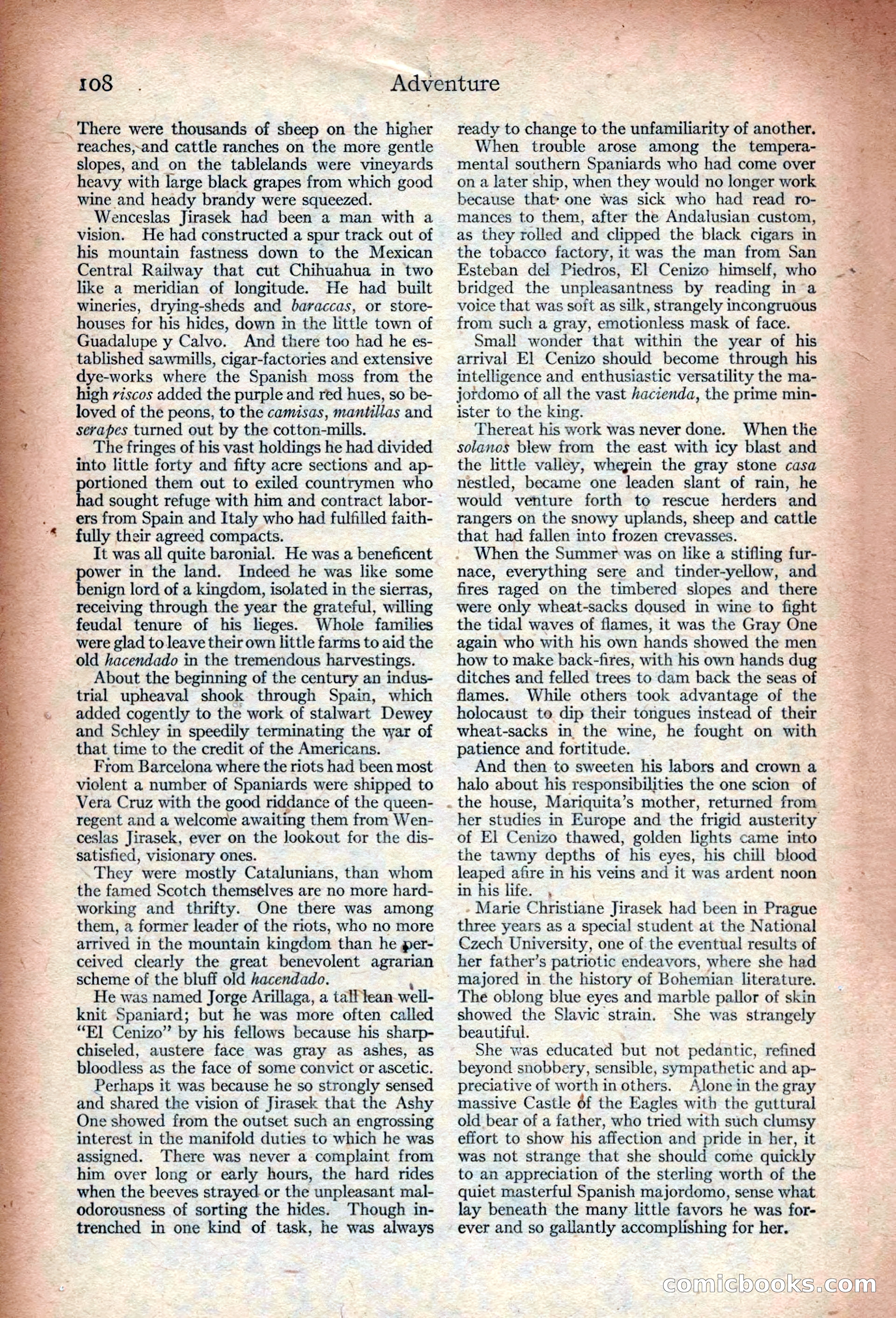
A restored page from Pulp Fiction, 1920. Page through the whole issue in the reader above.
📄 Transcribed text from this page (OCR, searchable)
Machine-transcribed from the original scan — historical spelling and the odd misread are preserved.
108 -" " - _— ae Tn —s oe = # a Guadalupe y Calvo. _tablished sawmills, cigar-factories and extensive There were thousands of sheep on the higher reaches,-and cattle ranches on the more gentle slopes, and on the tablelands were vineyards _ heavy with large black grapes from which good wine and heady brandy were squeezed. Wenceslas Jirasek had been a man with a vision. He had constructed a spur track out of his mountain fastness down to the Mexican Central Railway that cut Chihuahua in two like a meridian of longitude. He had built - wineries, drying-sheds and baraccas, or store- houses for his hides, down in the little town of And there too had he es- dye-works where the Spanish moss from the high riscos added the purple and red hues, so be- loved of the peons, to the camisas, mantillas and serapes turned out by the cotton-mills. The fringes of his vast holdings he had divided into little forty and fifty acre sections and ap- portioned them out to exiled countrymen who had sought refuge with him and contract labor- ers from Spain and Italy who had fulfilled faith- fully their agreed compacts. It was all quite baronial. He was a beneficent power in the land. Indeed he was like some benign lord of a kingdom, isolated in the sierras, receiving through the year the grateful, willing feudal tenure of his lieges. Whole families were glad to leave their own little farms to aid the old kacendado in the tremendous harvestings. About the beginning of the century an indus- trial upheaval shook through Spain, which added cogently to the work of stalwart Dewey and Schley in speedily terminating the war of that time to the credit of the Americans. From Barcelona where the riots had been most violent a number of Spaniards were shipped to Vera Cruz with the good riddance of the queen- regent and a welcome awaiting them from Wen- ceslas Jirasek, ever on the Jookout for the dis- satisfied, visionary ones. They were mostly Catalunians, than whom the famed Scotch themselves are no more hard- working and thrifty. One there was among them, a former leader of the riots, who no more arrived in the mountain kingdom than he per- ceived clearly the great benevolent agrarian scheme of the bluff old hacendado. ‘ He was named Jorge Arillaga, a tall lean well- knit Spaniard; but he was more often called “El Cenizo” by his fellows because his sharp- chiseled, austere face was gray as ashes, as bloodless as the face of some convict or ascetic. Perhaps it was because he so strongly sensed and shared the vision of Jirasek that the Ashy One showed from the outset such an engrossing interest in the manifold duties to which he was assigned. There was never a complaint from him over long or early hours, the hard rides when the beeves strayed. or the unpleasant mal- odorousness of sorting the hides. Though in- trenched in one kind of task, he was always vee F o i i i) ist Pe “ne £ Adventure a ready to change to the unfamiliarity of another, When trouble arose among the tempera- mental southern Spaniards who had come over on a later ship, when they would no longer work because that» one was sick who had read ro- mances to them, after the Andalusian custom, as they rolled and clipped the black cigars in = the tobacco factory, it was the man from San Esteban del Piedros, El Cenizo himself, who 3 bridged the unpleasantness by reading in “a_ voice that was soft as silk, strangely incongruous from such a gray, emotionless mask of face. Small wonder that within the year of his arrival El Cenizo should become through his intelligence and enthusiastic versatility the ma- jordomo of all the vast hacienda, the prime min- ister to the king. 3 _ Thereat his work was never done. When the solanes blew from the east with icy blast and the little valley, wheyein the gray stone casa nestled, became one leaden slant of rain, he would venture forth to rescue herders and rangers on the snowy uplands, sheep and cattle that had fallen into frozen crevasses. =: When the Summer was on like a stifling fur- nace, everything sere and tinder-yellow, and fires raged on the timbered slopes and there — were only wheat-sacks doused in wine to fight the tidal waves of flames, it was the Gray One again who with his own hands showed the men how to make back-fires, with his own hands dug ditches and felled trees to dam back the seas of flames. While others took advantage of the holocaust to dip their tongues instead of their wheat-sacks in the wine, he fought on with ) patience and fortitude. And then to sweeten his labors and crown a halo about his responsibilities the one scion of the house, Mariquita’s mother, returned from her studies in Europe and the frigid austerity of El Cenizo thawed, golden lights came into the tawny depths of his eyes, his chill blood leaped afire in his veins and it was ardent noon in his life. , ; - Marie Christiane Jirasek had been in Prague three years as a special student at the National Ss €zech University, one of the eventual results of pees > her father’s patriotic endeavors, where she had ce - majored in the history of Bohemian literature. The oblong blue eyes and marble pallor of skin showed the Slavic strain. She was strangely beautiful. She was educated but not pedantic, refined beyond snobbery, sensible, sympathetic and ap- preciative of worth in others. Alone in the gray massive Castle 6f the Eagles with the guttural old bear of a father, who tried with such clumsy effort to show his affection and pride in her, it was not strange that she should come quickly to an appreciation of the sterling worth of the quiet masterful Spanish majordomo, sense what lay beneath the many little favors he was for- ever and so gallantly accomplishing for her. CORMIGLOO©