
Pulp Fiction, 1920 · page 81 of 208
Adventure Magazine Cover — page 81: what you’re looking at
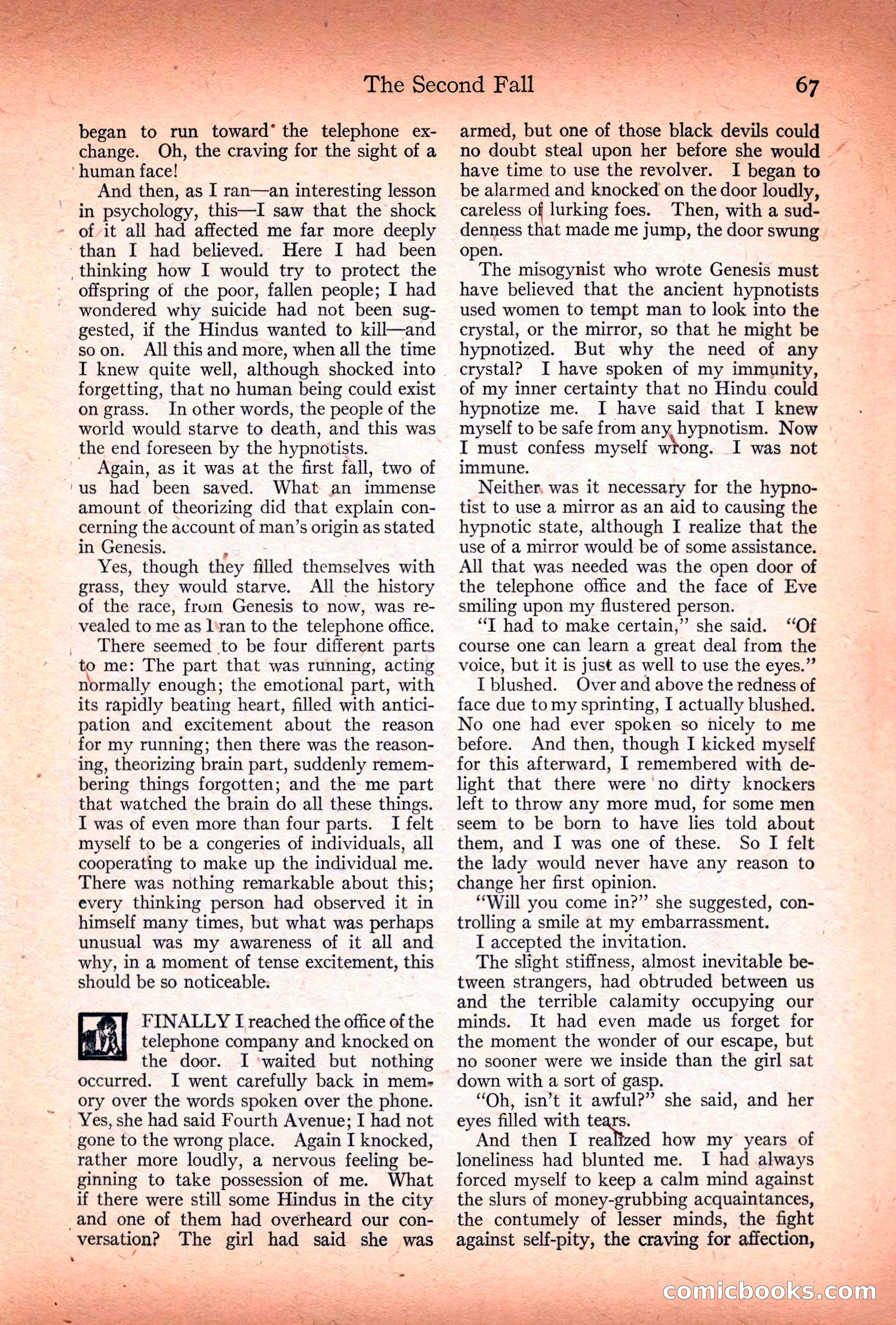
A restored page from Pulp Fiction, 1920. Page through the whole issue in the reader above.
📄 Transcribed text from this page (OCR, searchable)
Machine-transcribed from the original scan — historical spelling and the odd misread are preserved.
= Se =a cow — Sen = — 2 ee as = Toe ae aes ‘4 a * = St ats > > <<." 3 began to run toward” the telephone ex- change. Oh, the craving for the sight of a ‘human face! And then, as I ran—an interesting lesson in psychology, this—I saw that the shock - of it all had affected me far more deeply ‘than I had believed. Here I had been thinking how I would try to protect the offspring of the poor, fallen people; I had wondered why suicide had not been sug- gested, if the Hindus wanted to kill—and soon. All this and more, when all the time I knew quite well, although shocked into forgetting, that no human being could exist on grass. In other words, the people of the world would starve to death, and this was the end foreseen by the hypnotists. Again, as it was at the first fall, two of us had been saved. What an immense amount of theorizing did that explain con- cerning the account of man’s origin as stated in Genesis. Yes, though they filled themselves with grass, ‘they would starve. All the history of the race, from Genesis to now, was re- vealed to me as l'ran to the telephone office. There seemed to be four different parts to me: The part that was running, acting normally enough; the emotional part, with its rapidly beating heart, filled with antici- pation and excitement about the reason for my running; then there was the reason- ing, theorizing brain part, suddenly remem- bering things forgotten; and the me part that watched the brain do all these things. I was of even more than four parts. I felt myself to be a congeries of individuals, all cooperating to make up the individual me. There was nothing remarkable about this; every thinking person had observed it in himself many times, but what was perhaps unusual was my awareness of it all and why, in a moment of tense excitement, this should be so noticeable. FINALLY I reached the office of the telephone company and knocked on the door. I ‘waited but nothing occurred. I went carefully back in mem- ory over the words spoken over the phone. Yes, she had said Fourth Avenue; I had not gone to the wrong place. Again I knocked, rather more loudly, a nervous feeling be- ginning to take possession of me. What if there were still some Hindus in the city -and one of them had overheard our con- versation? The girl had said she was armed, but a one of those black devils could = no doubt steal upon her before she would — have time to use the revolver. I began to — be alarmed and knocked on the door loudly, careless of lurking foes. Then, with a sud- denness that made me jump, the door swung — open. The misogynist who wrote Genesis must have believed that the ancient hypnotists used women to tempt man to look into the crystal, or the mirror, so that he might be hypnotized. But why the need of any crystal? I have spoken of my immunity, of my inner certainty that no Hindu could hypnotize me. I have said that I knew myself to be safe from any. hypnotism. Now | I must confess myself wtong. I was not immune. Neither, was it necessary for the hypno- tist to use a mirror as an aid to causing the hypnotic state, although I realize that the use of a mirror would be of some assistance. All that was needed was the open door of the telephone office and the face of Eve smiling upon my flustered person. “T had to make certain,” she said. “Of course one can learn a great deal from the voice, but it is just as well to use the eyes.” I blushed. Over and above the redness of face due to my sprinting, I actually blushed. No one had ever spoken so nicely to me before. And then, though I kicked myself for this afterward, I remembered with de- light that there were no ditty knockers left to throw any more mud, for some men seem to be born to have lies told about them, and I was one of these. So I felt the lady would never have any reason to change her first opinion. “Will you come in?” she suggested, con- trolling a smile at my embarrassment. I accepted the invitation. The slight stiffness, almost inevitable be- tween strangers, had obtruded between us and the terrible calamity occupying our minds. It had even made us forget for the moment the wonder of our escape, but no sooner were we inside than the girl sat down with a sort of gasp. “Oh, isn’t it awful?” she said, and her eyes filled with <— And then I realized how my years of loneliness had blunted me. I had always forced myself to keep a calm mind against the slurs of money-grubbing acquaintances, the contumely of lesser minds, the fight against self-pity, the craving for affection, = —— ‘ a r\ SNS avi pS ~ A | r tes XS | a = rl = oe ¥, * a ~ ne ™ > 6 o de ae ba es - Fa Oe ee ee ane nore ae