
Pulp Fiction, 1920 · page 75 of 208
Adventure Magazine Cover — page 75: what you’re looking at
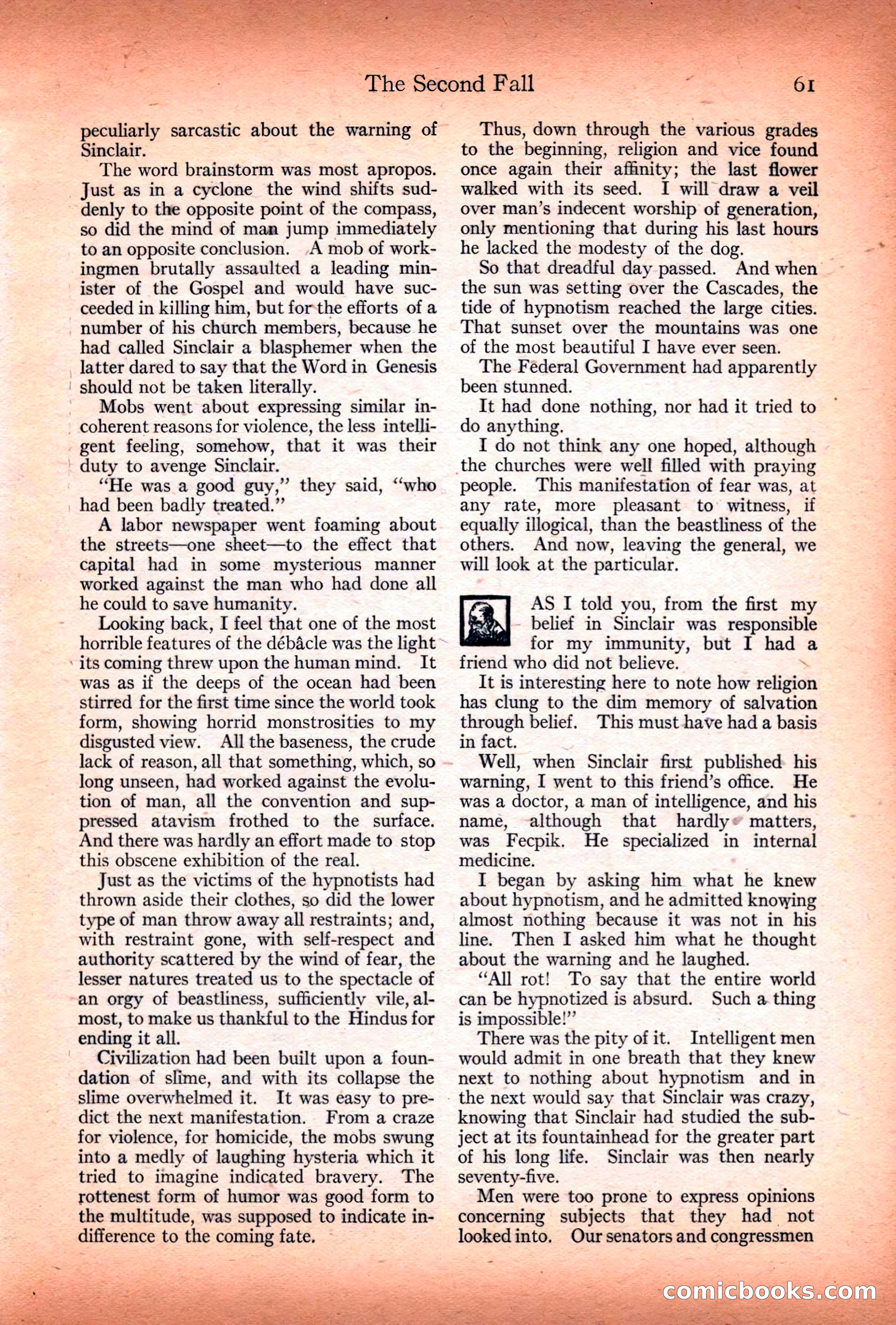
A restored page from Pulp Fiction, 1920. Page through the whole issue in the reader above.
📄 Transcribed text from this page (OCR, searchable)
Machine-transcribed from the original scan — historical spelling and the odd misread are preserved.
alisaly sarcastic about the warning of Sinclair. The word brainstorm was most apropos. Just as in a cyclone the wind shifts sud- - denly to the opposite point of the compass, so did the mind of man jump immediately to an opposite conclusion. A mob of work- ingmen brutally assaulted a leading min- ister of the Gospel and would have suc- ceeded in killing him, but forthe efforts of a - number of his church members, because he had called Sinclair a blasphemer when the latter dared to say that the Word in Genesis should not be taken literally. Mobs went about expressing similar in- - coherent reasons for violence, the less intelli- gent feeling, somehow, that it was their _ duty to avenge Sinclair. “He was a good guy,” they said, “who _ had been badly treated,” A labor newspaper went foaming about the streets—one sheet—to the effect that capital had in some mysterious manner worked against the man who had done all he could to save humanity. Looking back, I feel that one of the most horrible features of the débacle was the light” ‘its coming threw upon the human mind. It = saiterente to the coming, an ; ~<. e — Pe : > = a a aa aa was as if the deeps of the ocean had been stirred for the first time since the world took form, showing horrid monstrosities to my disgusted view. All the baseness, the crude lack of reason, all that something, which, so — long unseen, had worked against the evolu- tion of man, all the convention and sup- pressed atavism frothed to the surface. And there was hardly an effort made to stop this obscene exhibition of the real. Just as the victims of the hypnotists had thrown aside their clothes, so did the lower type of man throw away all restraints; and, with restraint gone, with self-respect and authority scattered by the wind of fear, the lesser natures treated us to the spectacle of -an orgy of beastliness, sufficiently vile, al- most, to make us thankful to the Hindus for ending it all. Civilization had been built upon a foun- dation of slime, and with its collapse the slime overwhelmed it. It was easy to pre- dict the next manifestation. From a craze for violence, for homicide, the mobs swung into a medly of laughing hysteria which it tried to imagine indicated bravery. The rottenest form of humor was good form to the multitude, was supposed to indicate in- 2 _ ne ds ~ ae Thus, aowe through the various eraites = to the beginning, religion and vice found once again their affinity; the last flower walked with its seed. I will draw a veil over man’s indecent worship of generation, only mentioning that during his last hours he lacked the modesty of the dog. So that dreadful day passed. And when — the sun was setting over the Cascades, the tide of hypnotism reached the large cities. That sunset over the mountains was one of the most beautiful I have ever seen. The Féderal Government had apparently been stunned. It had done nothing, nor had it tried to do anything. I do not think any one hoped, although the churches were well filled with praying people. This manifestation of fear was, at any rate, more pleasant to witness, if equally illogical, than the beastliness of the others. And now, leaving the general, we will look at the particular. AS I told you, from the first my - belief in Sinclair was responsible for my immunity, but I had a friend who did not believe. ‘ It is interesting here to note how religion has clung to the dim memory of salvation through belief. This must have had a basis in fact. Well, when Sinclair first published his warning, I went to this friend’s office. He was a doctor, a man of intelligence, and his name, although that hardly«* matters, was Fecpik. He specialized in internal medicine. I began by asking him what he knew about hypnotism, and he admitted knowing almost nothing because it was not in his line. Then I asked him what he thought about the warning and he laughed. “All rot! To say that the entire world can be hypnotized is absurd. Such a thing is impossible!”’ There was the pity of it. Intelligent men would admit in one breath that they knew next to nothing about hypnotism and in - the next would say that Sinclair was crazy, knowing that Sinclair had studied the sub- ject at its fountainhead for the greater part of his long life. Sinclair was then nearly seventy-five. Men were too prone to express opinions concerning subjects that they had not looked into. Our senators and eee _— — ar -; os “x a 2 Ds PL a 3 * ge ar a = — Se - a twee De ; ine on ae ’ ’ ia’ n TE uv at b ir eal # ThAL yr ; / aN : Yor 4 Ay: TH Pe Pere ener Mes ‘ . Het Ve) a eal ow Sin Aa’ ital ® SR Rae SA dh dity \s, ae itis | ~> oe A =a — 470 GS po << - om