
Pulp Fiction, 1920 · page 73 of 208
Adventure Magazine Cover — page 73: what you’re looking at
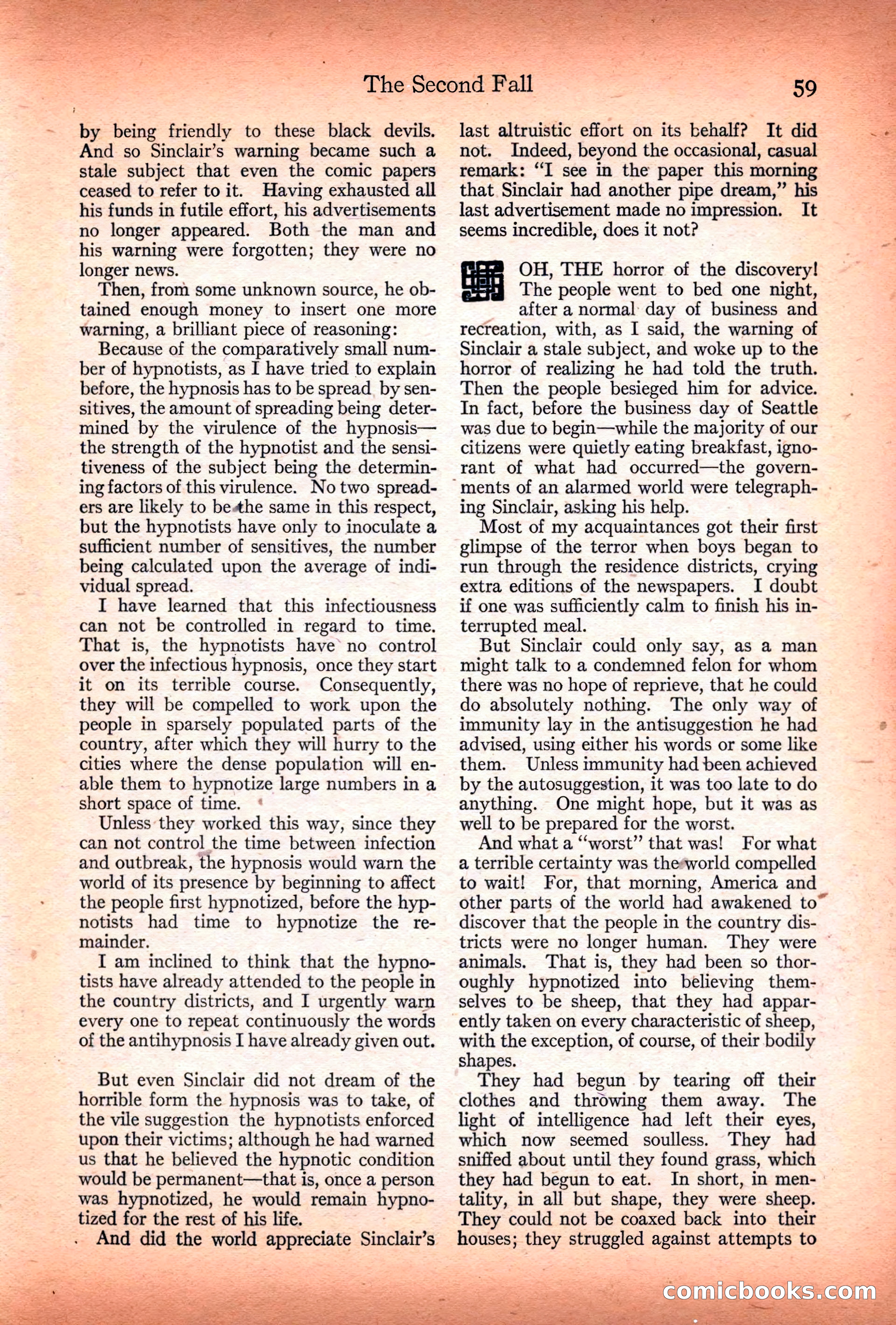
A restored page from Pulp Fiction, 1920. Page through the whole issue in the reader above.
📄 Transcribed text from this page (OCR, searchable)
Machine-transcribed from the original scan — historical spelling and the odd misread are preserved.
by being friendly to these black devils. And so Sinclair’s warning became such a stale subject that even the comic papers ceased to refer to it. Having exhausted all his funds in futile effort, his advertisements no longer appeared. Both the man and his warning were forgotten; they were no longer news. Then, from some unknown source, he ob- tained enough money to insert one more warning, a brilliant piece of reasoning: Because of the comparatively small num- ber of hypnotists, as I have tried to explain before, the hypnosis has to be spread_ by sen- sitives, the amount of spreading being deter- mined by the virulence of the hypnosis— the strength of the hypnotist and the sensi- tiveness of the subject being the determin- ing factors of this virulence. No two spread- ers are likely to beahe same in this respect, but the hypnotists have only to inoculate a sufficient number of sensitives, the number being calculated upon the average of indi- vidual spread. I have learned that this infectiousness can not be controlled in regard to time. That is, the hypnotists have’ no control over the infectious hypnosis, once they start it on its terrible course. Consequently, they will be compelled to work upon the people in sparsely populated parts of the country, after which they will hurry to the cities where the dense population will en- able them to hypnotize large numbers in a short space of time. * Unless they worked this way, since they can not control the time between infection and outbreak, the hypnosis would warn the world of its presence by beginning to affect the people first hypnotized, before the hyp- notists had time to hypnotize the re- mainder. I am inclined to think that the hypno- tists have already attended to the people in the country districts, and I urgently warn every one to repeat continuously the words of the antihypnosis I have already given out. But even Sinclair did not dream of the horrible form the hypnosis was to take, of the vile suggestion the hypnotists enforced upon their victims; although he had warned us that he believed the hypnotic condition would be permanent—that is, once a person was hypnotized, he would remain hypno- ee for the rest of his life. -noy eas the sees Pe ese Sinclair’ s last altruistic effort on its behalf? It did a not. Indeed, beyond the occasional, casual 2 remark: “I see in the paper this morning that Sinclair had another pipe dream,” his last advertisement made no impression. It seems incredible, does it not? OH, THE horror of the discovery! The people went to bed one night, after a normal: day of business and recreation, with, as I said, the warning of Sinclair a stale subject, and woke up to the horror of realizing he had told the truth. Then the people besieged him for advice. In fact, before the business day of Seattle was due to begin—while the majority of our citizens were quietly eating breakfast, igno- rant of what had occurred—the govern- “ments of an alarmed world were telegraph- - ing Sinclair, asking his help. Most of my acquaintances got their first glimpse of the terror when boys began to run through the residence districts, crying extra editions of the newspapers. I doubt if one was sufficiently calm to finish his in- terrupted meal. But Sinclair could only say, as a man might talk to a condemned felon for whom there was no hope of reprieve, that he could do absolutely nothing. The only way of immunity lay in the antisuggestion he had advised, using either his words or some like them. Unless immunity had been achieved by the autosuggestion, it was too late to do anything. One might hope, but it was as well to be prepared for the worst. And what a “‘worst” that was! For what a terrible certainty was therworld compelled to wait! For, that morning, America and other parts of the world had awakened to” discover that the people in the country dis- tricts were no longer human. They were © animals. That is, they had been so thor- oughly hypnotized into believing them- selves to be sheep, that they had appar- ently taken on every characteristic of sheep, with the exception, of course, of their bodily shapes. They had begun by tearing off their clothes and throwing them away. The light of intelligence had left their eyes, which now seemed soulless. They had sniffed about until they found grass, which they had begun to eat. tality, in all but shape, they were sheep. They could not be coaxed back into their bowess they Se againet Béterapis, to. Bae" or's In short, in men-— iar i/ 2 yd id ¥ t ot Oe ghar U * AP | Pema t and) | ’ tn ties RN ste * fu YD. “vubb sie “com iicnookecor