
Pulp Fiction, 1920 · page 71 of 208
Adventure Magazine Cover — page 71: what you’re looking at
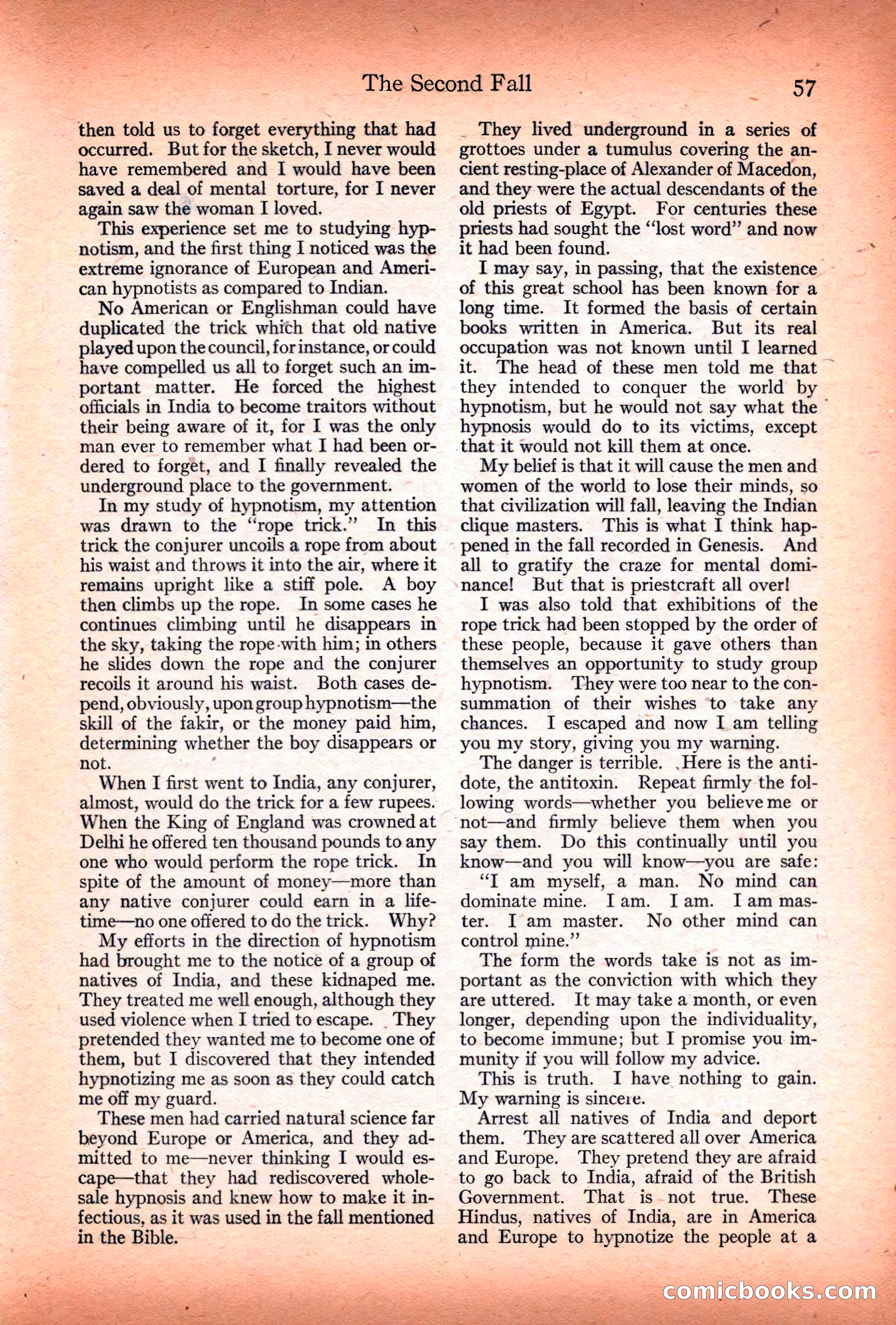
A restored page from Pulp Fiction, 1920. Page through the whole issue in the reader above.
📄 Transcribed text from this page (OCR, searchable)
Machine-transcribed from the original scan — historical spelling and the odd misread are preserved.
in the Bible. ee mi eighe <4. _ then told us to forget everything that had occurred. But for the sketch, I never would have remembered and I would have been saved a deal of mental torture, for I never again saw the woman I loved. This experience set me to studying hyp- notism, and the first thing I noticed was the extreme ignorance of European and Ameri- can hypnotists as compared to Indian. No American or Englishman could have duplicated the trick which that old native played upon the council, forinstance, or could have compelled us all to forget such an im- portant matter. He forced the highest officials in India to become traitors without their being aware of it, for I was the only man ever to remember what I had been or- dered to forget, and I finally revealed the underground place to the government. In my study of hypnotism, my attention was drawn to the “rope trick.” In this trick the conjurer uncoils a rope from about his waist and throws it into the air, where it remains upright like a stiff pole. A boy then climbs up the rope. In some cases he continues climbing until he disappears in the sky, taking the rope-with him; in others he slides down the rope and the conjurer recoils it around his waist. Both cases de- pend, obviously, upon group hypnotism—the skill of the fakir, or the money paid him, determining whether the boy disappears or not. When I first went to India, any conjurer, almost, would do the trick for a few rupees. When the King of England was crowned at Delhi he offered ten thousand pounds to any one who would perform the rope trick. In spite of the amount of money—more than any native conjurer could earn in a life- time—no one offered to do the trick. Why? My efforts in the direction of hypnotism had brought me to the notice of a group of natives of India, and these kidnaped me. They treated me well enough, although they used violence when I tried to escape. _ They pretended they wanted me to become one of them, but I discovered that they intended hypnotizing me as soon as they could catch me off my guard. These men had carried natural science far beyond Europe or America, and they ad- mitted to me—never thinking I would es- cape—that they had rediscovered whole- sale hypnosis and knew how to make it in- fectious, as it was used in the fall mentioned - ee Se os — , me, “- ~ They lived aikbrasoamal in a series a _ foe — grottoes under a tumulus covering the an- cient resting-place of Alexander of Macedon, and they were the actual descendants of the old priests of Egypt. For centuries these priests had sought the “‘lost word” and now it had been found. I may say, in passing, that the existence ~ of this great school has been known for a long time. It formed the basis of certain books written in America. But its real occupation was not known until I learned it. The head of these men told me that they intended to conquer the world by hypnotism, but he would not say what the © hypnosis would do to its victims, except that it would not kill them at once. My belief is that it will cause the men and women of the world to lose their minds, so that civilization will fall, leaving the Indian clique masters. This is what I think hap- pened in the fall recorded in Genesis. And all to gratify the craze for mental domi- nance! But that is priestcraft all over! I was also told that exhibitions of the rope trick had been stopped by the order of these people, because it gave others than themselyes an opportunity to study group hypnotism. ‘They were too near to the con- summation of their wishes ‘to take any chances. I escaped and now I am telling you my story, giving you my warning. The danger is terrible. ,Here is the anti- dote, the antitoxin. Repeat firmly the fol- lowing words—whether you believe me or ‘not—and firmly believe them when you say them. Do this continually until you know—and you will know—you are safe: “T am myself, a man. No mind can dominate mine. Lam. Iam. Iam mas- ter. I am master. No other mind can control mine.”’ The form the words take is not as im- portant as the conviction with which they are uttered. It may take a month, or even longer, depending upon the individuality, to become immune; but I promise you im- munity if you will follow my advice. This is truth. I have nothing to gain. My warning is sincere. Arrest all natives of India and deport them. ‘They are scattered all over America and Europe. They pretend they are afraid to go back to India, afraid of the British Government. That is not true. These Hindus, natives of India, are in America and Europe to hyping the eee at a ae itl ip with A cht) PT PE A OE A ee eee ere ‘Lit Ula