
Pulp Fiction, 1920 · page 61 of 208
Adventure Magazine Cover — page 61: what you’re looking at
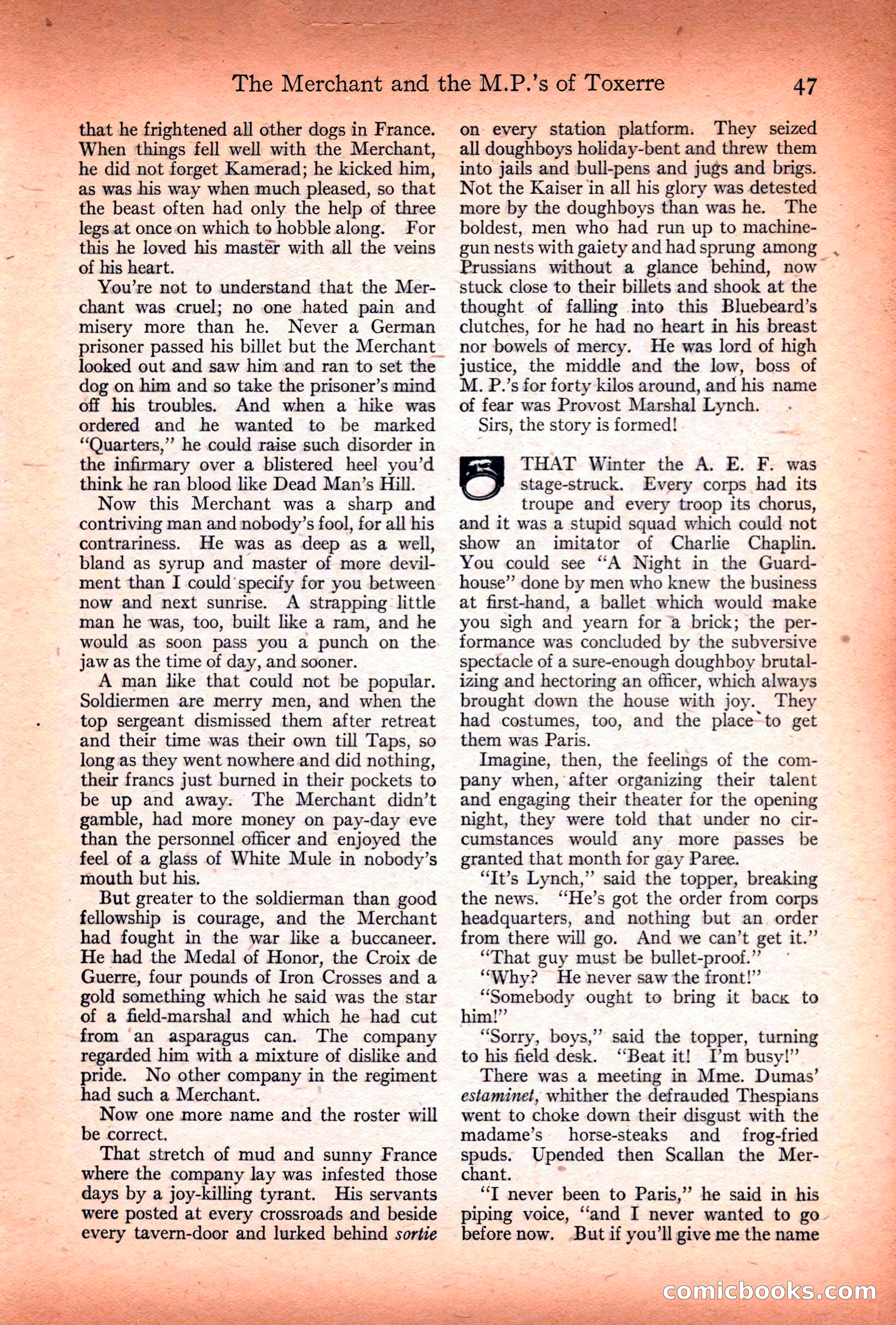
A restored page from Pulp Fiction, 1920. Page through the whole issue in the reader above.
📄 Transcribed text from this page (OCR, searchable)
Machine-transcribed from the original scan — historical spelling and the odd misread are preserved.
~ a _— <> ae Z a = Pn he frightened all >i Sie in Fance ras fell well with the Merchant, he did not forget Kamerad; he kicked him, : = Wien as was his way when much ‘pleased, so that the beast often had only the help of three legs at once on which to hobble along. For this he loved his master with all the veins of his heart. You’re not to understand that the Mer- chant was cruel; no one hated pain and misery more than he. Never a German prisoner passed his billet but the Merchant looked out and saw him and ran to set the dog on him and so take the prisoner’s mind off his troubles. And when a hike was ordered and he wanted to be marked “Quarters,” he could raise such disorder in the infirmary over a blistered heel you’d think he ran blood like Dead Man’s Hill. Now this Merchant was a sharp and contriving man and nobody’s fool, for all his contrariness. He was as deep as a well, bland as syrup and master of more devil- ment than I could’specify for you between now and next sunrise. A strapping little man he was, too, built like a ram, and he would as soon pass you a punch on the jaw as the time of day, and sooner. A man like that could not be popular. Soldiermen are merry men, and when the top sergeant dismissed them after retreat and their time was their own till Taps, so long as they went nowhere and did nothing, their francs just burned in their pockets to be up and away. The Merchant didn’t gamble, had more money on pay-day eve than the personnel officer and enjoyed the feel of a glass of White Mule in nobody’s mouth but his. But greater to the soldierman than good fellowship is courage, and the Merchant had fought in the war like a buccaneer. He had the Medal of Honor, the Croix de Guerre, four pounds of Iron Crosses and a gold something which he said was the star of a field-marshal and which he had cut from an asparagus can. The company regarded him with a mixture of dislike and pride. No other company in the regiment had such a Merchant. Now one more name and the roster will be correct. That stretch of mud and sunny France where the company lay was infested those days by a joy-killing tyrant. His servants were posted at every crossroads and beside every tavern-door and lurked behind sortie — x - = ..- o ¥ one : — ~ oe ; nee. eS ™ ‘ = ne ee ee ee pe. = 5. es RS Ee ee ns —— - a” as = = = a - SEA eas ee r< . ¥ a —_— = an = 5 Sage, © Se ee ee on: every ae Seren They si into jails and bull-pens and jugs and brigs. — Not the Kaiser in all his glory was detested — more by the doughboys than was he. The boldest, men who had run up to machine- all doughboys holiday-bent and threw sot 7 3 gun nests with gaiety and hadsprung among . Prussians without a glance behind, now — stuck close to their billets and shook at the thought of falling into this Bluebeard’s clutches, for he had no heart in his breast nor bowels of mercy. He was lord of high justice, the middle and the low, boss of M. P.’s for forty kilos around, and his name of fear was Provost Marshal Lynch. Sirs, the story is formed! THAT Winter the A. E. F. was stage-struck. Every corps had its troupe and every troop its chorus, and it was a stupid squad which could not show an imitator of Charlie Chaplin. You could see “A Night in the Guard- house” done by men who knew the business at first-hand, a ballet which would make you sigh and yearn for a brick; the per- formance was concluded by the subversive spectacle of a sure-enough doughboy brutal- izing and hectoring an officer, which always brought down the house with joy. They had costumes, too, and the place-to get them was Paris. Imagine, then, the feelings of the com- pany when, after organizing their talent and engaging their theater for the opening night, they were told that under no cir- cumstances would any more passes be granted that month for gay Paree. “Tt’s Lynch,” said the topper, breaking the news. “He’s got the order from corps headquarters, and nothing but an order from there will go. And we can’t get it.” “That guy must be bullet-proof.”’ ‘Why? He never saw the front!” “Somebody ought to bring it bacx to him!” “Sorry, boys,” said the topper, turning to his field desk. “Beat it! I’m busy!” There was a meeting in Mme. Dumas’ estaminet, whither the defrauded Thespians went to choke down their disgust with the madame’s_ horse-steaks and _ frog-fried spuds. Upended then Scallan the Mer- chant. : “T never been to Paris,” he said in his piping voice, before now. But if you’ll give me the name > P) ‘ tea, << = Ln = - an id _ eS ~n a a ny - Se i Pe I, Mae a “and I never wanted to go- ; F oe ow “GOMIEDOOKS: Con =e 3 ag je sig: t ~ ie ae Pix bus A! 0s ‘ar " ; - sed a othral , ahah +S LAR, on of bite rar | he se Had 4 re By . si a? av J “4 I ‘AT. > Jie tae : 4 ¥ ae ae a \ Ae rites AG oy WinisadteAi als dal d tod lan ai) a at a